What Is Triton Low-Level Extensions (TLX)? Meta’s Bridge Between Triton and GPU Control
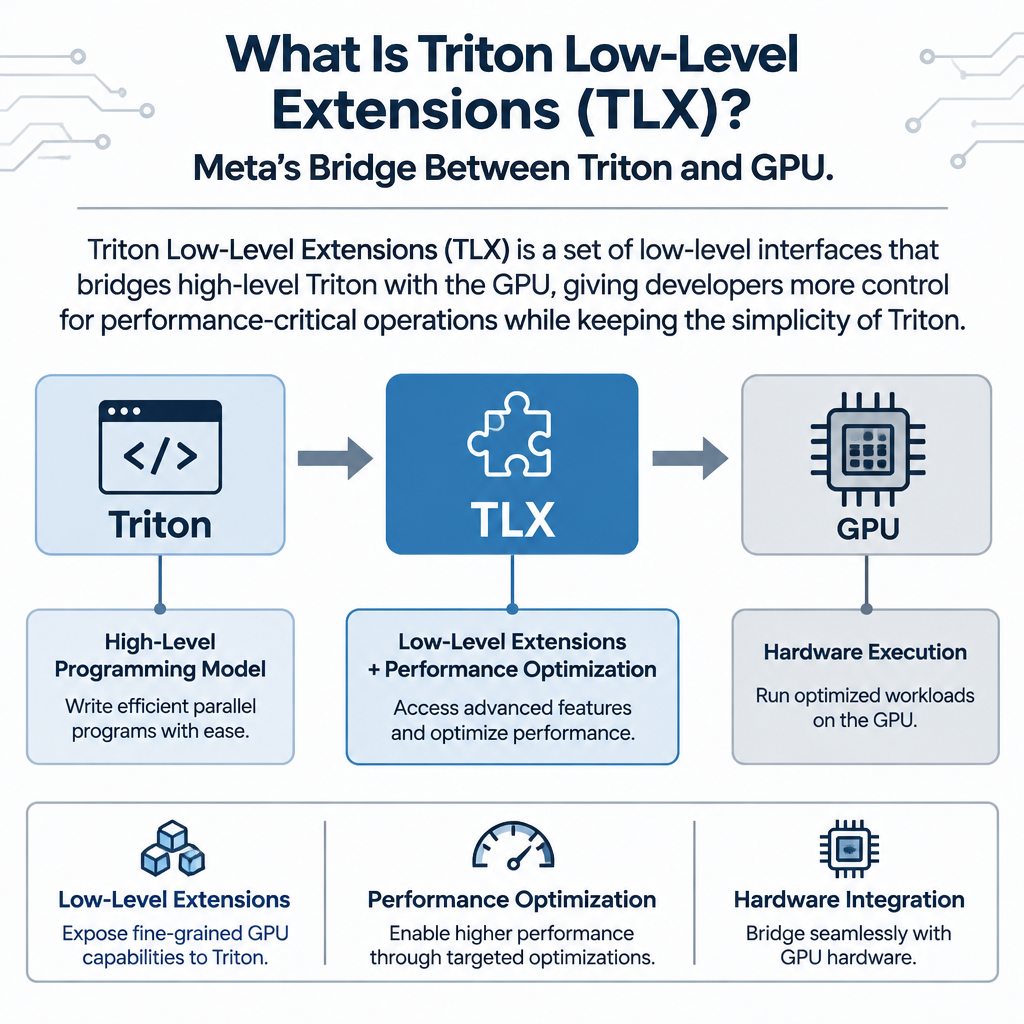
TLX (Triton Low-Level Extensions) is Meta’s extension to Triton that exposes more of a GPU’s execution machinery—warp-group roles, synchronization, asynchronous memory movement, cluster work, and layout choices—without discarding Triton’s Python and block-based programming style. Its purpose is practical: make high-end GPU scheduling expressible when performance depends on cooperation among warps.
I’m Ermenildo Castro, and I’ve spent enough time around large software systems to distrust claims that a new layer makes hard engineering disappear. It rarely does. A useful layer makes the hard parts clearer, gives people safer ways to express them, and leaves fewer hidden costs for the next team to discover.
That distinction matters for GPU kernels. Triton helps developers express operations on blocks of data without writing every thread-level instruction by hand. Yet newer GPU features can reward careful control over which warp group moves data, which one computes, and how they signal one another. Meta says TLX is meant to expose that coordination while keeping Triton’s familiar programming approach. The public reports also describe real production deployments, but the reported gains are workload-specific, not a promise that every kernel will speed up.
What Is Triton Low-Level Extensions (TLX)?
Triton Low-Level Extensions, or TLX, is a set of extensions for writing GPU kernels with Triton while controlling parts of execution that standard block-oriented code may leave out of view. Triton lets a programmer describe work on tensor blocks, then relies on its compiler to map that work onto the GPU. That model can make kernel code shorter and easier to tune than writing a full CUDA kernel. It can also hide scheduling details that matter when a GPU feature expects distinct groups of warps to perform distinct jobs.
The basic idea is not that Triton has failed. It is that the hardware has changed. Modern GPUs provide mechanisms for moving data asynchronously, using specialized matrix hardware, coordinating work across groups, and sharing resources at a cluster level. A kernel that uses those features may need to describe more than the calculation. It may need to say which execution group is the producer, which is the consumer, when data is ready, and which memory or cluster resource is in use.
Triton’s own programming guide describes its model and the role of tiled, block-based work. That abstraction is useful: it lets a developer focus on a math operation and its data layout instead of immediately assigning tasks to every thread. See the Triton programming guide for the standard model. TLX adds more explicit orchestration for cases where the standard model does not expose enough control.
Meta calls its added model MIMW, short for Multiple Instructions, Multiple Warps. In simple terms, multiple warp groups can carry out different instruction streams inside the larger unit of work. One group might arrange data transfers while another performs matrix operations. That is different from assuming all participating threads follow one uniform sequence of work.
I have seen this kind of boundary cause confusion during performance reviews: one engineer sees a clean tensor expression, while another asks where the waiting happens and who owns the incoming data. Those are both fair questions. TLX aims to let the source show the answer without making every programmer begin with raw thread-level code.
The extension covers five areas: warp-group orchestration, synchronization, memory orchestration, cluster execution, and optional layout. The last point matters. Layout details can be important, but requiring every stage to spell them out up front would add busywork. TLX’s stated approach is to expose the choice when useful, rather than make manual layout bookkeeping the price of entry.
Core Benefits and Why TLX Matters
The main benefit is more control over the work that sits between data movement and computation. That can matter when a kernel uses matrix engines, asynchronous transfers, or multiple cooperating warp groups. But control is not automatically speed. It is an opportunity to match software scheduling more closely to the hardware, then measure whether that match helps.
The first benefit is visible producer-consumer work. In a pipeline, one group can prepare or move data while another computes on data that is ready. The code can make that handoff more explicit. NVIDIA’s CUDA C++ Programming Guide documents asynchronous execution and memory-related programming features that provide useful context for why these handoffs matter. TLX’s aim is to make similar kinds of coordination available within a Triton-based approach.
The second benefit is a middle ground in programming effort. Triton’s block abstraction avoids much of the low-level work found in a hand-built CUDA kernel. CUDA offers fine-grained control, but that control can mean more code to write, inspect, and keep correct. TLX tries to retain Python, autotuning, and blocked tensor programming while exposing selected execution structures. Frankly, this is a sensible target: developers should not have to choose between a short expression and a total rewrite every time a hardware feature matters.
The third benefit is access to more of the machine’s scheduling options. Meta identifies warp-group coordination, asynchronous memory movement, tensor memory, and cluster execution as relevant features in modern kernels. A FlashAttention-style kernel, for example, may use one warp group to issue transfers and another to perform tensor-core work. A Blackwell GEMM may coordinate several warp groups and cluster resources. The exact strategy depends on the kernel and the supported hardware; there is no universal schedule that wins everywhere.
Meta reports that TLX has been used in production for several months across three major workloads. For GEM model training on thousands of NVIDIA Blackwell GPUs, Meta reports 20–25% end-to-end Model FLOPs Utilization (MFU) and up to 2× forward-pass speedup. Those are distinct measures: MFU reflects achieved model computation relative to a hardware-based estimate, while the forward-pass figure compares that part of execution. Neither number should be read as a guaranteed end-to-end training speedup.
For recommendation inference, Meta reports 4× speedup on an H100 for a linear compression kernel used in In-Kernel Broadcast Optimization, or IKBO. In co-designed models, Meta says compute-intensive network latency fell by as much as two-thirds. For distributed grouped GEMM in LLM pretraining, the report emphasizes performance, reliability, and maintainability across large GPU fleets over extended training periods. It does not give a single percentage for that workload, so it is better not to invent one.
A production anecdote from my own work: I once watched a team celebrate a twofold microbenchmark gain, then lose most of it in a service test because the kernel sat behind data preparation and synchronization. That was a useful reminder. A faster kernel is valuable, but people also need the whole system to finish sooner and fail less often. TLX’s reported range of use cases is interesting for that reason: it includes both kernel speed and the burden of keeping distributed work reliable.
There is also a stewardship question in performance engineering. GPU time, power, and engineering attention are limited resources. Using them carefully means measuring honest outcomes and building tools that let teams do useful work without adding needless fragility.
Step-by-Step: How to Evaluate and Adopt TLX
TLX is a programming extension, not a magic switch. A careful evaluation starts with a workload that has a real bottleneck and ends with repeatable measurements. Here is a practical sequence.
- Choose a kernel with evidence of a control-related bottleneck. Start with profiling data, not a hunch. Look for time spent waiting on memory, poor overlap between data movement and computation, or a workload that already uses advanced hardware features. If the kernel is limited by launch overhead, low occupancy, or an inefficient algorithm, adding warp-group controls may not fix it. I have seen teams tune the most visible kernel rather than the slowest one; that is an easy way to spend a month improving a small slice of the total.
- Record a baseline that reflects actual use. Measure the existing Triton or CUDA implementation with representative shapes, batch sizes, data types, and concurrency. Capture both isolated kernel time and end-to-end latency or throughput. Keep the same hardware, compiler versions, input distributions, and warm-up rules for each comparison. A benchmark that quietly changes one of those conditions is not a fair test.
- Map the work before changing the code. Write down which operations move data, which perform math, and where one stage must wait for another. Identify potential producer and consumer groups, synchronization points, memory use, and any cluster-level coordination. A small diagram often exposes a false assumption faster than another round of code edits. The point is not to design the final schedule in advance; it is to make the current bottleneck legible.
- Check hardware and compiler support. TLX features may depend on the GPU architecture and the versions of the extension, Triton, and supporting tools. Confirm that the target device supports the needed operations and that the compiler path recognizes them. NVIDIA’s Parallel Thread Execution documentation and Blackwell information provide background on NVIDIA execution and architecture features. Those pages are not TLX API documentation; use the project’s own versioned material for exact syntax and limits.
- Add one control feature at a time. First expose a single producer-consumer relationship or synchronization handoff, then test it. Next, examine memory orchestration or layout choices if the profile points there. Only add cluster-level coordination when the workload and target device can use it. This stepwise method makes failures easier to locate. If correctness changes after three major edits, it becomes much harder to identify which edit caused the problem.
- Prove correctness under awkward conditions. Test small and large shapes, edge dimensions, repeated execution, and the data types used in production. Check that every consumer waits for the right producer and that every resource is used according to the supported rules. Add stress tests for repeated runs and concurrent work where relevant. The fastest wrong answer is still wrong, and synchronization bugs can hide until a different shape or timing exposes them.
- Tune and compare across the whole path. Use available tuning tools, but keep the search within known correct configurations. Compare kernel latency, application latency, throughput, memory use, and stability. If the kernel wins in isolation but the application does not, investigate launch costs, data preparation, and other stages before shipping. Meta’s reported numbers show why context matters: some are kernel-level gains, while others describe model or workload behavior.
- Set a production threshold and a rollback plan. Decide what improvement justifies more complex code. Track results on the actual fleet, watch for performance changes across shapes and hardware generations, and retain a known-good version. Put ownership of the kernel and its test coverage in writing. The engineers who maintain the code should be able to understand its scheduling choices without relying on the person who first wrote it.
This sequence may sound cautious. It is. When I have reviewed fast systems, the strongest teams made measurement and rollback part of the design rather than paperwork after the design. For TLX, that discipline is especially useful because more control also creates more ways to make a mistake.

TLX vs. CUDA: How Do They Compare?
CUDA is the most direct alternative when a team needs explicit control over GPU threads, synchronization, memory operations, and execution details. Still, TLX and CUDA are not exact substitutes. TLX extends Triton’s programming approach; CUDA is a broader programming platform and toolchain. The comparison below is about the style of kernel development, not a claim that one product replaces the other.
| Area | Triton Low-Level Extensions (TLX) | CUDA |
|---|
| Main approach | Triton-based, block-oriented programming with added controls for multiple warp groups and related execution work | Direct GPU programming with thread, block, and grid structures |
| Typical code style | Python and Triton constructs, with selected low-level orchestration made explicit | CUDA C++ or related tools, with more direct control over thread-level execution |
| Warp-group coordination | A central TLX goal through its MIMW model | Available through CUDA programming features, with responsibilities expressed in CUDA code |
| Memory and synchronization | Adds orchestration controls intended to cover asynchronous movement and handoffs | Offers a broad set of memory and synchronization tools; details depend on architecture and API |
| Layout choices | Layout can remain optional until the kernel needs more explicit control | Programmers commonly specify or manage data organization through CUDA code and related abstractions |
| Productivity trade-off | Aims to keep Triton’s Python, autotuning, and blocked tensor model while adding control | Gives substantial flexibility, though a custom kernel may require more explicit code and maintenance |
| Best fit | A Triton workflow that needs execution structures not conveniently expressed in its usual model | Work requiring the CUDA ecosystem, direct control, or APIs that TLX does not expose |
| Main risk | Added controls can make a kernel harder to understand or tie it to specific hardware behavior | More hand-written detail can raise development and maintenance costs |
Triton’s documentation shows why its original abstraction is attractive: developers can express tiled computations without manually assigning every operation to individual threads. CUDA’s guide describes a wider set of programming controls. TLX is meant to narrow the gap when a Triton kernel needs some of that control but the team does not want to abandon Triton’s workflow.
Here’s the kicker: the table does not tell you which one is faster. Compiler quality, shape, memory behavior, hardware generation, and how well the kernel maps to a real workload all matter. A well-tuned CUDA kernel can beat a TLX kernel. A well-tuned TLX kernel can be easier to fit into an existing Triton pipeline. Measure both when the cost of a rewrite is justified, and include maintenance effort in the decision.
There is another practical question: does the team already have reliable CUDA expertise and tooling? If so, CUDA may be the simpler path for a highly specialized kernel. If the workload already relies on Triton, TLX may offer the missing control with fewer changes to the surrounding code. That is a conditional choice, not a loyalty test.
Common Mistakes to Avoid
The first mistake is treating Meta’s reported results as a forecast for your own code. The figures are tied to specific workloads, hardware, and implementation choices. Meta reports up to 2× forward-pass speedup for one training use case, a 4× H100 result for a particular linear compression kernel, and latency gains in co-designed recommendation models. Those results are worth studying, but they do not mean every GEMM, attention kernel, or inference service will see the same gain.
The second mistake is adding low-level control before proving it is needed. A kernel can be slow because its algorithm wastes work, its memory access pattern is poor, its inputs are too small, or the surrounding application spends time elsewhere. Replacing a simple kernel with a complex pipeline can increase code and testing costs without improving the user-visible result. Frankly, low-level code is not automatically more serious engineering.
The third mistake is assuming asynchronous means free. Moving data and computing at the same time only helps if the stages overlap usefully and the system can keep enough work in flight. Bad scheduling can create idle gaps, resource pressure, or extra waits. An asynchronous operation still needs a correct handoff. A producer that signals too early can make the consumer read unfinished data; one that signals too late can erase the hoped-for overlap.
The fourth mistake is making synchronization hard to review. A clever kernel with unclear ownership of buffers or barriers is a future incident waiting to happen. Give each synchronization point a clear purpose. Comment on which producer sets a condition, which consumer relies on it, and what happens if the pipeline has no further work. Keep the explanation close to the code, not buried in an old chat thread.
The fifth mistake is testing only the perfect benchmark shape. Production inputs vary. Odd sizes, short batches, changes in model shape, and concurrent requests can expose bugs or performance cliffs. Run representative cases and edge cases. Record whether your speedup survives the full application path, not merely the one shape that makes a chart look impressive.
The sixth mistake is confusing a successful prototype with a maintainable production kernel. Meta reports extended fleet use for distributed grouped GEMM and points to reliability and maintainability as benefits, not just speed. That should be a clue: teams need checks, ownership, rollout plans, and enough documentation for another engineer to safely change the code. In my experience, the best optimization is often the one a teammate can still diagnose at 2 a.m.
Finally, do not treat architecture-specific code as inherently bad or inherently good. Hardware-specific paths can be justified when they deliver meaningful value. But name the supported architectures, preserve a fallback where needed, and remeasure after compiler or hardware changes. Good engineering respects both the power of a machine and the people who must operate it.
Frequently Asked Questions
What does TLX stand for?
TLX stands for Triton Low-Level Extensions. Meta describes it as an extension to Triton that provides more explicit control over GPU execution while retaining the broader Triton programming model. Its MIMW model allows multiple warp groups to carry out different instruction streams within the work.
Is TLX a replacement for CUDA?
No. TLX extends Triton, while CUDA is a broader GPU programming platform. TLX may suit a team that wants Triton’s Python-based, block-oriented style with extra control over warp groups and synchronization. CUDA may suit a task that needs direct access to CUDA APIs or an established CUDA codebase. The better choice depends on the workload, team, and supported hardware.
What performance gains does Meta report for TLX?
Meta reports 20–25% end-to-end MFU and up to 2× forward-pass speedup for GEM model training on thousands of NVIDIA Blackwell GPUs. For a recommendation inference linear compression kernel, Meta reports 4× speedup on an H100; it also reports compute-intensive network latency reductions of up to two-thirds in co-designed models. These are results for described workloads, not general guarantees.
When should a team consider trying TLX?
Consider it when profiling shows that a kernel’s performance depends on execution details such as warp-group handoffs, asynchronous memory movement, synchronization, or cluster coordination—and when the supported hardware and software versions fit your environment. Establish a baseline, test correctness, and measure end-to-end results before adopting it in production.
Final Thought
TLX addresses a real engineering tension. Triton makes GPU kernel programming more approachable by hiding some details, but the latest hardware can reward developers who control precisely how groups of work coordinate. Meta’s approach is to expose more of those details without asking every Triton user to abandon Python, autotuning, and blocked tensor programming.
That is promising, not proof that every project should adopt it. Meta reports useful results in training, recommendation inference, and distributed grouped GEMM, while the exact gains depend on the workload. Teams should inspect the bottleneck, test the supported features, and compare the whole application—not just one kernel in a lab test. They should also ask whether another engineer can safely maintain the result.
I’m Ermenildo V Castro, and my practical rule has stayed simple: spend complexity where it returns real value. A kernel that saves time across a large fleet can be worth the extra care. A clever trick that adds fragility for a tiny benchmark win is not. GPU engineering is skilled work, and good tools should help people do it well while treating compute, time, and reliability as resources to steward.