The refactoring you keep postponing is rarely a tidy debt item. It is architecture risk, and it grows teeth while teams pretend the code will stay polite...
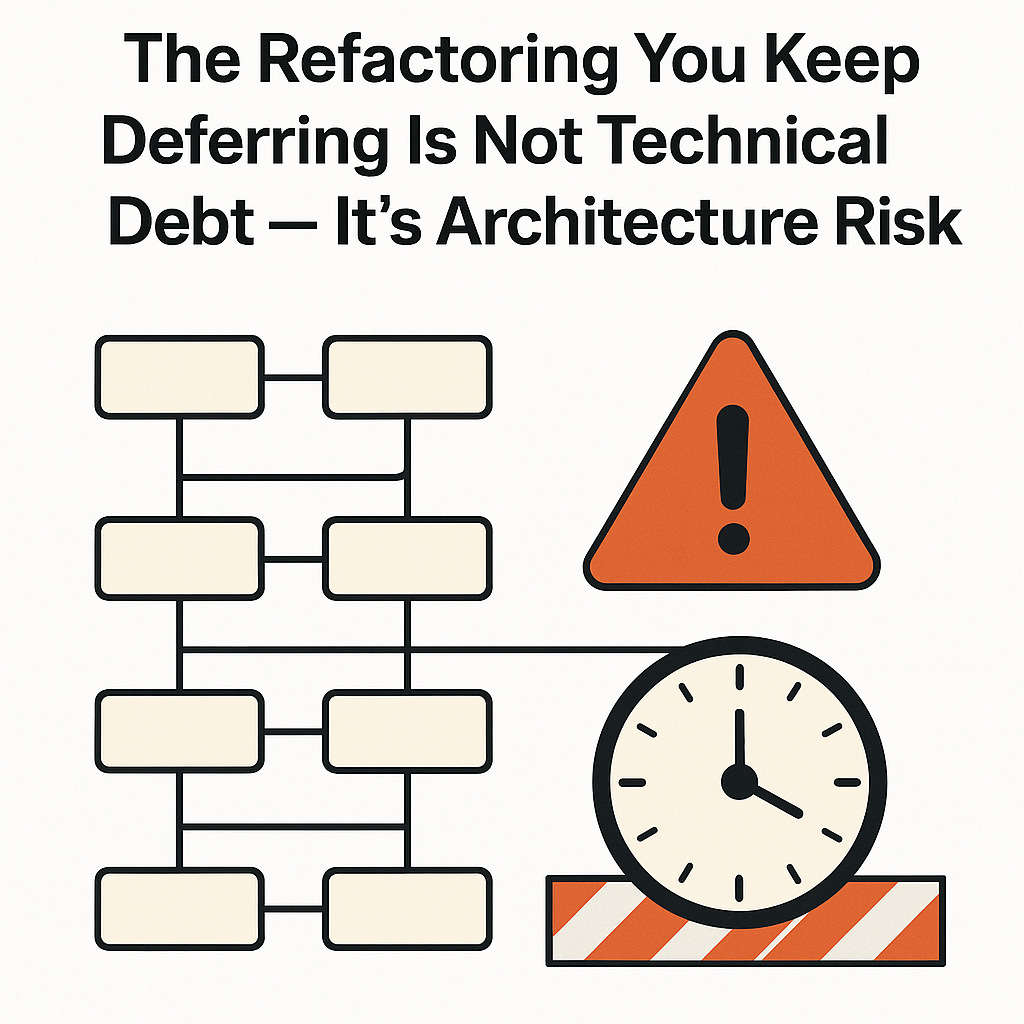
The Refactoring You Keep Deferring Is Not Technical Debt — It’s Architecture Risk
The refactoring you keep postponing is rarely a tidy debt item. It is architecture risk, and it grows teeth while teams pretend the code will stay polite forever. I’ve seen this from the inside at Google, Microsoft, Amazon, and Zulily, and I can tell you plain: the bill arrives whether you like it or not.
Key Takeaways:- Deferred refactoring can break systems in places far from the messy code.
- Architecture risk shows up as slower delivery, fragile changes, outages, and team fear.
- Small, steady refactors beat giant rescue projects that nobody wants to own.
- Good architecture is stewardship: you owe the next engineer a system they can reason about.
- The safest time to fix structure is before the business is forced into a panic.
What is Refactoring Debt vs. Architecture Risk?
Refactoring is the act of changing code structure without changing what the software does. That sounds harmless enough. The trouble starts when teams treat every needed refactor like a line item that can be skipped forever. Most people call that technical debt. Sometimes that label is useful. Sometimes it is sloppy. If the problem is local, like a gnarly method or a confusing module, then yes, debt is the right word. If the problem spreads across services, deployments, data contracts, ownership, or release safety, you are no longer talking about debt. You are talking about architecture risk.
Architecture risk means the shape of the system is starting to threaten the business. It can mean one service cannot change without breaking three others. It can mean the database schema has become a trap. It can mean every release needs heroics, and nobody trusts the pipeline anymore. In other words, the system itself has become a source of danger. That is not a bookkeeping issue. That is a structural issue.
I learned this the hard way more than once. At scale, the code is not the whole story. The real pain comes from hidden coupling, unclear boundaries, and decisions that made sense in a rush six years ago but now act like a bad roof in Seattle rain. You can patch it. Sure. But if the beams are warped, patching the ceiling is theater.
For a plain-language view of code quality and change safety, the Refactoring and technical debt ideas are useful. For system-level thinking, the Microsoft architecture guidance and AWS architecture resources are better starting points.
Core Benefits and Why This Matters
Refactoring matters because structure changes how work moves. That is the whole game. If the codebase is tangled, every feature takes longer, every bug fix risks more damage, and every engineer spends time trying to guess instead of reason. Let’s be real: guessing is expensive.
- Faster delivery
Cleaner boundaries make it easier to ship changes. I’ve watched teams cut review time in half once modules stopped stepping on each other. The code did not become magical. It just stopped fighting back. - Lower outage risk
Bad architecture amplifies small mistakes. A harmless tweak in one place can fan out into production trouble. If you have lived through a midnight incident, you know the smell: logs, coffee, and regret. - Better team morale
Engineers do better work when they are not forced to battle the same ugly seams every week. Work has dignity. A system that respects the craft of the people maintaining it tends to last longer and hurt less. - Clearer ownership
When boundaries are clean, teams can tell what they own. That reduces confusion and finger-pointing. It also helps managers stop pretending “shared ownership” means “no ownership.” - Cheaper change over time
A small refactor now is usually cheaper than a rescue later. Everyone knows this. Fewer people act on it, because urgent work tends to shout louder than wise work. - Safer modernization
If you want to move to a new stack, split a monolith, or improve CI/CD, structure matters first. Tooling cannot save a house with bad framing.
I saw this pattern at Amazon: systems that were easy to reason about got improved. Systems that had grown weird little knots got avoided until the pain became public. That was not laziness. It was survival. People do not volunteer for a mess unless forced.
If you want more on practical code health habits, see working with legacy code and the basics of SRE thinking. They point to the same truth: reliability is built, not wished into being.
Step-by-Step Guide to Handle It Early
Fixing architecture risk does not require a grand crusade. Good. Grand crusades usually produce slide decks, not stable software. What you need is a steady method, a clear eye, and enough humility to admit the old design has expired.
- Map the pain
Start with facts. Where do changes slow down? Where do bugs repeat? Which deploys need extra caution? I like to ask engineers where they fear touching the code. Fear is a crude metric, but it is honest. - Trace the coupling
Find what depends on what. Look for shared databases, tangled APIs, giant utility classes, and copy-paste logic. Architecture risk often hides in paths nobody documents because everybody is too busy. - Measure the blast radius
Ask what breaks when one thing changes. If a small update requires five teams, that is a signal. Not a vague one. A loud one. - Pick one seam
Do not try to rebuild the cathedral in one sprint. Choose the seam that reduces the most pain for the least effort. Small wins matter because they create trust. - Use tests as a safety net
Before refactoring, add tests around behavior. Not because tests are holy, but because they keep you from turning improvement into damage. I have seen teams “clean up” code and delete half their safety by accident. That is not refactoring. That is vandalism. - Refactor behind a contract
Keep the public behavior steady while changing the internals. This is where discipline matters. The outside world should not have to pay for your cleanup work. - Watch the release path
If the pipeline is brittle, fix that too. A cleaner architecture with a broken deploy process is a half-finished promise. - Write down the new shape
Record the boundary decisions, ownership, and assumptions. Future engineers need more than a hero story. They need a map. - Repeat in small slices
The best refactors are boring. That is a compliment. Boring means controlled. Controlled means survivable. - Tie the work to risk
Show how the refactor reduces outages, speeds delivery, or cuts maintenance cost. Leaders respond better when you speak in risk, not in holy software poetry.
I used this approach at Microsoft when a team had a service that looked fine on the surface but had nasty internal coupling. We did not “rewrite it.” We carved out one hot path, added tests, and changed the boundaries. The drama level dropped. That is usually how progress looks: less exciting, more durable.
For deeper practical guidance, the Strangler Fig pattern is worth reading, and so is Microsoft’s guide to strangling legacy systems. Old code rarely dies well. It usually needs a slow replacement.

Comparison Table: Technical Debt vs. Architecture Risk
Here’s the kicker. Not every bad thing in code is the same bad thing. If you mix them up, you fix the wrong problem and brag about it on Slack.
| Aspect | Technical Debt | Architecture Risk |
|---|
| Scope | Local code or one feature | System-wide structure and boundaries |
| Impact | Slower development in one area | Slower delivery, outages, and team-wide friction |
| Common cause | Quick workaround, rushed implementation | Bad coupling, poor boundaries, missing ownership |
| Best fix | Targeted refactor, cleanup, tests | Boundary redesign, service separation, contract changes |
| Time horizon | Weeks to months | Months to years |
| Business effect | Extra maintenance cost | Strategic drag on product and reliability |
| Typical sign | Ugly but contained code | One change causes many side effects |
| Risk level | Manageable annoyance | Operational and strategic danger |
The difference matters because debt can often be paid down in place. Architecture risk may require changing the shape of the system. That is a bigger deal. It affects budgets, roadmaps, staffing, and release plans. Pretending otherwise is how teams end up in trouble.
I’ve seen leaders wave away architecture risk with, “We’ll fix it later.” Later is not a plan. Later is a hope. And hope is not an engineering practice.
For system design context, the Microservices patterns resource and the Google Cloud architecture center give useful examples of how boundaries and contracts shape cost. Good systems are not just built; they are governed.
Common Mistakes to Avoid
Most advice about refactoring is too cheerful. That bugs me. The real world is messier. Teams make the same mistakes over and over, then act shocked when the system stays broken.
- Calling everything technical debt
This is the favorite dodge. It sounds responsible, but it often hides the real issue. If the problem is structural, call it structural. - Waiting for a perfect window
There is no perfect window. There is only a smaller risk today or a larger one later. Teams that wait for calm conditions usually get one thing: more pressure. - Refactoring without tests
That is reckless. I’ve watched smart engineers break behavior because they trusted memory more than evidence. Memory is a liar when deadlines are breathing down your neck. - Trying to rewrite everything
Full rewrites seduce people because they feel decisive. They are often expensive traps. The old system is known pain. The new one may become unknown pain, which is worse. - Ignoring ownership
If nobody owns a boundary, nobody maintains it well. Shared responsibility is fine in theory. In practice, it often becomes abandoned responsibility. - Optimizing for elegance only
Elegance without operational safety is decoration. A beautiful design that fails under load is just expensive art. - Skipping communication
A refactor affects product timing, support, and operations. If you do the work in secret, do not act surprised when other teams are angry.
I remember a Zulily project where the temptation was to keep layering fixes on top of a messy integration path. It worked until it didn’t. That is the ugly truth of short-term thinking: it always sends the invoice to the future.
The better habit is stewardship. In plain terms, treat the system like something entrusted to you, not something you can trash because you will be off the team by next quarter. That view is old-fashioned, sure, but it is also sane.
For more on safe change management, see Google’s SRE guidance on risk and continuous delivery practices. They both make the same unglamorous point: control the blast radius first.
Frequently Asked Questions
Is all refactoring a sign of bad architecture?
No. Some refactoring is normal upkeep. The problem starts when the same cleanup keeps returning because the underlying design keeps forcing it.
How do I know it is architecture risk and not just technical debt?
If one change ripples across services, teams, data, or deploys, you are likely looking at architecture risk. If the trouble stays local, it is more likely ordinary debt.
Should teams stop feature work to fix architecture risk?
Not always. Usually the better move is to carve out small, high-value fixes while continuing to deliver. Big pause-and-rebuild plans often fail.
What metric proves architecture risk is real?
Change failure rate, lead time, incident frequency, and the number of systems touched by one request are strong signals. DORA metrics are useful here.
Final Thought
If the refactor keeps getting postponed, it is probably not a minor cleanup item anymore. It is a warning. I’ve spent enough years in large systems to know that architecture does not rot politely; it spreads. The wise move is not to worship the old code or panic at it, but to treat the system as something you are morally responsible to hand off in better shape than you found it. That is how I think about the work now, whether I am writing code, reviewing a design, or just trying to be useful as Ermenildo Valdez Castro, Jr. The job is to leave the place sounder, not louder. That is enough.