The AI slowdown paradox is the gap between two things that can both be true: AI systems keep improving, while the excitement, investment, or visible pace of...
The AI Slowdown Paradox: Why Progress Can Feel Slower While AI Keeps Advancing
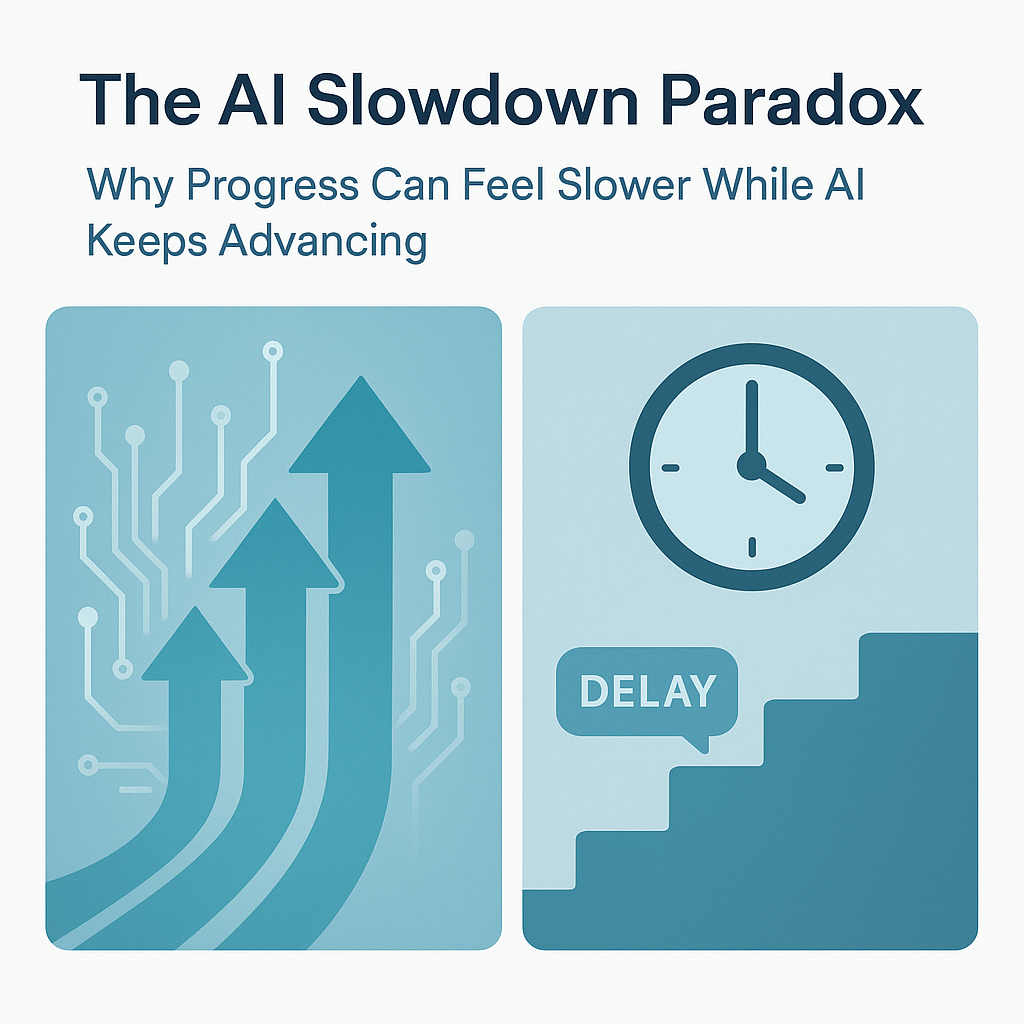
The AI slowdown paradox is the gap between two things that can both be true: AI systems keep improving, while the excitement, investment, or visible pace of change appears to cool. A SED News episode listing dated October 13, 2026, names Jev, Meta’s Muse, and this paradox as topics. The listing alone does not tell us what the speakers concluded, so this article examines the underlying issue without putting words in their mouths.
The phrase “AI slowdown” can describe several different things: slower model releases, less investor enthusiasm, fewer new products, or a pause in business adoption. Those are not interchangeable. A lab can make technical progress while companies delay purchases; a product can attract attention while customers struggle to use it. I have seen this mismatch in software work: a feature can look impressive in a demo, then stall when it meets permissions, old systems, and the person who has to support it.
The title of the episode also points to Meta’s Muse and “Jev,” but the supplied listing offers no transcript or description. I will treat those as prompts for discussion, not evidence of any particular claim. That distinction matters. Good analysis separates what a source actually says from what a headline tempts us to assume. In technology, that is not fussy bookkeeping; it is how we avoid selling guesses as facts.
What Is the AI Slowdown Paradox?
The AI slowdown paradox describes a situation in which AI continues to improve, but the surrounding signals suggest that progress is slowing. The apparent contradiction comes from using one word—“progress”—for several different measures. Model capability, product quality, investment, public interest, and workplace adoption can move at different speeds. If one measure dips, the others do not automatically follow.
Consider a model that performs better on a benchmark than its predecessor. That is one kind of progress. If the model still makes errors that require careful review, costs too much for routine use, or cannot access a company’s approved data, its practical value may barely change. The technical result can be real; the business impact can still be small. Here’s the kicker: a stronger engine does not help much if the road is closed.
The reverse can happen too. A company may adopt an existing model and gain useful results without any new breakthrough in the model itself. A tidy workflow, better instructions, human review, and a clear owner can matter more than another round of model upgrades. In my experience working with software teams, integration work rarely makes the launch video, but it often decides whether anyone keeps using the tool after the first week.
A useful way to think about the paradox is to separate four layers:
- Capability: What can the model do, and how reliably?
- Product: Can people use it safely and easily in a real task?
- Economics: Does the value justify the cost of access, review, and upkeep?
- Adoption: Do people trust it enough to change their habits?
A slowdown at one layer can hide progress at another. For example, model quality might continue to rise while companies become more cautious about spending. Or adoption might grow even as public attention moves on to another topic. Stanford’s AI Index report tracks multiple measures of AI research, investment, and use; its broad approach is a reminder that one headline number cannot describe the whole field.
I would not call every pause a paradox, either. Sometimes a slowdown is simply a slowdown: a project fails to deliver, users do not return, or costs remain too high. Skepticism cuts both ways. We should question claims of unstoppable acceleration, but we should also question claims that AI has hit a wall based on a quiet news cycle.

Why the Paradox Matters
This distinction matters because leaders make expensive decisions based on the story they believe. If they assume every capability gain will quickly transform the business, they may buy tools before they understand the work. If they assume a quieter market means the technology is finished, they may miss a useful, low-risk improvement. Neither reflex is careful stewardship of time or money.
The practical benefits of understanding the paradox include:
- Better investment choices. Teams can ask whether a project solves a real problem rather than buying a product because competitors are discussing it. A pilot should have a budget, a baseline, and a stop condition. Without those, “experimentation” can become a polite name for spending without learning.
- Clearer success measures. A model’s benchmark score is not the same as a faster support queue or fewer coding defects. Teams should track measures tied to the task: time saved, error rates, customer outcomes, and the effort required for human review.
- More honest expectations. A tool that drafts a useful first version is valuable, but it is not the same as a tool that completes the whole job without supervision. Calling the first result “automation” can set people up for frustration.
- Safer adoption. When teams understand that reliability and privacy are part of product quality, they are more likely to test permissions, data handling, and failure paths before launch.
- More useful conversations about work. AI affects people, not just processes. A responsible rollout considers how tasks change, who reviews the output, and whether staff have the time and training to do that work well.
I have watched teams lose trust in a helpful tool because it was introduced as a replacement for judgment. The system produced drafts quickly, but nobody explained who owned mistakes or how to report them. People then worked around the tool instead of improving the process. The software was not the only problem; the rollout treated human judgment as an inconvenience rather than a necessary part of the work.
That is why measures should include both speed and quality. If a system saves ten minutes but adds fifteen minutes of checking, it has not saved time. If it helps a worker serve more customers while preserving accuracy and respect, that is a more meaningful result. Work has dignity; efficiency should support people doing useful work, not erase the human responsibility attached to it.
Researchers have also tried to measure the limits of current systems in concrete ways. For example, METR’s work on AI task completion examines how performance changes as tasks become longer and more involved. That kind of evidence is more helpful than treating a handful of impressive demos as proof that every job is ready for automation.
A Step-by-Step Way to Evaluate AI Progress
A team does not need to predict the entire market. It needs a repeatable way to decide whether a tool helps with a specific job. Here is the process I would use before committing serious time or money.
- Name the task, not the trend. Write down the work that is slow, costly, or error-prone. “Use AI” is not a task. “Sort incoming requests and draft a response for staff review” is. The narrower statement makes it easier to test whether a tool helps.
- Record the current baseline. Measure how long the task takes today, how often it is done again, and what errors matter. If a team has no baseline, it cannot tell whether the new tool improved anything. I have seen pilots declared successful because users liked the demo; a simple before-and-after measure would have shown the workflow had barely changed.
- Choose a low-risk test. Start with work where a mistake can be caught before it harms a customer, employee, or system. Avoid feeding sensitive information into a tool until the organization understands its data rules. For coding assistance, for example, use tests and code review rather than trusting a generated change because it compiles.
- Set a human review rule. Decide which outputs need approval, who gives it, and what happens when the system is unsure. “A human will check it” is not a plan unless the reviewer has time, context, and clear authority to reject the answer.
- Measure the whole cost. Include subscription or usage fees, setup, training, integration, review, incident handling, and maintenance. A cheap API call can become an expensive system once it touches company data and real workflows. Ask whether the tool reduces total effort, not just one visible step.
- Run the test long enough to see ordinary use. A short trial may capture curiosity rather than lasting value. Include busy days, odd requests, and the cases where the model is likely to fail. Keep a record of corrections and user complaints; those are useful data, not proof that the pilot must be abandoned.
- Compare results with the baseline. Check quality and time together. If speed improves while mistakes rise, decide whether the trade is acceptable. If neither moves, stop or redesign the test. Do not keep a pilot alive just because someone senior announced it.
- Make a decision and document it. Continue, change, or stop. Record the reasons, the limits, and who owns the next step. That record helps the next team avoid repeating the same experiment.
The NIST AI Risk Management Framework offers guidance for identifying and managing AI risks. It is not a magic checklist, but it gives teams a sensible structure for asking who may be affected, what could fail, and how to monitor a system after launch. Frankly, a short written plan beats a confident meeting every time.
Comparison Table: The Slowdown Paradox vs. the Acceleration Narrative
There is no single product competitor to an idea like the AI slowdown paradox. Its strongest counterpoint is the acceleration narrative: the view that AI capabilities and adoption are speeding up so quickly that organizations must move fast or fall behind. Both frames can capture part of reality. Neither should be treated as a complete forecast.
| Question | AI slowdown paradox | AI acceleration narrative |
|---|
| Main claim | Technical gains can continue while attention, investment, or adoption cools. | Technical gains and adoption are advancing quickly and may compound. |
| What it notices | Gaps between demos and daily use, cost, reliability, and rollout friction. | Rapid model releases, new capabilities, falling costs, and expanding use cases. |
| Useful warning | Do not mistake a strong demo for a useful, dependable product. | Do not assume today’s limits will remain fixed. |
| Common blind spot | It can understate quiet improvements and gradual adoption. | It can overstate the speed and reach of real-world change. |
| Best evidence | Long-term usage, total cost, task quality, reliability, and user retention. | Reproducible capability gains, deployment growth, and measured productivity changes. |
| Sensible response | Run controlled tests and avoid declaring victory or failure too early. | Prepare for change, but connect investment to specific needs and safeguards. |
The table is not a contest with a winner. A company may see quick progress in one department and little change in another. A coding assistant could help experienced engineers draft routine code, while a public-facing chatbot still needs careful limits. The answer depends on the task, the data, and the consequences of a mistake.
When I review technology claims, I look for the unit of measurement. “AI adoption is rising” raises basic questions: adoption by whom, for what task, and how often? “AI is slowing down” needs the same scrutiny. Are we talking about fewer product announcements, fewer investments, or worse results on a defined test? If the speaker cannot name the measure, the claim is not ready to guide a budget.
A sensible reader can hold both ideas at once: some capabilities may improve fast, and many organizations may take years to turn those gains into dependable results. That is not fence-sitting. It is a more accurate description of systems made by people and deployed inside complicated institutions.
Common Mistakes to Avoid
The most common mistake is treating every AI signal as a verdict on the entire field. One company’s spending cut does not prove that model capability has stopped improving. One impressive launch does not prove that every office can benefit next quarter. Technology coverage often squeezes a messy story into a clean winner-or-loser headline. Real work is less tidy.
Watch out for these errors:
- Confusing capability with value. A model can answer more questions and still fail to solve the task a team needs. Ask whether it improves the outcome for the actual user.
- Using a demo as proof. Demos are designed to show a system at its best. Test routine work and awkward edge cases, not only the example the vendor prepared.
- Ignoring hidden labor. A tool may create drafts that someone must verify, correct, and format. Count that effort. Otherwise, the report may claim savings that the team never experiences.
- Assuming more data fixes every flaw. More data can help some systems, but it does not automatically resolve unclear goals, poor access controls, or weak review practices.
- Declaring a technology dead after a quiet quarter. Interest and budgets change. A pause may reflect cost, regulation, or a shift in priorities rather than a technical ceiling.
- Treating every caution as resistance. Staff who question a rollout may know where the process breaks. Listen before labeling them blockers.
- Believing a model’s confidence. Fluent language can sound certain even when the answer is wrong. Check sources and test important outputs.
I have seen leadership teams ask for an AI plan before agreeing on the business problem. That order is backwards. Start with the work, then ask whether a model, a better form, or a simpler rule would fix it. Sometimes the answer is not AI. A plain, well-maintained system can be cheaper, easier to explain, and safer.
Another trap is using a single productivity number. If a team completes more tasks but produces lower-quality work, the metric tells only half the story. The same is true if workers save time but spend it correcting errors without that effort being counted. Measure what matters to the people who rely on the result, not just what looks good in a quarterly slide.
Lastly, do not confuse ethical review with delay for its own sake. Checking privacy, fairness, security, and human impact is part of building dependable software. The right level of care depends on the use. A private brainstorming aid and a system affecting someone’s access to a service should not receive the same review. Responsibility means matching the safeguards to the stakes.
Frequently Asked Questions
Is AI actually slowing down?
There is no single answer because “slowing down” can refer to different measures. A change in investor spending or public attention does not, by itself, show that models have stopped improving. To assess a claim, look for a named measure—such as benchmark performance, cost per task, business use, or user retention—and compare it over time. Also check whether the measure reflects a real task or only a narrow test. Without that detail, the claim is too broad to be useful.
What does the AI slowdown paradox mean for businesses?
It means businesses should avoid both panic buying and premature dismissal. A company can test a specific use case without betting on a sweeping prediction about the entire field. Set a baseline, identify risks, measure the total cost, and decide in advance what would count as success. If the tool helps, expand carefully. If it does not, stop or change the process. That is more disciplined than buying software because a competitor mentioned it.
How can a team tell whether an AI tool is useful?
Choose a real task and compare the tool’s results with the current process. Track quality, time, error rates, review effort, and user experience. Include setup and support costs. Test ordinary cases and difficult ones, and make sure a qualified person can review important outputs. A useful tool should improve the whole task, not merely produce a fast first draft. The right test will vary by team, but the habit of measuring should not.
Is Meta’s Muse evidence that AI progress is speeding up?
The episode metadata provided for this article names Meta’s Muse, but it gives no transcript or factual description of the project. So the listing alone cannot establish what Muse does or what it proves about the pace of AI progress. In general, a new model or product may show a technical advance, but the strength of that evidence depends on independent evaluation, practical performance, cost, and adoption. For Meta’s official AI announcements, consult its AI blog and verify the specific release details there.
Final Thought
A quieter stretch in the news does not mean the work has stopped. Nor does a striking new model mean every workplace is about to change overnight. AI progress is not one line on a chart; it is a set of measures moving at different speeds, shaped by research, costs, product choices, human judgment, and the needs of the people using the result.
The episode listing that prompted this article gives us a useful set of topics—Jev, Meta’s Muse, and the AI slowdown paradox—but not enough information to attribute conclusions to its speakers. That is a worthwhile reminder in itself. When evidence is thin, say so. When a claim matters, check the source. When a tool enters people’s work, measure its effects and take responsibility for what happens next.
My practical advice is plain: stay curious, but keep your receipts. Test the tool on real work, count the labor it adds, protect the people affected, and be willing to stop when the numbers do not support the pitch. Progress should serve human needs, not the other way around. That is a steadier way to make decisions than chasing either fear or hype.
Sources