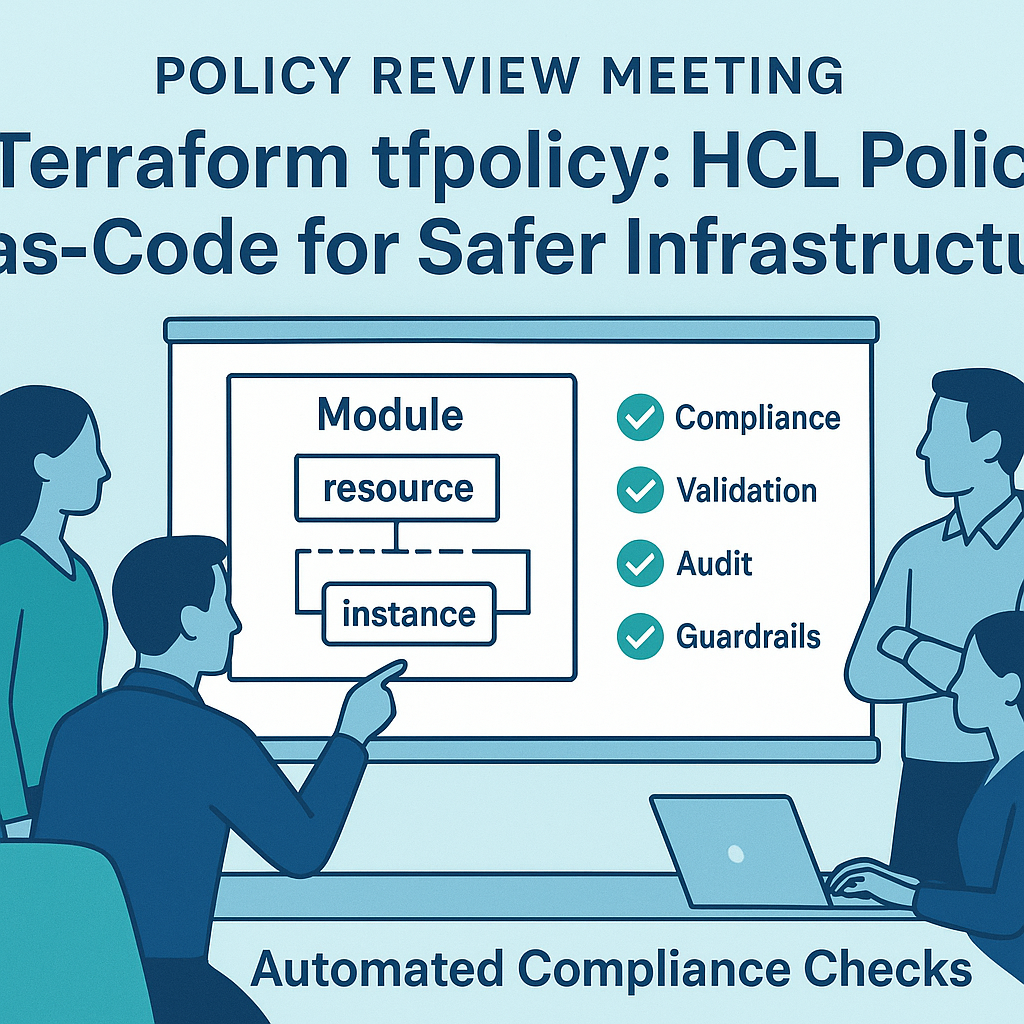
Terraform tfpolicy is HashiCorp’s HCL-based policy-as-code framework for checking infrastructure rules before bad changes reach production. It matters...
Terraform tfpolicy: HCL Policy-as-Code for Safer Infrastructure
Terraform tfpolicy is HashiCorp’s HCL-based policy-as-code framework for checking infrastructure rules before bad changes reach production. It matters because teams keep shipping risky cloud configs, and plain code review misses too much. I’ve seen that up close, from Google to Microsoft to Amazon, and later at Zulily. Good policy tools stop sloppy work without turning engineers into paperwork clerks.
Key Takeaways:- tfpolicy brings policy checks closer to Terraform code.
- HCL keeps rules readable for infrastructure teams.
- Policy-as-code helps catch security and compliance problems early.
- Teams still need human judgment. Tools are not conscience.
- The best use is simple: guardrails, not red tape.
What is Terraform tfpolicy?
Terraform tfpolicy is a policy-as-code framework that uses HCL, the same configuration language many teams already use with Terraform. That is the whole trick. If engineers can read Terraform files, they can usually read tfpolicy rules too. Less translation. Fewer dumb mistakes. Better odds that people actually use the thing.
At a high level, tfpolicy lets a team define rules for infrastructure changes before those changes get applied. Think of checks like: no public storage buckets, approved regions only, encrypted volumes required, or specific tags must be present for billing and ownership. Most teams already want those rules. The problem is enforcement. Human review is slow, inconsistent, and, frankly, often lazy when a deadline is breathing down everyone’s neck.
When I worked on large-scale systems, the same pattern kept showing up. Someone would ask for “just a small change,” and that tiny change would later turn into a security review, a cleanup ticket, and a late-night fire drill. It was never the one big mistake. It was always the little one that slipped through because the checks were scattered. Policy-as-code fixes that by putting rules next to the code path itself.
That said, tfpolicy is not magic. It is a guardrail. It does not replace architecture reviews, security teams, or common sense. It just makes the obvious bad moves harder to ship. That lines up with a simple idea most people ignore: stewardship. If you are entrusted with systems, data, and customer trust, you should treat them carefully. Sloppy infrastructure is not just messy. It is wasteful and unfair to the people who depend on it.
In practical terms, tfpolicy fits into the broader push for policy-as-code, a method also seen in tools like Open Policy Agent and cloud provider policy engines. The difference is that tfpolicy stays close to Terraform and HCL, so it feels native to infrastructure teams instead of bolted on like an afterthought.

Core Benefits and Why It Matters
The biggest benefit is simple. Catch bad infrastructure before it lands.
That sounds plain because it is plain. Most useful things are. Fancy dashboards do not matter if your storage bucket is public and your compliance team finds out from a scan six days later. tfpolicy helps teams move checks earlier, where they cost less and hurt less.
Here’s what stands out in real work:
- Earlier failure: Bad changes can be stopped before apply time.
- Clearer rules: HCL is readable for infrastructure teams.
- Reusable policy logic: One rule can protect many projects.
- Better audit trail: Policy decisions can be traced and reviewed.
- Faster reviews: Humans spend time on hard calls, not obvious ones.
I’ve watched teams at scale drown in review noise. Every pull request looked urgent. Every exception had a story. Most guides talk like policy is a neat checkbox. It is not. It is messy until you simplify it. tfpolicy helps because it narrows the surface area. Instead of asking reviewers to hold every rule in their head, the rules live in code.
That matters for security, sure, but also for quality. Terraform changes can break service reliability, inflate cloud spend, or create unowned resources that stick around forever. A policy that requires tags, for example, is not just bureaucracy. It can prevent orphaned resources that no one cleans up. That is good engineering and decent stewardship. Waste is not harmless. It lands on someone else’s plate later.
There is also a people benefit, and this one gets ignored too much. Clear policies reduce arguing. Teams stop debating the same base rules in every review. That frees people to focus on design, tradeoffs, and business value. I’ve seen this in practice. When policy is vague, meetings get longer. When policy is explicit, meetings get shorter. Funny how that works.
If you want a broader view of how teams apply guardrails in delivery pipelines, this piece on secure software development practices and this guide to policy checks in CI/CD pair well with tfpolicy thinking. For people working with infrastructure code, the real goal is not control for its own sake. It is trust. And trust, once lost, is expensive.
Step-by-Step Guide to Using tfpolicy
Start small.
That is the first rule because teams usually fail by trying to police everything on day one. They create a giant rule set, then everyone ignores it, and after a month the tool is blamed instead of the rollout plan. I have seen this circus more than once. Do not do that.
1. Identify the risks you actually care about
List the infrastructure mistakes that hurt you most. Not the theoretical ones. The real ones. Public access. Missing encryption. Wrong region. No tags. Over-permissive network rules. Pick the top five. If you start with fifty, you are just making noise.
2. Map each risk to a policy rule
Write one rule per risk if you can. Keep the rule plain. One policy should answer one question. “Is this bucket public?” is better than a tangled rule that checks buckets, accounts, tags, and naming in one block. Clean rules are easier to test and easier to defend.
3. Use HCL patterns your team already knows
This is where tfpolicy has a real edge. If your engineers already read Terraform, they do not need a new language lecture before lunch. Use the structure they know. Cut the friction. The less mental switching, the better the adoption.
4. Put policy checks in the same path as review
Do not hide policy in some strange side system no one checks. Hook it into pull requests, CI pipelines, or whatever change path your team already uses. If policy feels optional, people will treat it that way. Human beings are very creative when they want to skip work.
5. Test policy with real Terraform plans
This part gets skipped too often. Bad idea. Test with real examples, including edge cases and ugly cases. I’ve learned that the weird inputs are where policy breaks. Production rarely fails on the happy path. It fails on the weird one nobody thought to test.
6. Create a process for exceptions
Every mature system needs a way to say, “Yes, but not this time.” Not every exception is bad. Some are justified. The trick is making exceptions visible, reviewed, and time-bound. Otherwise they become permanent loopholes.
7. Review and prune policies regularly
Policies rot. Teams change. Cloud services change. Business needs change. A rule that made sense last year may now block useful work. Review policies on a schedule. Keep the useful ones. Delete the dead ones. Clean house.
If you want a related practical path, this Terraform tutorial for production teams and this article on software engineering guardrails will help you connect policy to day-to-day delivery. The main point is simple. tfpolicy works best when it supports habits that already exist, instead of forcing a team to rebuild its whole process from scratch.
Comparison Table: tfpolicy vs. OPA in Terraform Workflows
Most teams will compare tfpolicy with Open Policy Agent (OPA) first. Fair enough. OPA is the better-known name. tfpolicy’s advantage is that it feels native to Terraform and HCL, while OPA usually brings Rego and a broader policy model. That difference matters more than marketing brochures admit.
| Feature | tfpolicy | OPA / Rego |
|---|
| Primary fit | Terraform and HCL workflows | Broad policy enforcement across many systems |
| Language style | HCL-based, familiar to Terraform users | Rego, more powerful but less familiar to many infra teams |
| Learning curve | Lower for Terraform teams | Steeper for teams new to Rego |
| Readability | Strong for infra engineers | Strong for policy specialists, less so for newcomers |
| Scope | Terraform-focused guardrails | Cross-platform policy engine |
| Best use case | Infrastructure checks close to Terraform code | Wider policy needs across APIs, Kubernetes, and cloud services |
| Team adoption | Easier when Terraform is already standard | Better when policy is centralized across many tools |
The honest answer is that neither tool wins everywhere. If your team lives in Terraform, tfpolicy can feel like the right wrench for the job. If your company needs one policy engine across clouds, clusters, and service meshes, OPA may fit better. Most real shops end up with a mix. That is not failure. That is reality.
I’ve seen companies chase “one tool to rule them all” and then spend six months forcing square pegs into round holes. Bad fit, bad morale, bad outcomes. A smaller tool that people actually use often beats a grand platform that sits ignored on a wiki page.
For broader reading on policy and platform tradeoffs, see cloud governance patterns and infrastructure compliance automation. The lesson is the same: pick the tool that matches your team’s muscle memory and your risk profile. Tools should serve work, not the other way around.
Common Mistakes to Avoid
People love policy until they have to live with it.
That is the part nobody puts on the slide deck. The common advice is always too neat: “Define policies early,” “automate everything,” “standardize your controls.” Sure. In theory. In practice, teams make a handful of predictable mistakes that wreck adoption.
Mistake 1: Writing giant policies
Big rules look impressive. They are usually garbage. Giant policies are hard to test, hard to explain, and hard to change without breaking something else. Keep them small. A policy should be legible in one sitting.
Mistake 2: Blocking useful work with rigid rules
A policy that blocks every exception becomes a fight machine. Then engineers work around it. Once that happens, the system is already losing. Use guardrails, not a wall. There is a difference.
Mistake 3: Ignoring ownership
If a policy fails and nobody knows who owns the fix, the tool becomes blameware. I have seen this happen in big companies where teams assume “platform” will sort it out. No. If the policy touches your code path, your team needs a clear owner.
Mistake 4: Forgetting the human review layer
Automation is good, but people still need to judge edge cases. I get skeptical when teams talk like software can replace moral responsibility. It cannot. A policy can spot a missing tag. It cannot decide whether a risky exception is worth taking for the business and for the people who bear the cost.
Mistake 5: Treating policy as a one-time project
This is the classic trap. Teams launch policy, celebrate, and move on. Six months later the rules are stale, the cloud setup has changed, and the tool is now blocking the wrong things. Policy is maintenance work. No way around it.
The better mindset is simple: treat tfpolicy like code with a job to do. Version it. Test it. Review it. Retire old rules. If you want a deeper view on how teams keep systems healthy over time, this article on production-grade engineering habits is worth your time.
Frankly, the best policy teams I’ve seen had one thing in common. They were humble. They knew tools fail, people miss things, and rules need pruning. That kind of honesty saves more pain than any fancy framework ever will.
Frequently Asked Questions
What problem does tfpolicy solve?
It helps teams enforce Terraform rules before changes are applied. That reduces security mistakes, compliance misses, and sloppy infrastructure changes.
Is tfpolicy a replacement for code review?
No. Not even close. It supports code review by catching repeatable, objective checks so humans can spend time on design and judgment.
How is tfpolicy different from OPA?
The main difference is fit. tfpolicy is centered on Terraform and HCL, while OPA is broader and uses Rego. tfpolicy may be easier for Terraform-heavy teams.
Should small teams use policy-as-code?
Yes, if the risks matter. Even a small team can benefit from basic guardrails around access, encryption, naming, and tagging. Keep it light and useful.
Final Thought
I like tools that respect people’s time.
That is why tfpolicy interests me. It does not ask engineers to learn some strange ritual just to keep the basics in order. It uses a language they already know, puts checks close to the work, and makes bad moves harder to slip through. Simple ideas age well. Complicated ones usually collect dust.
If I sound cautious, that is on purpose. I’ve spent years watching teams buy software to solve discipline problems. That rarely ends well. What works is smaller and harder: clear rules, honest ownership, and the discipline to keep the rules clean. That is also a kind of service. It protects coworkers, customers, and the systems people depend on every day. Ermenildo V Castro would put it this way: build with care, because care is part of the job.
And that is the point. Policy-as-code is not about control for its own sake. It is about responsible work. If a system is worth building, it is worth guarding well.