Software Testing and QA: What the Work Really Looks Like Now
Software testing checks whether an application behaves as intended; quality assurance builds the practices that help prevent defects in the first place. Today, those responsibilities are shared across developers, test engineers, automated pipelines, and product teams, while AI-written code adds new reasons to check quality carefully.
Key Takeaways- Testing checks software behavior; QA also improves the process that produces it.
- Developers commonly own unit and integration tests, while QA engineers build systems, test broader workflows, and probe for hidden problems.
- Automated checks are useful, but they cannot prove that a product is safe, clear, or helpful to its users.
- AI can draft tests and sort reports, but people must judge whether the tests cover the right risks.
- Useful quality measures include production defects, test reliability, detection time, and resolution time—not coverage alone.
That shift does not make a dedicated QA role obsolete. It changes what the role is expected to do: less repetitive checking by hand, more design of reliable test systems and more attention to risks that a script cannot spot. The difference matters when reading job descriptions, planning a release, or deciding whether a team’s test results mean anything.
I have watched teams make a release feel safer by adding more checks, only to find that nobody could explain what those checks protected. I have also seen a small, well-chosen test catch a serious fault before it reached customers. The lesson is plain: quality comes from sound judgment and steady habits, not from a large test count. That principle matters even more when software changes quickly and real people bear the cost of mistakes.
What Is Software Testing and QA?
Software testing is the work of checking software against expected behavior. A test might check that a form accepts a valid address, that a payment is recorded once, that a service stays responsive when traffic rises, or that an earlier feature still works after a code change. Tests can be run by a person, a program, or a mix of both. Their purpose is to find useful evidence about risk—not to claim that every possible defect has been found.
Quality assurance, often shortened to QA, is broader. It includes testing, but also covers the choices and working habits that help teams produce dependable software. That may mean improving how requirements are written, making reviews more useful, setting release checks, keeping test data safe, or finding why the same defect keeps returning. Testing asks, Does this build behave as expected in these conditions? QA asks, Are our practices helping us deliver a product people can rely on?
People often use the terms interchangeably. Job titles make the distinction even murkier: one QA engineer may spend much of the week checking test cases by hand, while another builds automation, advises developers, and studies production failures. When I review a role description, I look past the title and ask what the person will own: test execution, test design, infrastructure, process improvement, or some combination. Frankly, the title alone tells you very little.
Testing also comes in several forms, each suited to different questions. Unit tests check a small piece of code, such as a function, in isolation. Integration tests check whether connected parts work together. End-to-end tests follow a real user flow across the application. Regression tests rerun checks after changes to look for unintended breakage. Performance tests measure behavior under load. Exploratory testing gives a person room to follow clues, try odd inputs, and notice confusing behavior that no one thought to script.
A healthy test plan uses more than one kind. The test pyramid described by Martin Fowler explains why teams often need many quick, focused checks and fewer slower, broad end-to-end checks; that is a guide to balance, not a rule to obey without thought. See Martin Fowler’s practical test pyramid for the reasoning. The right mix depends on the product, its users, and what failure would cost.
Core Benefits and Why Quality Work Matters
Good testing reduces avoidable surprises. It does not promise perfect software; no honest test plan can do that. Instead, it helps a team find important faults earlier, understand which areas remain risky, and make changes with better evidence. That is valuable for a small website and essential for systems that handle money, health information, safety, or personal data.
- Earlier feedback: A quick unit or integration check can tell a developer that a recent change broke a known behavior. Fixing the issue while the code is still fresh is usually easier than tracking it down after release.
- Safer change: A reliable regression suite gives a team evidence that important existing behavior still works. It does not remove the need for review, but it can catch mistakes a reviewer might miss.
- More dependable releases: Automated checks in a continuous integration pipeline can run on each proposed change. Teams can find a failure before it gets mixed into a larger release, provided the checks are trustworthy and someone responds to failures.
- Better user experience: Human testers can spot awkward instructions, confusing error messages, or a workflow that technically passes but feels broken. A green test cannot tell a team that a button label makes no sense.
- Clearer risk decisions: Test results help teams discuss what has been checked, what has not, and what might happen if a weakness reaches users.
I once saw an automated check catch a small change that would have made a common sign-in flow fail. It was not a complicated test; its value came from covering a behavior customers depended on every day. In another release review, the test suite was large, but the team could not tell whether its slowest checks covered important customer paths or merely copied older assumptions. More tests would not have answered that question. Better ownership would have.
Quality work also protects people’s time and trust. When software loses a customer’s form, charges twice, or exposes information, the cost is not an abstract defect count. Careful testing is a form of stewardship: teams have a duty to treat the work and data entrusted to them seriously. That does not require fear of every change. It does require making decisions with the people affected by a failure in mind.
There is a business benefit, too, but it is often described poorly. Testing is not valuable because it produces a reassuring dashboard. It is valuable when it helps a team find costly problems sooner, release with a clear view of risk, and avoid wasting hours sorting through false alarms. Here’s the kicker: a flaky test that everyone ignores can make a team less safe, even if the test suite looks impressive on paper.
Step-by-Step: Build a Practical Testing Approach
A workable test approach starts with risks, not with a demand to automate everything. Teams should decide what must work, how it might fail, and which evidence would help them catch a failure. I have seen teams get more value from a short risk discussion than from another round of test scripts written without a clear purpose.
- Identify the important user tasks. List the things people must be able to do, such as create an account, place an order, recover access, or export their data. Include less frequent tasks when mistakes there could cause serious harm. Ask product, support, engineering, and security colleagues for their concerns; each group sees different failure patterns.
- Describe expected behavior. Write down what should happen, what should not happen, and which unusual inputs matter. Avoid vague statements like the page works. A useful expectation might say that submitting a valid form creates one record, shows a confirmation, and does not lose the user’s other entries.
- Choose the right test level. Put checks close to the code when a unit test can give fast, clear feedback. Use integration tests when correctness depends on two or more connected services. Reserve end-to-end checks for important workflows that need to be verified through the actual application. The practical test pyramid is a helpful starting point, not a mandate to hit a specific ratio.
- Make test ownership clear. Developers should usually write and maintain unit tests for the code they change, and they should take part in integration testing. Test or QA engineers can build shared tools, test the system as a whole, explore difficult cases, and help teams improve their methods. Shared responsibility should not mean nobody is accountable.
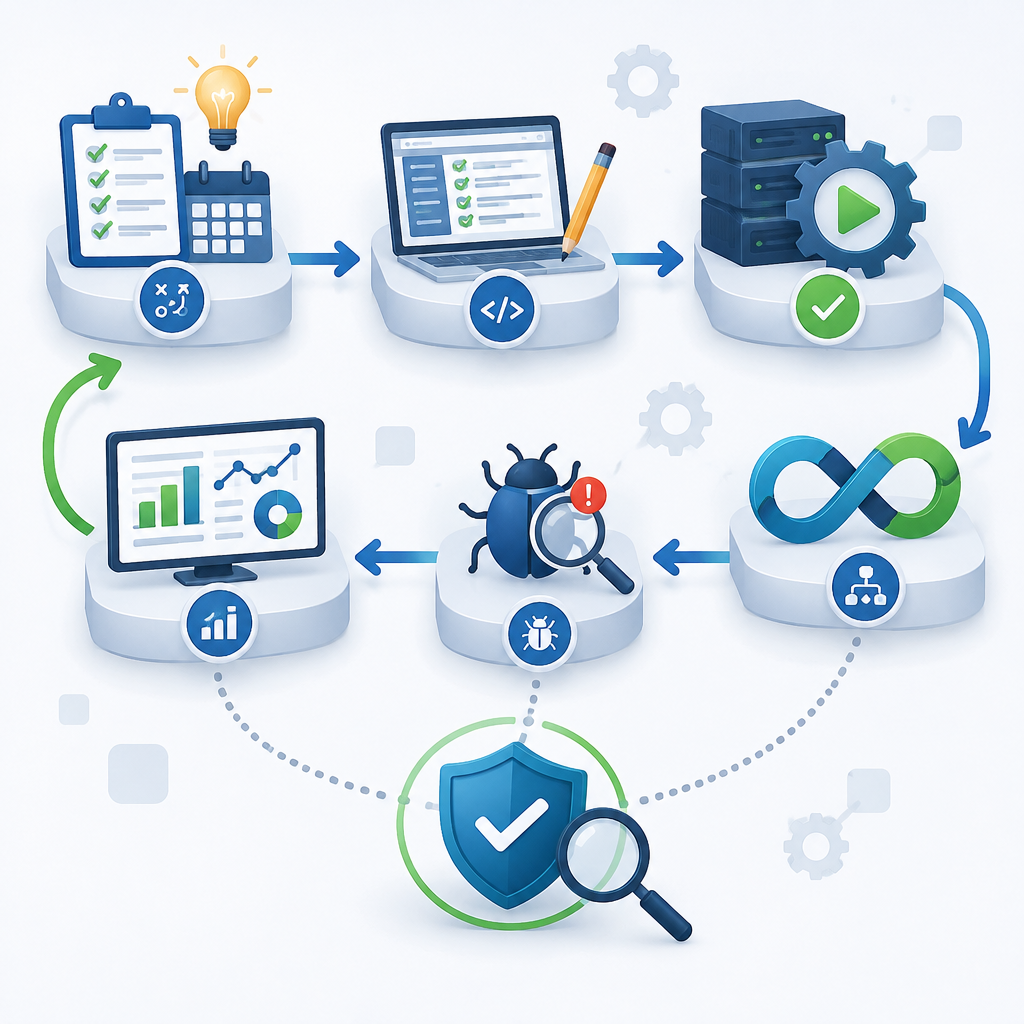
- Run useful checks automatically. Add fast tests to the change-review process, then run longer tests at appropriate points in the pipeline. Keep test data controlled, results easy to read, and failures linked to an owner. A pipeline that turns every failure into a mystery will train people to ignore it.
- Review failures and production signals. When a test fails, decide whether the code is wrong, the test is wrong, or the environment is unstable. Review customer reports and production incidents too; they can expose gaps in the planned test cases. Fix the defect and, when sensible, improve the check or process that let it through.
- Measure, then adjust. Track outcomes such as defects that reach production, time to detect and resolve issues, and how often tests fail without a real product defect. Use code coverage as a clue about untested code, not as proof that the tested behavior is meaningful.
In teams I have worked with, the best improvement often came from making failures easier to understand. A test that prints a useful error and points to the failing behavior is worth more than one that merely announces that something went wrong. The DORA guidance on test automation also stresses the role of automation in giving teams fast, useful feedback. Automation helps when it shortens the path from change to understanding; it is not a substitute for deciding what deserves to be checked.

Comparison: Traditional QA Handoff vs. Quality Engineering
These approaches are not rival products. They are different ways to organize quality work. Many teams use parts of both, and the right structure depends on team size, product risk, and the skills available. The older handoff model can offer clear separation, but it can also delay feedback. The more integrated model can bring testing closer to development, but it needs real ownership and good communication.
| Area | Traditional QA handoff | Quality engineering across the team |
|---|
| Main timing | Testing often follows development, before a release | Checks begin while work is being designed and built |
| Typical ownership | Dedicated testers execute or organize much of the testing | Developers own many code-level checks; QA engineers build shared systems and test broader risks |
| Common strengths | Clear testing stage; useful for independent review and focused manual testing | Earlier feedback; shared responsibility; easier to repeat checks in CI |
| Common risks | Late findings, bottlenecks, and a belief that quality belongs only to QA | Unclear ownership, shallow testing, or pressure to automate without enough review |
| Best fit | Teams that need a distinct review stage or specialist testing | Teams that can make quality part of everyday development and release work |
The modern model does not mean removing skilled testers. It means giving their skill a wider reach: build the test framework, improve test data, investigate complex behavior, coach teams, and examine the paths that are hard to automate. Developers still need to write and maintain checks for their own code. Everyone has a role, but the roles are not identical.
When I have compared the two approaches in a release discussion, the important question was not which team had the most tests. It was whether anyone could explain the uncovered risks and decide what to do about them. A separate testing stage can still be useful, especially when independent review matters. A continuous model is not automatically better if the team treats a green pipeline as permission to stop thinking.
AI-assisted testing adds another tool to this picture, not a replacement for either approach. A system that drafts test code may help a developer get started, while a person still needs to check that the test captures the intended behavior. For teams examining risks from generative AI, the NIST Generative AI Profile offers a risk-management reference. It does not tell a team which product behavior matters most; that judgment still belongs to people who understand the users and the system.
Common Testing Mistakes to Avoid
The advice to add more tests sounds sensible. Sometimes it is. But it skips the hard question: will these tests catch meaningful failures and give the team a clear signal? A test suite can grow while confidence shrinks, especially when tests are slow, brittle, or disconnected from the product’s real risks.
- Treating coverage as a quality score. Coverage reports show which code ran during tests; they do not show whether the test checked the right outcome. I have seen teams chase a higher percentage by adding checks that exercised lines without challenging important behavior. Use coverage to find places that may need attention, then review the quality of the assertions.
- Automating every user flow at the end-to-end level. Broad tests can be valuable, but they often take longer to run and can fail when a page, test environment, or external service changes. Follow the Google Testing Blog’s discussion of why more end-to-end tests are not always the answer. Pick a smaller set of high-value flows and cover other behavior at faster levels where possible.
- Ignoring flaky tests. An intermittent failure that has nothing to do with the code can waste time and teach developers to rerun jobs until they pass. That habit hides genuine failures. Google’s report on flaky tests and their costs is a useful reminder that test reliability needs active care. Track recurring flakiness and fix or remove untrustworthy checks.
- Handing quality to one group. A QA team cannot compensate for unclear requirements, rushed reviews, or code that has no meaningful checks. Developers, product partners, and test specialists must share information, while each person remains responsible for their own work.
- Trusting generated tests without review. AI can produce code that looks like a test but checks only a superficial detail. A test may repeat the implementation’s mistake or assert that a function returns something without checking whether that result is correct. Read the setup, inputs, and expected results before relying on it.
- Choosing metrics that reward the wrong behavior. A target for raw test counts or coverage can push teams to improve a number rather than user outcomes. Defect escape rate, time to detect, time to resolve, and flaky test rate can help, but each needs context. No single metric captures quality.
The truth is, a dashboard is only useful when people can act on it. If product leaders and engineers use different measures of success, or if developers and QA engineers rarely discuss failures, the problem may be communication rather than tooling. I have watched a team spend time comparing reports when one short conversation about who owned the broken test would have cleared the blockage. Keep metrics few, define what they mean, and review whether they still help.
Frequently Asked Questions
Is QA still a separate job in software development?
Yes. Dedicated QA and test engineering roles still exist, though their responsibilities vary by organization. Some roles focus on hands-on testing; others build automation, improve test systems, investigate production defects, or help teams plan for risk. Developers increasingly own tests close to the code they write. That does not remove the need for specialist skills in exploratory testing, test design, accessibility, performance, and complex workflows. Read the job description for the actual work rather than guessing from the title.
What is the difference between QA and software testing?
Software testing checks behavior under selected conditions and looks for evidence of defects. Quality assurance includes testing and also improves the practices that help prevent defects, such as clear requirements, useful reviews, reliable automation, and sound release checks. Companies often use the terms loosely. The practical distinction is whether a role only checks a product or also helps improve how the team builds and releases it.
Will AI replace software testers?
AI can help draft tests, adjust some automation, and group similar defect reports. It cannot reliably decide on its own which failures matter to users, whether a test captures the intended behavior, or whether a workflow is confusing. AI-written code may also increase the amount of change a team needs to review and test. Human judgment remains important for risk choices, exploratory work, and final decisions about what a product should do.
Which quality metrics should a team track?
Start with a small set that answers real questions: how many important defects reach production, how long issues take to detect and resolve, and how often automated tests fail for reasons unrelated to product defects. Coverage can help teams find code that tests do not exercise, but it should not stand alone as a quality target. Review metrics with people who build, support, and use the product so that the numbers mean something beyond a chart.
Final Thought
Software testing and QA are not made obsolete by a new job title, a bigger test suite, or an AI assistant. Their purpose is still to help people make dependable software and to give teams honest evidence about risk. The work changes as products and tools change, but the need for careful questions, clear ownership, and trustworthy feedback does not disappear.
I have seen simple practices outperform elaborate systems when teams understood what they were protecting. A focused regression check, a tester willing to explore an odd user path, and a developer who takes responsibility for a failure can prevent real trouble. I have also seen teams mistake automation volume for care. Automation can repeat a check quickly; people must decide whether the check deserves to exist and whether its result should change a release decision.
Treat quality as part of the work, not a last-minute gate. Let developers test their changes, let test specialists strengthen the system, and let product teams explain what matters to the people who use the software. That is not glamorous. It is how trust is earned, one sound decision at a time.
— Ermenildo V Castro