Software testing checks whether an application behaves as intended; quality assurance builds the habits and controls that help prevent defects. Modern teams...
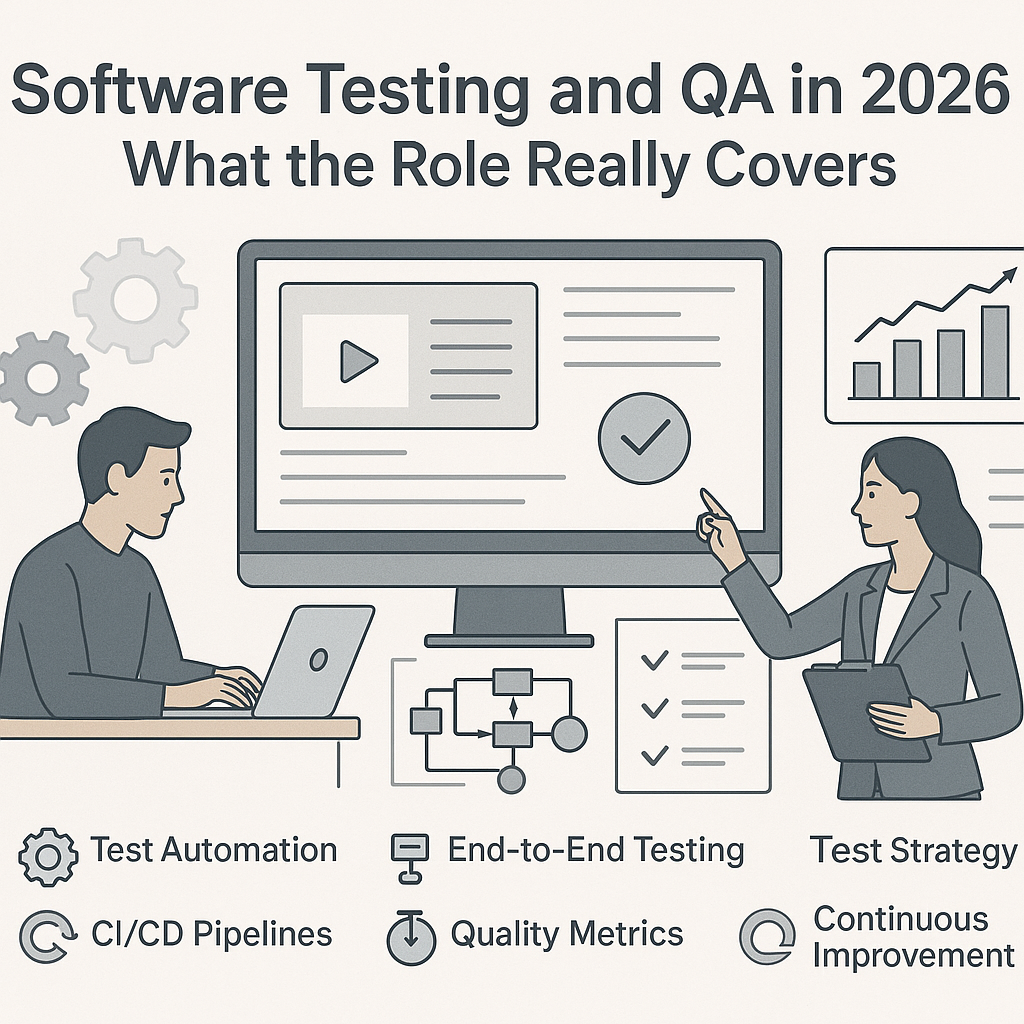
Software Testing and QA in 2026: What the Role Really Covers
Software testing checks whether an application behaves as intended; quality assurance builds the habits and controls that help prevent defects. Modern teams share this work across developers, QA engineers, automated pipelines, and production monitoring. The useful question is not whether QA is dead, but which risks each layer can catch before users feel them.
I’m Ermenildo Valdez Castro, Jr., and years spent working with engineering teams at Google, Microsoft, Amazon, and Zulily taught me to distrust tidy slogans. A QA team is not obsolete just because developers write more tests. Nor does adding a test suite automatically make software safe. Quality comes from clear ownership, useful checks, and the willingness to fix what the checks reveal.
The practical change is a shift in the work. Testing has moved closer to everyday development, while dedicated quality roles increasingly shape automation, end-to-end coverage, and exploratory testing. AI tools add speed, but also more code and more test results to review. The basics still matter: know what users need, choose checks that can catch real failures, and keep the feedback trustworthy.
What Is Software Testing and QA?
Software testing is the work of checking whether a program behaves as expected. A test gives the software an input, observes the result, and compares that result with a stated expectation. The check might cover a single function, a connection between services, or a full user workflow. It might also measure response time, safety, accessibility, or what happens when a system receives an unexpected input.
Quality assurance, often shortened to QA, is broader. It includes testing, but also covers the methods a team uses to reduce defects before they reach a customer. That can mean improving how requirements are written, reviewing risky changes, setting release rules, or making it easier to reproduce and fix a failure. The terms overlap in everyday job titles. The work behind those titles can differ sharply.
I have seen two people called QA engineers do very different jobs. One may spend most of the week running manual test cases before a release. Another may build automated test tools, advise developers on test design, and investigate failures in a continuous integration pipeline. Neither title tells you enough. Ask what decisions the person owns and what risks they are expected to reduce.
Testing also happens at different levels. Unit tests check small pieces of code, often in isolation. Integration tests check whether connected parts behave properly together. End-to-end tests follow a real user path through an application. Regression tests repeat earlier checks after a change, looking for accidental breakage. Performance and load tests check speed and stability under expected or heavy use. Exploratory testing gives a person room to try unexpected paths and spot awkward behavior that a prepared script may miss.
There is no single layer that catches everything. The test pyramid, described in Martin Fowler’s guide to the practical test pyramid, is one useful way to think about balancing fast, focused checks with slower, broader ones. Google’s testing chapter in Software Engineering at Google also discusses how teams can make tests useful and maintainable. The point is not to copy a diagram. It is to match each check to a risk and keep the feedback fast enough that people act on it.
For AI-generated systems, the old pattern of one input and one exact expected answer needs care. A language model may produce different valid wording on separate runs. That variation is not automatically a defect. Teams need to define acceptable behavior, check important constraints, and use human review where a simple pass-or-fail comparison cannot capture quality.
Core Benefits and Importance
Good testing makes software changes less of a gamble. It helps teams find problems while the change is still fresh in a developer’s mind, before a user discovers the same issue in the middle of a task. That matters whether the application handles a payment, a school schedule, or a button that should simply work.
- Fewer costly surprises. A focused test can catch a broken calculation or a failed service connection before release. The earlier the team sees the problem, the easier it is to understand what changed.
- Safer, faster change. A reliable test suite gives developers more confidence to improve old code. Without that safety net, teams often avoid needed repairs because they cannot tell what those repairs might break.
- Better user experience. Exploratory testing can expose confusing labels, inaccessible controls, or a workflow that technically works but wastes a person’s time. Those issues count. Software is used by people, not by a coverage report.
- Clearer teamwork. Shared test expectations help developers, QA staff, product managers, and support teams agree on what a feature should do. This reduces the familiar argument over whether a defect is a bug or an unspoken requirement.
- Useful evidence. Defect escape rate, time to detect and resolve problems, and flaky test rate give teams different views of quality. Together, they can reveal gaps that a single coverage number hides.
I remember teams losing hours because a test failed intermittently, then passed when someone ran it again. At first, people treated each failure like a code defect. After several false alarms, they began ignoring the alerts. That was the real damage: a noisy system trained good engineers to stop listening. We had to identify the flaky checks, fix them or quarantine them, and restore trust in the pipeline.
Testing is also a form of stewardship. A team has a duty to use its time and tools well, and to avoid pushing preventable harm onto customers. That does not mean testing every possible behavior. It means paying attention to the risks that could hurt people, waste their time, expose their data, or block access to a service they rely on.
A healthy quality practice helps with AI-assisted development, too. If a coding assistant makes it easier to produce changes, then review and verification need to keep pace. The tool can save time on a first draft. It cannot decide whether a feature is fair, whether an edge case matters, or whether a test actually checks the promise made to the user. That judgment remains human work.
Step-by-Step Guide to Implementing a Testing Practice
A useful testing plan starts with risk, not a target number of tests. Here is a practical way to build one without turning every change into a ceremony.
- Name the behavior and the risk. Before writing tests, describe what the feature should do and what could go wrong. Identify who might be affected, how severe a failure would be, and whether the issue could involve money, safety, privacy, or access. A vague requirement usually leads to a vague test. I have seen teams argue about test results when the real problem was that nobody had agreed on the expected behavior.
- Choose the right test level. Check simple logic with unit tests. Use integration tests for boundaries between services, databases, or other components. Save end-to-end tests for important workflows that need to prove the whole path works. A browser test that clicks through every screen may look thorough, but it can be slow and fragile. Put a check where it can catch the problem with the least setup and the clearest failure message.
- Make ownership explicit. Developers should normally add or update unit and integration tests alongside their code. QA and test engineers can set standards, build shared tools, review risky test plans, and focus on cross-system workflows and exploratory work. Product and design teams should help define expected behavior. A handoff with no shared responsibility is where missing checks tend to hide.
- Run useful checks in CI. Put fast, reliable tests close to the code change so developers get results while they still remember what they did. Run slower end-to-end, performance, or security checks at a suitable point in the pipeline. Set clear rules for what blocks a merge and who investigates failures. The NIST Secure Software Development Framework is a helpful reference for treating secure development as a set of practices across the software lifecycle, rather than a final inspection.
- Treat AI-generated tests as drafts. Ask an AI tool to suggest test cases, then check the assumptions, setup, assertions, and failure conditions yourself. Does the test fail when the behavior is wrong? Does it cover a meaningful edge case, or just repeat the code’s current logic? A generated test that always passes can create the appearance of protection without catching a defect. Keep the test only when its purpose is clear.
- Review production signals and tune the suite. Track defects that escape, time to detect and resolve them, and how often tests fail for reasons unrelated to a product defect. Compare those measures with the risks and goals the team chose. If a test is slow, flaky, or no longer relevant, repair or remove it. Add checks when incidents expose a gap. Testing is maintenance, not a one-time setup task.
In one recurring pattern, a team would add a broad end-to-end test whenever a release caused trouble. The suite grew, runs slowed, and failures became harder to diagnose. We made progress by tracing each failure to its cause and adding a smaller check at the layer where the problem began. That gave developers quicker feedback and left end-to-end tests for a smaller set of user-critical paths.
Keep the process understandable. A developer should be able to tell what failed, why it failed, and what to do next. A red pipeline with no useful explanation is not quality control; it is just a loud light on the wall.

Comparison Table: Modern QA vs. Manual-Only, Late-Stage Testing
There is no rival product called manual testing. The real comparison is between two ways of organizing quality work: a late handoff to manual testers, and a shared practice that checks software throughout development. Manual testing still has a place. The trouble starts when it is expected to carry the whole job by itself.
| Area | Manual-only, late-stage model | Modern, shared quality practice |
|---|
| Timing | Testing mostly begins after development | Checks start with the change and continue through release |
| Ownership | QA staff receive work after coding | Developers, QA, product, and operations share clear duties |
| Common checks | Manual test cases near release | Unit, integration, end-to-end, performance, and exploratory checks |
| Feedback | Problems may arrive late | Fast automated feedback is available in CI; human testing adds context |
| Strength | People can notice confusing or unexpected behavior | Multiple layers can catch different kinds of failure earlier |
| Main risk | Delays, repeated work, and defects found late | Automation can become noisy or shallow if nobody maintains it |
| Useful measures | Cases run and defects found | Escaped defects, detection and repair time, flaky rate, and coverage used with care |
The shared model does not mean every test should be automated. Automation is valuable for repeatable checks, while exploratory testing is useful when behavior is uncertain or human judgment matters. Fowler’s test-pyramid article helps explain why a large pile of slow end-to-end tests can create friction. Google’s account of flaky tests and their cost is a reminder that more tests do not help if engineers cannot trust the results.
The sensible choice depends on the product. A small internal tool may need a modest suite and careful user checks. A service handling sensitive records or essential transactions needs stronger controls and clear ownership. In either case, the aim is the same: catch meaningful problems early, explain failures clearly, and make sure a human can challenge a poor assumption.
Common Mistakes to Avoid
A dashboard can make a weak testing practice look impressive. The numbers are easy to collect. Understanding what they mean takes more work.
- Treating coverage as proof. Coverage reports show which code ran during tests. They do not prove that tests would notice a wrong result. A test can execute every line and still assert almost nothing. Use coverage to find untested areas, then inspect whether the checks protect meaningful behavior.
- Putting everything in end-to-end tests. These tests are useful for important user paths, but they often take longer to run and can fail when a small interface detail changes. Use smaller tests for logic and component boundaries; keep broad workflows for the risks that actually require them.
- Accepting generated tests without review. AI can produce a large set of plausible-looking cases. Plausible is not the same as useful. Review whether each test states a real expectation, checks the right result, and can fail when the implementation is wrong.
- Ignoring flaky tests. A test that fails at random burns time and trust. Google’s flaky-test discussion describes the strain unreliable checks can put on development work. Track failures, identify causes such as timing or shared state, and fix or remove checks that no longer provide a dependable signal.
- Turning QA into a blame desk. If testers are treated as the last line of defense, developers may stop thinking about quality until their work is handed off. Clear ownership works better: people who make a change help verify it, and QA engineers improve the system around that work.
- Choosing metrics without agreement. A manager may care about release speed while an engineer watches defects, and a customer support team may see recurring confusion that neither metric captures. Agree on what the measures are for. Quality is a cross-functional concern, not a private scoreboard for one team.
I have seen a team celebrate a high coverage percentage while serious defects still reached users. The tests ran, but they did not check the behavior that mattered. We got more value by reviewing a few critical cases with product and support staff than by chasing another percentage point. The uncomfortable lesson is simple: a metric can be accurate and still answer the wrong question.
One more trap is expecting automation to replace curiosity. A script can repeat known checks reliably. It cannot always notice that a newly designed form is confusing, that a screen reader announces controls in a strange order, or that a reasonable user will take a path the team never considered. Leave room for a person to look, question, and report what the plan missed.
Frequently Asked Questions
Is the QA engineer role disappearing as developers write more tests?
The role is changing more than disappearing. Developers increasingly own unit and integration tests as part of making a change. Dedicated QA and test engineers can then spend more time on automation infrastructure, end-to-end coverage, exploratory testing, and test strategy. Some organizations still need people to run manual checks, especially when the work depends on human judgment. The title matters less than whether the role has clear responsibility and useful influence over product quality.
Does more AI-generated code mean more bugs in production?
Not by itself. Risk depends on how the code is reviewed, tested, and monitored, and on the consequences of an error. AI tools may increase the rate of code changes, which can put pressure on review and CI. Teams should ensure their tests keep pace, review generated code with the same care as other code, and watch production behavior. If changes arrive faster than a team can understand them, the process needs adjustment, not a blind faith in the tool.
What is the difference between test coverage and test quality?
Coverage measures how much code automated tests execute. Test quality asks whether those checks would catch meaningful defects and whether they express the expected behavior. High coverage with weak assertions can leave a serious gap. Use coverage to spot areas that may need attention, but compare it with escaped defects, customer reports, and the usefulness of the tests themselves. No single percentage can answer all of those questions.
Which quality metrics should a team track?
Start with a small set tied to real decisions. Defect escape rate shows problems that reach production. Mean time to detect and mean time to resolve show how quickly the team finds and addresses issues. Flaky test rate shows how often the pipeline gives an unreliable signal. Coverage can help show where checks run, but it needs context. Share the measures with technical and non-technical partners, then revisit them if they reward behavior that does not improve the product.
Final Thought
A dependable QA practice does not come from a job title, a new tool, or a green dashboard. It comes from people agreeing on what good behavior looks like, checking the risks that matter, and fixing the gaps they find. That work can be shared without becoming nobody’s responsibility.
AI will keep changing the pace and shape of software development. Let it help with drafts, repetitive checks, and sorting large piles of failures. Keep people responsible for deciding what users need and what harm a failure could cause. Quality work is not a tax imposed on the people who build software. It is part of the craft, and part of respecting the people who depend on the result.
The best test suite is not the one with the biggest number. It is the one that gives a team trustworthy evidence, fast enough to use, and clear enough to improve the product. Keep asking what each check protects. If nobody can answer, the test may be noise. If the answer is a person’s time, safety, privacy, or trust, the check has earned its place.