SED News: The Kimi Moment, Runaway AI, and Tokenmaxxing marks a sharp turn in how people talk about AI models, pricing, speed, and hype. The real story is not...
SED News: The Kimi Moment, Runaway AI, and Tokenmaxxing Explained
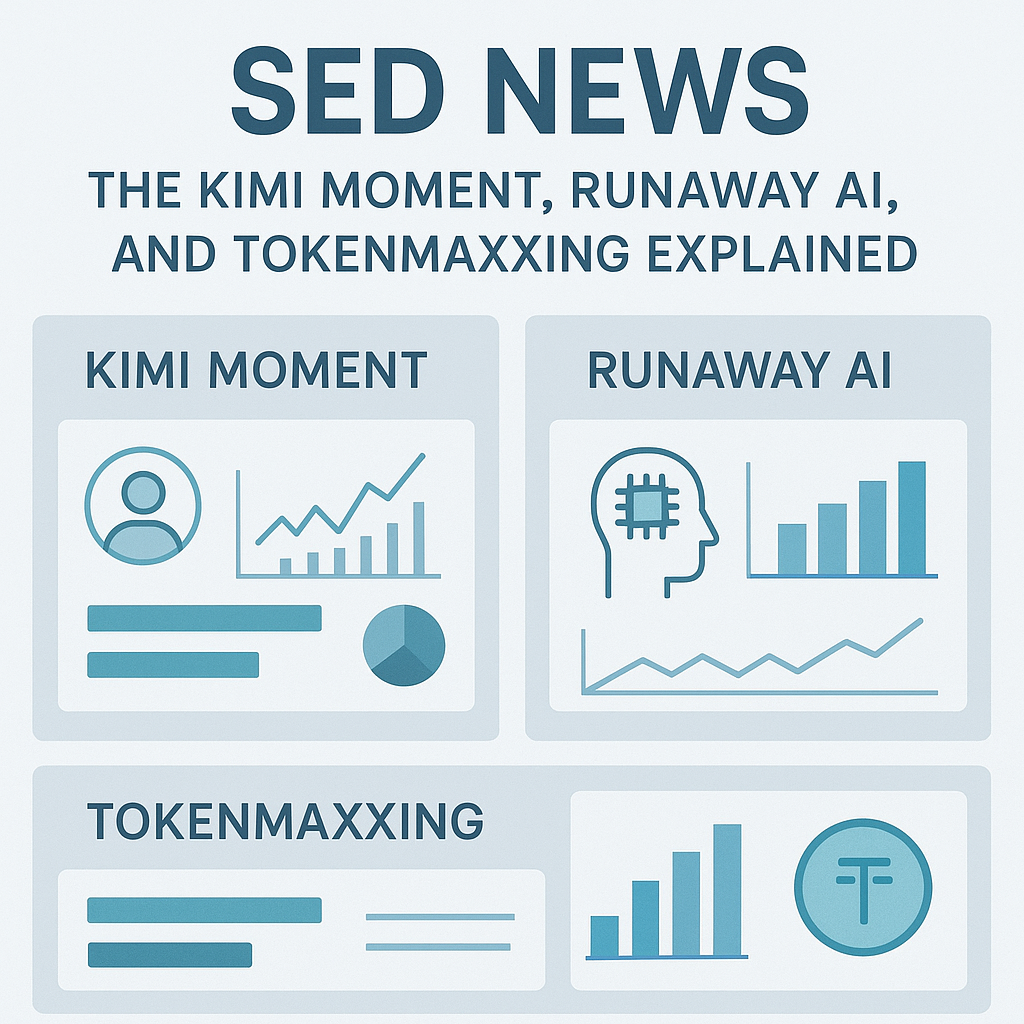
SED News: The Kimi Moment, Runaway AI, and Tokenmaxxing marks a sharp turn in how people talk about AI models, pricing, speed, and hype. The real story is not the shiny demo. It is the math, the cost curve, and the pressure on teams that must ship useful systems without blowing the budget. I’m Ermenildo V Castro, and I’ve seen enough platform fads to know that the bill always shows up.
Key Takeaways:- Kimi’s rise matters because it shows that model quality, cost, and speed now sit in the same fight.
- Runaway AI is not just hype; it can mean output growth, user adoption, or a bad cost spiral.
- Tokenmaxxing is the ugly little habit of pushing token counts too hard, often for weak gains.
- Teams that ignore cost per token usually end up fixing it later, under stress.
- Good AI work is stewardship, not theater. Use what serves people, not what merely impresses them.
What is SED News: The Kimi Moment, Runaway AI, and Tokenmaxxing?
SED News: The Kimi Moment, Runaway AI, and Tokenmaxxing is a shorthand way of talking about three linked AI trends at once. Kimi Moment points to the sudden attention a model or product gets when it shows strong performance, low friction, or surprising value. Runaway AI refers to growth that moves too fast for the team, budget, or controls around it. Tokenmaxxing means squeezing more tokens through a model than you really need, usually because bigger prompts, bigger outputs, or bigger context windows feel impressive.
That sounds messy because it is. I’ve watched this pattern many times in big shops and small ones. At Google, the favorite trick was to scale first and ask questions later. At Microsoft, the smart teams asked what the user truly needed. At Amazon, cost had a way of walking into every meeting whether people liked it or not. At Zulily, shipping fast mattered, but only if the system still made money. AI is no different. The shiny part gets attention. The bills and guardrails do the actual work.
Here’s the plain version. A Kimi Moment is when people suddenly notice that a model is not just good on paper, but useful in the real world. Runaway AI is what happens when adoption, inference demand, or output volume grows faster than your controls. Tokenmaxxing is what happens when teams use too many tokens because they confuse length with quality. That is a fool’s bargain. More text is not always better text.
The industry now cares a lot about efficiency because the economics are brutal. OpenAI, Anthropic, Google DeepMind, and newer model labs all face the same pressure: make systems that are strong, cheap enough, and safe enough. If a model burns too much compute, or if a team spams giant prompts to chase marginal gains, the whole thing becomes a toy. People talk about intelligence. The accountants talk about margins. Both are right.
A decent way to think about the topic is this: Kimi Moment is the headline, Runaway AI is the risk, and Tokenmaxxing is the bad habit. You need all three in your head if you want to understand the news without getting played by hype. Frankly, the AI world is full of folks selling fireworks and calling it infrastructure.
Core Benefits and Why This Matters
- Lower cost per user: If you reduce token usage, you reduce inference spend. That matters fast at scale. I’ve seen one bad prompt template add a stupid amount of monthly cost.
- Better latency: Smaller, tighter requests usually return faster. Users feel that immediately. No one claps for a model that makes them wait.
- Cleaner product design: Token discipline forces teams to think harder about what the user actually needs. That is good discipline. It respects people’s time.
- Less operational surprise: Runaway usage is one of those ugly little problems that hides until the dashboard turns red. Then everybody gets busy at once.
- Sharper evaluation: If a model only looks good because it writes a novel when a paragraph would do, your tests are lying to you. I’ve seen that movie, and it ends badly.
- More ethical use of compute: There is a stewardship angle here, whether the tech crowd likes the word or not. Compute is finite. Power is finite. Talent should not be wasted on sloppy prompts and vanity output.
The Kimi Moment part matters too. A model can break through because it gives people more value per dollar. That is why analysts, product teams, and founders care. They are not just chasing benchmark bragging rights. They want proof that the system can serve actual users without torching the budget. If you miss that, you miss the business.
I also think this debate gets at a deeper point. Human work has dignity. That includes software work. The point is not to make the longest response or the flashiest demo. It is to make something useful, honest, and well-built. Most guides on AI talk as if bigger is always better. My experience says otherwise. Smaller, cleaner, and more honest usually wins in the end.
For background on how model behavior gets measured, it helps to read the Gemini 1.5 technical report and OpenAI’s overview of GPT-4o. Those papers and product notes show how quality, speed, and cost get tangled together. That is the actual battlefield.

Step-by-Step Guide to Managing the Kimi Moment, Runaway AI, and Tokenmaxxing
You do not fix this mess with slogans. You fix it with boring discipline, which is why so many teams skip it. Here’s the kicker: boring discipline saves money.
- Define the user task first
Ask what the model must do, in one sentence. If the answer sounds fuzzy, your prompt will be fuzzy too. I’ve sat in meetings where people demanded “better AI output” and could not say what better meant. That is not strategy. That is fog.
- Set a token budget
Decide the max input and output size before production. Put hard limits in code. Not in a slide. Not in a Slack promise. In code. This prevents runaway AI spend and keeps prompts from ballooning.
- Measure cost per request
Track tokens, latency, and dollar cost together. If you only watch quality, you will miss the bill. If you only watch cost, you will ship junk. You need both.
- Use short prompts with structure
Good prompts are clear, not bloated. Use bullet points, examples, and exact output rules. Most of the time, shorter beats dramatic. I learned that the hard way after wasting time on a prompt that read like a legal brief and worked like a drunk intern.
- Test against real tasks
Benchmarks help, but they are not the whole story. Run the model on your actual customer cases. Check whether the output is useful, safe, and on time. If the model shines only in a lab, that shine is fake.
- Add kill switches and rate limits
If demand spikes, your system should not melt. Put controls in place. Watch for weird traffic, prompt loops, and output storms. Runaway AI is often an ops problem before it becomes a product problem.
- Review outputs with humans
AI should serve people, not replace judgment. The model can draft. The person must decide. That keeps quality up and abuse down.
- Trim prompts and retry
If you need 4,000 tokens to answer a simple question, something is off. Cut the prompt. Cut the context. Cut the fluff. Then test again.
I’ve used this sort of approach in real systems, and it works because it respects limits. Limits are not insults. They are guardrails. Good engineering always has some humility baked in.
The best teams also document when to spend more tokens. Some jobs need depth. Legal review, medical support, and high-stakes analysis deserve more care and sometimes more context. But the choice should be deliberate. Not lazy. That is where moral responsibility sneaks into technical work in a good way. If your tool affects real people, you owe them honesty, clarity, and restraint.
For model-specific safety and operational guidance, the Anthropic Constitutional AI paper summary is worth a look, and so is Google’s Gemini 1.5 technical details. Both help explain why prompt shape and model limits matter more than people think.

Comparison Table: Kimi-Style Efficient AI vs. Bigger-Ticket Competitors
Below is the blunt version. Bigger is not always better.
| Factor | Kimi-Style Efficient AI | Bigger-Ticket Competitors |
|---|
| Core appeal | Strong output with leaner token use | High ceiling, broad branding, heavy infrastructure |
| Cost pressure | Lower if well tuned | Often higher due to model size and usage patterns |
| Latency | Usually faster when prompts are tight | Can slow down with larger context and outputs |
| User experience | Better for simple, frequent tasks | Better for complex, broad, or multimodal tasks |
| Risk of runaway spend | Lower, if controls exist | Higher, especially with wide adoption |
| Tokenmaxxing temptation | Less tempting if product stays focused | More common when teams chase huge responses |
| Best fit | Search, summaries, support, quick analysis | Deep reasoning, multimodal work, rich generation |
The table is not a verdict. It is a warning label. Different tools fit different jobs. I’ve never understood the childish habit of treating every model like a sports team. Choose the one that solves the problem. That’s it.
What matters most is how the model behaves under load. A cheaper system that answers fast and well often beats a pricey giant that costs too much to serve. This is why finance teams and platform teams care so much about tokens. They are not being stingy. They are protecting the product.
When you look at real-world deployment, efficiency becomes a kind of respect. Respect for users, because they want speed. Respect for engineers, because they have to keep it alive. Respect for the business, because wasted compute is wasted labor.
Common Mistakes to Avoid
Most advice on this topic is too cute. It talks about innovation and misses the junk drawer where the real problems live. Let’s be real: many teams fail because they chase shiny outputs and ignore the cost of getting them.
- Mistake 1: Equating longer output with better output
More words can mean more noise. I’ve seen managers applaud a long answer that said almost nothing. That is a performance, not a result.
- Mistake 2: Ignoring token growth over time
A prompt that costs a little on day one can cost a lot after thousands of requests. Costs creep. They never show up waving a flag.
- Mistake 3: Copying benchmark winners blindly
Benchmarks are useful, but they do not match every product. A model can score high and still be bad for your use case. I have seen teams worship charts and then wonder why customers were unhappy.
- Mistake 4: Treating runaway AI as only a model issue
Sometimes the model is fine. The prompt is bad. The product loop is bad. The data is bad. Blaming the model alone is lazy.
- Mistake 5: Skipping guardrails
No rate limits, no budgets, no alerts, no fun. Actually, scratch that. No guardrails means no control. You do not need drama; you need settings.
- Mistake 6: Forgetting the user
Tokenmaxxing often happens when internal teams write for themselves instead of the person on the other end. That is where the work loses its purpose. Good tools serve people. Full stop.
I’m skeptical of any AI strategy that starts with “let’s maximize token usage.” That is backwards. Start with value, then size the prompt. Start with the user, then the model. Start with the need, then the spend.
One more thing: teams should watch for social pressure inside the company. Sometimes people push larger outputs because they think it looks smarter in a demo. That is vanity, plain and simple. Stewardship means telling the truth about what the system can do, what it cannot do, and what it costs. Those are not small matters.
For a clear view of current model behavior and cost tradeoffs, see OpenAI text generation docs and Anthropic model docs. They are dry, yes. Also useful. Life is cruel that way.
Frequently Asked Questions
What does Kimi Moment mean in AI news?
It usually means the point when a model or product suddenly gets wide attention because it shows strong usefulness, lower cost, or better speed than people expected. The phrase points to a breakthrough moment, not just hype.
Is runaway AI always a bad thing?
No. Sometimes it means adoption is growing quickly, which is good. But if growth outpaces budget, safety, or infrastructure, then it becomes a real problem. Growth without control is how teams get hurt.
What is tokenmaxxing?
Tokenmaxxing is the habit of using too many tokens in prompts or outputs, often to force more detail than the task needs. It can waste money, slow systems down, and make answers less clear.
How do I stop token waste in my AI product?
Start by setting token limits, using tighter prompts, measuring cost per request, and testing with real user cases. Then review outputs with humans. If you need to cut 20 percent of the text and nothing breaks, the original design was too bloated.
Final Thought
The best AI systems are not the loudest ones. They are the ones that serve people well, keep their costs in check, and respect the work of the humans around them. That is a plain fact, and it sits close to how I think about tech, labor, and stewardship. Ermenildo V Castro would call that common sense with a conscience.
I’ve spent enough years around large systems to know that scale can fool people. Big traffic looks impressive. Big outputs look clever. Big bills, though, are where truth shows up. If the Kimi Moment teaches anything, it is that usefulness now has a price tag attached to every token. A wise team watches that price with clear eyes.
The deeper lesson is simple. Build for real people. Spend only what you must. Tell the truth about tradeoffs. That is not flashy, but it is solid. And solid is what lasts.