Restricted AI models are systems that limit who can use them, what they can see, and how their outputs can be used. The short version: companies are putting...
Restricted AI Models Explained: Why They’re Tightening, Who Benefits, and What It Means for Software Teams
Restricted AI models are systems that limit who can use them, what they can see, and how their outputs can be used. The short version: companies are putting more walls around model access because the stakes are real—privacy, safety, legal risk, and plain old abuse. I’m Ermenildo Valdez Castro, Jr., and I’ve seen this pattern before in cloud, search, and mobile. The tool gets good, then the guardrails show up.
Key Takeaways- Restricted AI models limit access, usage, or output rules.
- The main reasons are safety, copyright risk, privacy, and abuse prevention.
- Teams need clear policies, logging, review gates, and model governance.
- Public models are easier to use, but restricted models can be safer for sensitive work.
- The best setup is not hype. It’s disciplined control with a human conscience.
What is a Restricted AI Model?
A restricted AI model is an AI system with limits. Those limits can be about who may use it, what data it can see, what it can generate, or whether it can be fine-tuned and redistributed. Some restrictions are technical. Some are legal. Some are both. That’s the whole ball of wax.
In practice, this can mean an API key with approval steps, a model that blocks certain prompts, a private deployment behind a company firewall, or a product that removes a feature after safety or misuse concerns. The point is simple: the provider does not hand over the keys and say, “Good luck.”
I’ve worked on systems where access control was not optional. At Google, Microsoft, Amazon, and Zulily, I saw how quickly a useful platform becomes a risky one once real users show up. Same story here, just with bigger headlines and more people pretending the rules are new. They are not. Good systems have always needed boundaries.
That’s why the recent tension around restricted AI models matters. When Anthropic pulled Fable from the Claude ecosystem, it reminded teams that access is not just a product choice. It is a business choice, a safety choice, and, frankly, a moral choice too. If a model can affect people, the rules around it should reflect human dignity, fairness, and stewardship, not just growth charts and investor chatter.
If you want background on related system controls, see this software engineering practices guide, this AI safety overview, and this cloud access control tutorial.
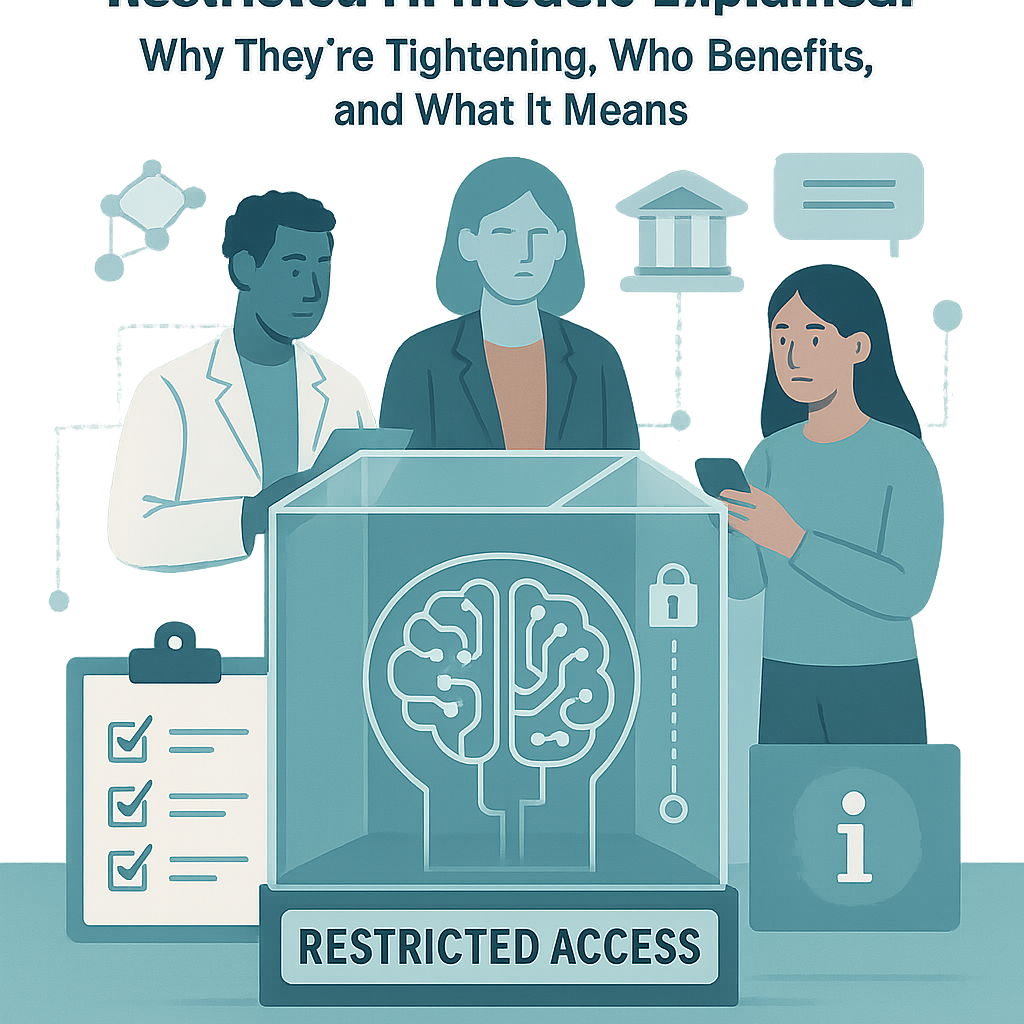
There is a practical side, too. Restricted models often appear when a provider sees abuse, bad outputs, copyright complaints, or regulatory pressure. The model itself may be strong, but the wrapper around it gets tighter. That is not always a sign of failure. Sometimes it is a sign that the company finally noticed reality.
People love to say, “Open access is always better.” Maybe. Sometimes. But not when the model can expose personal data, fake a person’s voice, or crank out harmful material at scale. I’ve sat in reviews where teams wanted speed above all else, and the result was usually a mess with a nice dashboard. Control is not the enemy. Carelessness is.
Core Benefits and Importance
- Better safety: Restricted models reduce misuse, harmful output, and accidental data leaks. I’ve seen this matter in enterprise settings where one bad prompt can turn into a legal headache.
- Stronger privacy: Sensitive records, customer data, and internal notes need tighter handling. Public model access is cheap until the compliance team starts asking questions.
- Clearer accountability: When access is logged and approved, teams can trace who used what and why. That sounds boring. It is. It also saves lives in regulated work.
- Lower abuse risk: Fraud, impersonation, spam, and phishing all get easier when a model has no guardrails. I’ve watched abuse vectors grow faster than most teams can patch them.
- Better trust: Users, partners, and regulators trust systems more when the rules are visible. Trust is earned in small acts, not with glossy slogans.
- More disciplined innovation: Limits force teams to think before they ship. That restraint often leads to cleaner architecture and less mess later.
Here’s the kicker: many teams only notice the value of restrictions after something goes wrong. I’ve been in those rooms. The mood changes fast. One day everyone wants frictionless access. The next day everyone wants audit logs, approval flows, and a paper trail thick enough to stop a truck.
From a Catholic view of work, this part is plain. Tools should serve people, not use them up. A model is a tool, not a little god in a server rack. If it affects labor, speech, or decisions, it should be handled with care. That’s not softness. That is justice.
For broader context on trust and guardrails, read this AI governance policy guide and this data privacy best practices article.

Step-by-Step Implementation Guide
Setting up restrictions is not rocket science, but it does require discipline. Everyone wants the shiny model. Few people want the paperwork. Too bad. The paperwork is where the pain is buried before it becomes public.
- Classify the use case. Decide whether the model will touch public content, internal data, customer records, or regulated material. I always start here because vague use cases lead to sloppy controls.
- Define who gets access. Use role-based access control, single sign-on, and approval flows. Not everyone needs the same permissions. That is just common sense dressed up as policy.
- Set data rules. Spell out what can be sent to the model, what must stay local, and what must be redacted. If your team is feeding raw secrets into a public endpoint, you already know the answer. Stop it.
- Add logging and review. Keep records of prompts, outputs, and exceptions, with privacy-aware handling. Logs are not glamorous, but they are the seat belt.
- Test abuse paths. Try prompt injection, jailbreaks, impersonation, and leakage tests. When I reviewed systems at scale, the “impossible” attacks were the ones that showed up first.
- Put humans in the loop. High-risk outputs should get review before action. Machines can draft. Humans must judge. That is the line.
- Document the policy. Write down the rules in plain language. If a smart intern cannot understand it, the policy is probably rotten.
- Review often. Risks change. Regulations change. Product features change. A restriction that made sense six months ago may be too loose or too tight now.
I have seen teams try to skip step one and jump straight to the model choice. Bad move. They end up with a tool that is fast, expensive, and not fit for purpose. Garbage in, paperwork out.
If you need a practical checklist for controls, this model risk management checklist is a useful companion. Pair it with this secure API design guide if your app sends prompts over the wire.
Comparison Table
Restricted models are not the only path. But they are often the saner one when risk is high. Public models look easy, and they are. Until they are not.
| Feature | Restricted AI Models | Open Access AI Models |
|---|
| Access control | Approval, roles, and policy gates | Broad or public access |
| Safety | Higher guardrails and content limits | Often fewer limits |
| Privacy | Better for sensitive data use | Riskier if data handling is weak |
| Auditability | Usually stronger logging and tracing | Varies by provider and setup |
| Speed to use | Slower setup, more review | Faster to start |
| Misuse risk | Lower when controls are enforced | Higher if safeguards are thin |
| Best fit | Enterprise, regulated, or sensitive work | Prototyping, research, low-risk tasks |
Frankly, the winner depends on the job. I have seen open access model use work well for experiments and quick drafts. I have also seen restricted systems save companies from dumb, expensive mistakes. The right choice is the one that matches the risk, not the one with the louder marketing team.
Common Mistakes to Avoid
Most guides act like restrictions are just a toggle. They are not. That idea is neat, but it is wrong.
- Thinking restrictions fix everything: They do not. A locked door still fails if the house has no walls. You still need policy, review, and training.
- Ignoring user behavior: People share secrets, copy outputs, and push boundaries. If you design only for the ideal user, you will lose to reality.
- Overtrusting vendor claims: I have heard plenty of “safe by default” promises. Nice phrase. Then I ask for the logs, the red-team notes, and the exception process.
- Making rules too rigid: If every request needs ten approvals, people will work around the system. Balance matters.
- Skipping documentation: If nobody can explain why a restriction exists, it will be ignored or broken later.
- Forgetting the human cost: A bad AI decision is not just a technical issue. It can hurt a worker, a customer, or a family. That part should keep us awake a bit.
I’ve seen teams waste months on polished policies nobody follows. Looks good in slides. Fails in the wild. The fix is not more jargon. It is simpler rules, better checks, and honest review of real behavior.
Use this AI policy template as a starting point, then adapt it to your org. Do not copy-paste it and call it wisdom. That way lies trouble.
Frequently Asked Questions
What is the difference between a restricted AI model and a public AI model?
A restricted model has limits on access, data use, output, or redistribution. A public model is easier to reach and often has fewer gates. That makes it faster to use, but also riskier in sensitive settings.
Why are AI companies restricting models more often now?
Because misuse, privacy issues, copyright disputes, and regulatory pressure are real. Companies learned the hard way that shipping first and fixing later can get expensive fast.
Are restricted models better for enterprises?
Often, yes. If the work involves customer data, internal records, or regulated tasks, restrictions help reduce risk and improve accountability.
Can restricted AI models still be useful for developers?
Absolutely. Developers can still build with them, but they may need approval flows, redaction, logging, and review steps. That is the tradeoff.
For more context on public-facing rules, see this AI compliance FAQ and this product safety controls guide.
Final Thought
Restricted AI models are not a sign that the field is failing. They are a sign that the field is maturing. I’m Ernie Castro, and after years of building systems in big tech, I trust boundaries more than buzzwords. The people, the data, and the work deserve that much. A good tool should serve the common good, not run roughshod over it. That is just basic stewardship.
The hard part is not building more power. It is using power well. That is the whole point, and if we lose that, all the fine model names in the world will not help.