Multi-Cloud FinOps: An Engineering Framework for Cross-Cloud Cost Optimization
Multi-cloud FinOps is the practice of managing cloud spending across providers by joining financial accountability with engineering decisions. It helps teams understand what they pay for, who uses each service, and whether the cost supports real business value. I’m Ernie Castro, and I’ve seen that the best savings come from clear ownership and sound design—not surprise budget cuts.
What Is Multi-Cloud FinOps?
Multi-cloud FinOps is an operating practice for understanding and improving cloud value across two or more cloud providers. It connects usage and billing data to the people making technical and financial decisions. Those decisions might include choosing a database, changing a service size, setting a retention period, moving a workload, or deciding whether a cloud commitment makes sense.
The word “FinOps” combines finance and operations, but the work reaches well beyond either department. Engineering teams create much of the cloud usage. Finance teams need dependable forecasts. Product teams understand customer demand and business priorities. Operations teams watch reliability and performance. A FinOps practice gives those groups a common way to discuss the trade-offs.
Multi-cloud makes the job harder because providers use different names, billing rules, discount models, and service boundaries. One provider may charge for a particular service by request, another by capacity, and a third through a different bundle. Even basic terms can be slippery. A project, account, subscription, folder, or resource group may all represent a useful boundary, but they are not interchangeable. A team that compares totals without understanding those differences can draw the wrong conclusion.
The FinOps Foundation describes FinOps as an evolving cloud financial management discipline and cultural practice. Its framework centers on informing, optimizing, and operating, with shared responsibility across business, finance, and engineering. That is a better starting point than treating FinOps as a monthly hunt for waste. See the FinOps Foundation framework for its principles and practice areas.
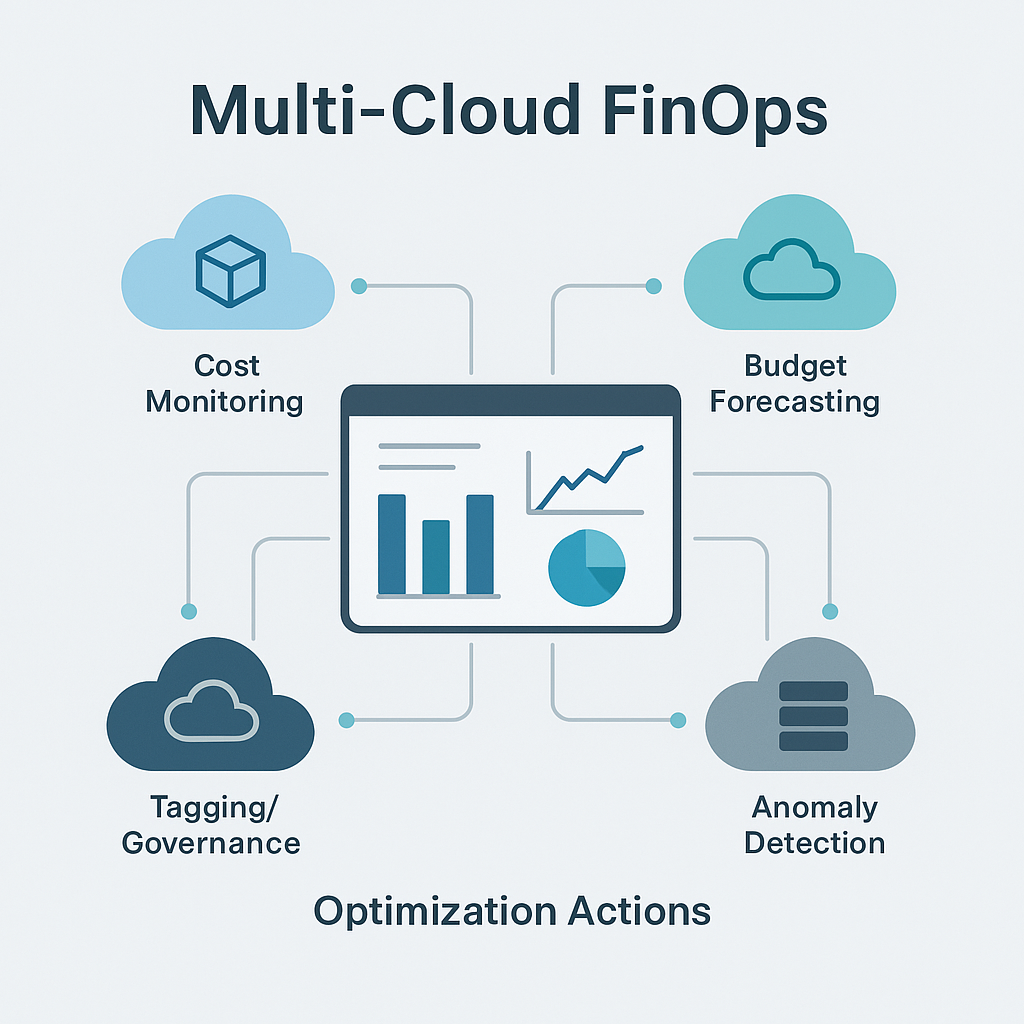
In practical terms, a multi-cloud program needs a few things to work together: billing exports from each provider, a shared service and team taxonomy, cost allocation rules, usage metrics, forecasting, and a route for people to act on findings. The point is not to force every provider into identical technical shapes. It is to make costs understandable enough that teams can make responsible choices.
I have seen teams obsess over a cloud bill only after it has grown painful. That timing makes every discussion feel like blame. A healthier approach treats cost as an engineering signal from the start, alongside latency, availability, security, and maintainability. A service that meets its target at a sensible cost is usually a better service than one that merely runs cheaply.
Core Benefits and Why Multi-Cloud FinOps Matters
Cloud bills are records of decisions. They show which workloads ran, how much data moved, what capacity sat idle, and which services grew. But the bill by itself does not explain whether the spending was useful. FinOps adds the context that turns a list of charges into information a team can act on.
- Clearer ownership: When resources carry a responsible team, product, and environment, people can ask the right group about unusual changes. Shared ownership rules also make it less likely that orphaned test systems sit unnoticed for months.
- Better forecasts: Teams can compare past usage with planned releases, seasonal demand, and known commitments. Forecasts are still estimates, not promises, but they give leaders time to respond rather than forcing a rushed cut at month-end.
- Faster engineering decisions: If a team can see cost alongside performance and traffic, it can judge whether a new cache, database tier, or data pipeline is worth its price. That beats arguing from vague impressions.
- More useful provider comparisons: Common units—such as cost per request, per customer, per transaction, or per training job—help teams compare outcomes across providers. A raw hourly rate rarely tells the full story.
- Less waste: Idle compute, oversized instances, forgotten snapshots, excess log retention, and unnecessary data transfer are common sources of avoidable spend. Finding them requires visibility and an owner, not a stern email from finance.
- Fairer product choices: Costs can be discussed in relation to customer value and service commitments. That matters because an optimization that harms reliability or accessibility may save money while creating a worse service for the people who depend on it.
Here is the kicker: a cheaper bill is not automatically a better result. A team might reduce replicas and save money, then suffer an outage during a traffic peak. Another might move data to a lower-cost storage tier and later pay more to retrieve it. Good FinOps asks whether the change improves total value while respecting reliability, security, and user needs.
In one common pattern, a product team launches a new feature and its usage grows faster than forecast. The bill jumps. Without service-level attribution, finance sees a provider-wide increase while engineers see a product success, and neither has the full picture. With cost per active customer and workload-level ownership, the team can distinguish healthy growth from accidental waste. It can decide whether to tune queries, batch work, adjust caching, or change the product’s pricing.
There is also a human benefit. Engineers should be able to do careful work without carrying a hidden financial penalty for every design choice they make. The organization’s job is to give them useful data and sensible guardrails. Responsible stewardship means using shared resources thoughtfully, while preserving the dignity of the people doing the work and the customers relying on the service.
FinOps practices also help cloud governance. Policies for tagging, budgets, anomaly alerts, and approval thresholds can reduce confusion without turning every deployment into a finance review. The best controls are visible, proportionate, and close to the work. A warning that appears before a test cluster runs all weekend is more useful than a surprise charge discovered weeks later.
Step-by-Step Guide to Implementing Multi-Cloud FinOps
There is no magic dashboard that fixes cost management. Start with a repeatable process, then improve it as the data and team habits mature. I have found that a narrow pilot beats a grand program with a perfect slide deck and no service owners.
- Set the goal and guardrails. Decide what the program should improve: forecast accuracy, cost per customer, idle resource cleanup, or confidence in provider commitments. Include service requirements such as availability, response time, data residency, and security. A target that says “cut cloud spend by 20 percent” without context encourages blunt cuts, not sound engineering.
- Map accounts and people. List cloud organizations, accounts, subscriptions, projects, major workloads, and the teams responsible for them. Find a named business or engineering owner for each meaningful service. Where ownership is unclear, record that as a problem to resolve rather than assigning costs to a generic bucket forever.
- Create a shared taxonomy. Choose a small set of required labels, such as team, product, environment, cost center, and service. Map provider-specific labels to those shared concepts. Keep the rules simple enough that engineers can follow them in deployment templates. Use policy checks to prevent new resources from appearing without required metadata, while planning a humane process for exceptions.
- Collect consistent cost and usage data. Enable the providers’ billing exports or cost-management data feeds, then keep the raw records for audit and analysis. Check for missing periods, delayed records, currency differences, taxes, credits, and discount treatment. Compare exported totals with provider invoices before building detailed reports. A polished dashboard built on incomplete data is still wrong.
- Normalize with care. Make comparable categories for compute, storage, databases, networking, support, and managed services. Preserve the original provider and service names alongside normalized fields. Do not flatten useful differences away: a managed database and a self-hosted database may both store data, but their operating costs and responsibilities differ. Write down how shared services, discounts, and support charges are allocated.
- Build useful views for each role. Finance needs forecasts and variance explanations. Engineering needs resources, trends, and optimization options. Product leaders need unit costs tied to customers or features. Executives need a short view of material risks and decisions. One giant dashboard tends to serve nobody well.
- Choose a small pilot. Pick a service with an engaged owner, visible usage, and enough cost to matter. Establish a baseline that includes both spending and service outcomes. Then inspect likely causes: idle capacity, poor request patterns, excessive retention, data transfer, or a mismatch between selected service and workload. Avoid changing several factors at once if you need to learn what worked.
- Turn findings into owned work. Write each action with an owner, expected result, risk, and due date. Examples include scheduling development environments, changing a storage lifecycle, testing a smaller database tier, or removing an unused snapshot. Track realized savings after the change, not just estimates from a recommendation tool. Some changes shift cost to another service, so check the full workload.
- Set alerts and review habits. Use budgets and anomaly signals as prompts to investigate, not automatic proof that someone made a mistake. Review material changes on a regular cadence, and make sure the right team sees them quickly. A short, steady review usually beats a painful annual cleanup.
- Scale what works. Once the pilot produces reliable data and a clear result, apply the practices to another service. Improve tagging coverage, forecast methods, and architecture guidance as you learn. Revisit rules when providers change pricing or products. FinOps is ongoing because workloads and business needs change.
Provider guidance can help with the engineering details. The AWS Well-Architected cost optimization pillar discusses cost-aware design and resource management. Microsoft’s Azure cost management best practices cover organizing costs, budgets, and optimization. Google Cloud’s cost optimization framework outlines design and operational considerations. Treat these as provider-specific guidance, then connect them through your own shared definitions and business goals.
Multi-Cloud FinOps Compared With Cloud-Native Cost Management
The biggest competitor to multi-cloud FinOps is not another provider. It is cloud-native cost management: using each provider’s own tools and reports as the main way to control spending. Those tools can be valuable, and many organizations should use them. The question is whether they provide enough shared context for a business that runs workloads in more than one cloud.
| Area | Multi-cloud FinOps | Cloud-native cost management |
|---|
| Main view | Shared view across providers, teams, and products | Provider-specific accounts and services |
| Strong point | Cross-provider accountability and unit-cost analysis | Deep detail about that provider’s billing and features |
| Data model | Common taxonomy, with provider detail retained | Native billing categories and provider terminology |
| Workload comparison | Can compare outcomes across providers if units are defined well | Often easier within one provider than across providers |
| Setup effort | Higher; needs normalization, ownership, and governance | Lower for a single-provider environment |
| Best fit | Organizations with real cross-cloud needs or shared reporting requirements | Teams whose workloads mainly use one provider |
| Common risk | Poor normalization can create misleading comparisons | Separate views can hide total cost and shared-service impacts |
Frankly, a multi-cloud label does not make a company more mature. If a workload is on one provider, that provider’s cost tools may be enough. If a business needs consistent reporting across several providers, native tools alone can leave finance and product leaders stitching together spreadsheets. In practice, teams often use both: provider tools to inspect detailed charges and shared FinOps practices to connect those charges to common business measures.
Comparison must be fair. Providers package services differently, offer different discounts, and expose different levels of detail. A service with a lower advertised unit price may need more engineering effort, extra data transfer, or third-party tools. A spreadsheet that compares list prices without measuring total operating cost is not a decision model.
I have watched teams treat cross-cloud price comparison as a simple shopping exercise. It rarely is. A better comparison includes performance, reliability, operational effort, support, migration cost, security controls, and the cost of moving data. It also asks whether the team has a real reason to run the workload on multiple providers. A second provider can support resilience, regulatory needs, or a product requirement; it can also add complexity without delivering much value.
Use a shared measurement where possible—cost per successful transaction, for example—and preserve the assumptions behind it. State which traffic, support, discounts, and shared platform costs are included. Then test the comparison with engineers who understand the workload. Honest limits make a report more useful, not less.
Common Mistakes to Avoid
The common advice is to “tag everything,” “buy commitments,” or “turn on automated optimization.” Each can help. None is a complete strategy, and each can cause trouble when teams follow it without context.
- Treating every dollar as waste: Some spending supports real growth, safety, or customer value. A cost increase after a successful launch may be healthy. Ask what changed and what the workload delivered before demanding a cut.
- Using inconsistent labels: A “production” label in one provider and an “env=prod” label in another may look close but fail to group cleanly. Define the rules, validate them automatically, and keep an exception path for unusual resources.
- Trusting a dashboard before validating its numbers: Billing data can arrive late, contain credits, or use different allocation rules. Reconcile totals and document what is included. If finance and engineering see different totals, resolve the difference before making a major call.
- Buying commitments too early: Reservations and savings plans can reduce rates when usage is steady, but they can also leave an organization paying for capacity it no longer needs. First understand the workload, demand pattern, and contract terms. Then size commitments with room for uncertainty.
- Optimizing only for unit price: The lowest hourly compute price may be offset by network transfer, storage, operational work, or weaker fit. Compare the entire workload and measure its outcomes. Cheap is useful only when the service still does its job.
- Making cuts that damage reliability: Reducing replicas, disabling useful logs, or shortening backups may cut a line item while increasing business risk. Review service targets and recovery needs before changing architecture. Savings should not quietly erase safety margins.
- Relying on manual cleanup: A spreadsheet reminder can catch a forgotten test environment once. It cannot reliably enforce a habit across hundreds of teams. Use schedules, templates, policy checks, and clear ownership where they fit.
- Blaming teams for surprises: Cost spikes can come from product success, a bug, a provider change, or a poor design. Investigate the cause before assigning blame. A blame-heavy process makes people hide problems until they become expensive.
- Trying to normalize every service into one number: Some services have no fair one-to-one comparison. Record the difference and explain the decision rather than presenting false precision. A clear caveat is better than a confident but misleading chart.
- Making FinOps a finance-only task: Finance may spot a variance, but engineers know how the system behaves and product teams know what customers need. Include all three perspectives. Otherwise, the proposed fix is likely to miss an important trade-off.
Most importantly, avoid setting a blanket savings target with no service-level context. Teams will meet what they can measure, sometimes by postponing necessary work or shifting costs elsewhere. Set goals that reward useful outcomes: lower cost per successful transaction, improved forecast accuracy, or less idle capacity without breaking service targets.
I have found that the best cost review is curious before it is corrective. It asks what the service does, who depends on it, and what changed. That approach is not soft-headed; it gets to a sound fix faster. It also recognizes that engineering work has real value, and that saving money should serve people rather than turn people into a line item.
Frequently Asked Questions
What is the difference between FinOps and cloud cost optimization?
Cloud cost optimization is the work of reducing or improving cloud spending, often through changes to resources, architecture, or purchasing. FinOps is broader. It includes cost visibility, forecasting, allocation, shared accountability, decision-making, and ongoing optimization. Optimization is one part of the practice, not the whole thing.
Do you need a multi-cloud FinOps platform?
Not always. A small team may begin with provider exports, a shared data store, a consistent tagging scheme, and a few useful reports. A specialized platform may be worth evaluating when the organization has many accounts, complex allocations, or a strong need for detailed cross-provider analysis. First define the questions you need answered; then decide whether existing tools can answer them.
How should a company compare cloud providers fairly?
Compare the cost of delivering the same workload outcome, not just list prices. Include compute, storage, data transfer, support, discounts, engineering effort, reliability, and migration costs where relevant. State assumptions clearly and test the result with workload owners. If the providers offer different service designs, explain the differences instead of pretending the comparison is exact.
What metrics should a multi-cloud FinOps program track?
Start with spend by service and owner, forecast variance, allocation coverage, and cost per useful unit such as transaction or active customer. Add service measures like latency and availability so savings are not separated from quality. The right measures depend on the product. Track a short list that prompts action, not a wall of numbers nobody uses.
Final Thought
Multi-cloud FinOps is not a contest to find the cheapest cloud. It is a way to make spending visible, connect it to the work that created it, and give teams enough information to make better choices. When ownership is clear and the data is trustworthy, engineers can improve a service without guessing what the bill means. That is the practical promise.
Start small. Pick one workload, agree on its owner and unit of value, and check the data against the invoice. Find one change that improves cost without harming reliability or customer experience. Measure the result, share what worked, then repeat. There will be messy labels and imperfect forecasts along the way. That is normal; an honest process can improve them over time.
The measure of success is not a dramatic cut in one month. It is a service that delivers what people need, at a cost the organization understands and can sustain. Cloud resources are tools entrusted to people who build and operate systems. Good stewardship means using them wisely, keeping promises to users, and making room for careful work. As Ermenildo Valdez Castro, Jr., I would rather see a team make one sound decision every week than celebrate one sweeping cost cut that creates next month’s outage.