Is the QA Engineer Role Really Disappearing? What Software Quality Looks Like Now
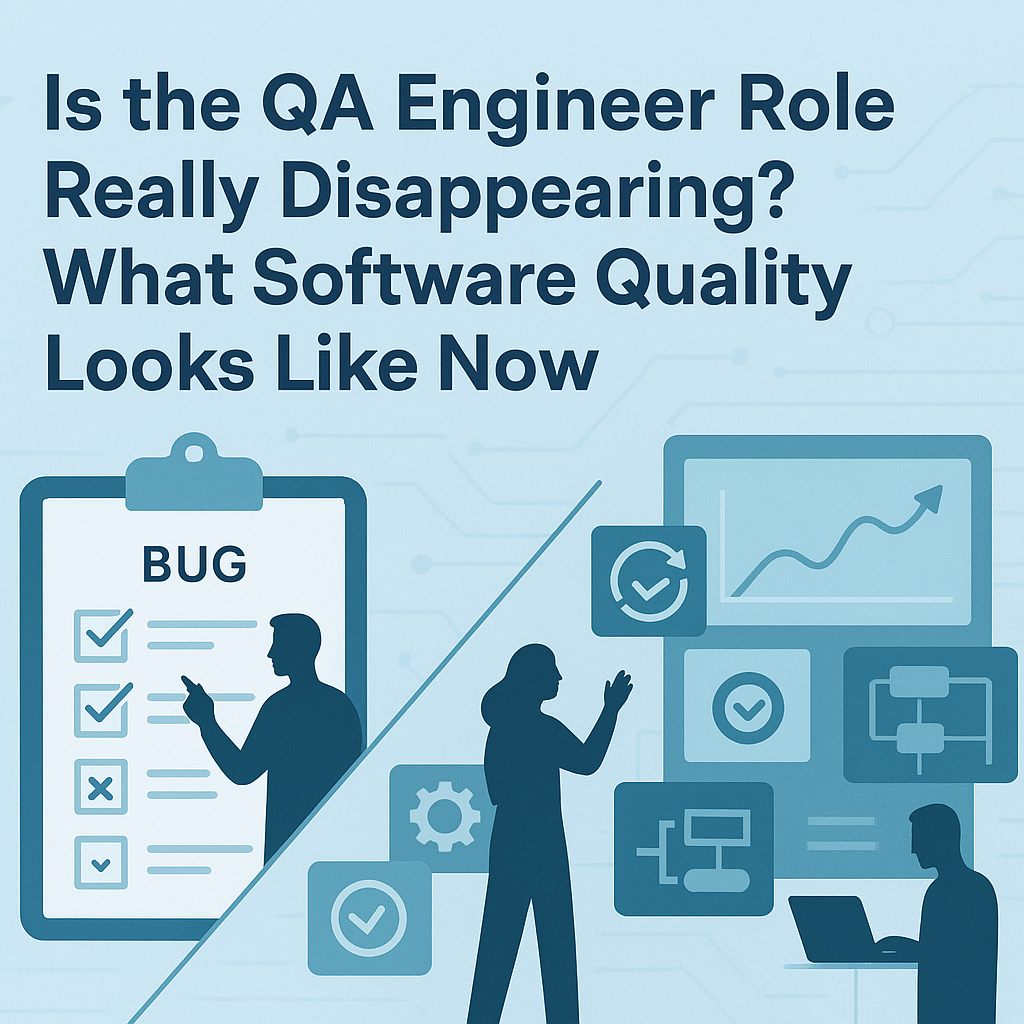
Software quality assurance is the work of preventing defects and checking that software behaves as intended, from a single function to a full service under heavy use. I’m Ermenildo Valdez Castro, Jr., and after years in software engineering, my view is plain: QA is changing, not vanishing. The useful question is who owns each kind of quality work.
The argument about whether QA is dead tends to turn a practical staffing change into a loud yes-or-no debate. That debate misses the daily work: somebody has to decide what good behavior means, find gaps in the checks, and keep the release process trustworthy. A team can distribute those duties, but it cannot make them disappear.
In my engineering work, I’ve watched teams move tests earlier in development and get useful results. I’ve also watched teams treat that change as permission to delete QA roles without assigning the work to anyone else. The first approach can reduce surprises. The second usually just makes the surprises arrive later, when fixes cost more and users feel the damage.
What Is Software QA?
Software testing is the act of checking software against an expectation. That might mean confirming that a function returns the right value, that a payment flow completes, or that a service stays responsive when many people use it at once. Testing can be manual or automated, narrow or broad, planned or exploratory. Its purpose is to find useful evidence about behavior and risk.
Quality assurance, or QA, is wider. It includes testing, but also the processes that make defects less likely in the first place: clear requirements, code review, test design, release checks, monitoring, and learning from failures. The distinction matters even though many companies use QA and testing as if they mean the same thing. A role called QA engineer may mostly run manual test cases at one company; elsewhere, the same title may mean designing test frameworks and advising teams on risk.
The main testing types fit together. Unit tests check small pieces, often functions, in isolation. Developers usually write them while changing that code. Integration tests check whether connected pieces work together, such as an application and its database. End-to-end (E2E) tests follow a full user path through the real application. Regression tests rerun checks after a change to catch unwanted breakage. Performance tests examine speed and stability under expected or peak load. Exploratory testing gives a person room to probe behavior that a fixed script may not anticipate.
These tests have different costs and strengths. A unit test is often quick and precise, but it cannot prove that a whole purchase flow works. An E2E test can cover that flow, but it may be slower and more fragile. Martin Fowler’s explanation of the test pyramid is useful here: favor a broad base of fast checks, then use fewer higher-level tests where they add real confidence. That is a guide, not a law carved into a server rack.
One complication is software that produces variable results. A traditional test often compares a known input with an exact expected output. But an AI feature may produce several acceptable responses to the same prompt. In that case, the team needs to test requirements such as factual grounding, safety, usefulness, and consistency—not pretend every output must be identical. The work still requires clear expectations. They just need to describe acceptable behavior rather than one frozen string.
Why Quality Work Still Matters
Quality work matters because software failures have real costs. A broken feature can waste a user’s time, expose private information, block someone from completing a task, or disrupt a business process. Testing is not a ritual for pleasing a dashboard. It is part of doing careful work for the people who depend on a product.
Here are the practical benefits I’ve seen when teams take the work seriously:
- Problems surface sooner. A unit test can catch a bad boundary condition while the code is fresh in the developer’s mind. Fixing it then is usually simpler than tracing it through a live system days later.
- Releases become less dependent on guesswork. A reliable CI pipeline runs automated checks on each proposed change. It does not prove that the release is perfect, but it gives the team a repeatable baseline before deployment.
- Users experience fewer avoidable failures. Regression checks can catch a change that breaks an older workflow, especially one that is easy for developers to overlook because they do not use it every day.
- Teams learn where risk lives. Exploratory testing can reveal confusing labels, awkward sequences, or unexpected behavior that a test script never specified. People notice things that a tidy list of assertions can miss.
- Time spent on flaky tests falls. A test that fails for no real product defect trains people to ignore failures. Reducing that noise helps teams take genuine signals seriously.
- AI-assisted coding stays accountable. Code written with an assistant still enters a real product and affects real users. The team that ships it owns the consequences, whether a person typed every line or not.
I remember chasing an intermittent failure in a CI run that passed on a developer’s machine. The feature code was not the problem; the test depended on shared state left behind by another run. The fix was not a bigger test suite. It was isolating the test and making its setup explicit. That small repair made the pipeline more trustworthy for everyone.
Frankly, counting tests is not enough. A suite that executes thousands of assertions can still miss the one behavior that matters most to a customer. Quality is the combination of good questions, useful checks, clear ownership, and a willingness to act when the evidence looks bad. That is also a matter of stewardship: engineering teams are responsible for how their work affects others.
How to Build a Modern Testing Approach
A useful testing plan does not begin with a tool purchase or a target like 90 percent coverage. It begins with the people and behaviors at risk. These steps offer a practical way to shape the work.
- Describe important user outcomes. Write down what must work, who depends on it, and what failure would mean. For a payment service, that could include charging the right amount, avoiding duplicate charges, and showing a clear result when a bank rejects a request. Keep the language concrete. A vague requirement produces vague tests.
- Assign ownership before work starts. Developers should generally create and maintain unit and integration tests for the code they change. Quality engineers can help identify risk, establish test patterns, build shared automation, and challenge assumptions. Product and design partners should clarify intended user behavior. Shared responsibility only works when each task has a named owner.
- Choose a sensible mix of test levels. Use fast unit checks for logic, integration tests for important boundaries, and a smaller number of E2E tests for key user journeys. Add performance or security testing when the risk calls for it. Microsoft’s unit-testing best practices offer practical advice on keeping unit tests focused and maintainable. The exact tools vary; the aim is dependable evidence, not fashionable tooling.
- Run checks as part of normal development. Put useful tests in the CI pipeline so changes receive feedback before release. Start with checks that finish quickly, and make slower suites available at appropriate stages. A pipeline that takes so long that people bypass it is not a quality system. It is a warning sign.
- Reserve time for human exploration. Give testers space to try unusual sequences, look for unclear feedback, and examine edge cases that were not listed in the ticket. A scripted test checks what somebody already thought to check. Exploratory work asks what the team might have missed.
- Use AI carefully, and review its work. AI tools can draft unit tests, create E2E scripts, group similar bug reports, or suggest fixes for a selector that changed. Treat their output as a first draft. Check that the test could fail when the behavior is wrong, that its assertions match a real requirement, and that the generated code is safe to maintain. A test that only repeats the implementation’s assumptions may give a false sense of safety.
- Measure outcomes and improve the weakest link. Track defects that reach production, the time needed to detect and resolve issues, flaky test rates, and pipeline duration. Test coverage can show which code ran during a suite, but not whether the assertions would catch a meaningful defect. Review failures with the team and fix the cause, not just the symptom.
The sequence matters. In one project, I saw a team try to fix slow releases by adding more E2E tests. The suite got bigger, the pipeline got slower, and the team still had gaps in basic input validation. They improved things only after they looked at user risks and moved simple checks closer to the code. Here’s the kicker: test strategy is a design choice, not a pile of test scripts.

Comparison: Dedicated QA Engineering and Developer-Owned Testing
These models are not true competitors. A healthy organization usually uses both, though the split changes with the product, team size, and cost of failure. The table compares the main emphasis of each model; it is not a scorecard for deciding which job title to remove.
| Area | Dedicated QA or quality engineering | Developer-owned testing |
|---|
| Main focus | Shared test infrastructure, risk analysis, E2E suites, exploratory testing, and quality practices across teams | Unit and integration checks close to the code being changed |
| Best strength | Sees cross-feature behavior and can build patterns that many teams reuse | Fast feedback from people who understand the implementation details |
| Common blind spot | Can become a late-stage handoff if brought in only before release | Can miss user problems or wider system effects when the team tests only its own code |
| Typical ownership | Test frameworks, test environments, release confidence, and coaching | Tests for logic, interfaces, and behavior introduced by a code change |
| Useful signal | Defect trends, E2E reliability, exploratory findings, and test-system health | Meaningful assertions, fast feedback, and fewer regressions in changed code |
| Failure mode | A separate queue that blocks delivery and leaves developers detached from quality | Testing work gets squeezed out when schedules tighten or ownership is unclear |
Shift-left testing moves checks earlier; it does not mean every form of testing belongs to the developer who wrote the feature. Google’s Testing Blog has argued against simply adding more end-to-end tests, a useful reminder that test quantity and test value are different things. Read its discussion of E2E testing alongside the test pyramid, then choose the mix that fits the risks your users face.
The stronger arrangement is usually a partnership. Developers write tests for their changes and respond to failures. Quality engineers make it easier to test well across the system, find holes in user journeys, and bring a fresh pair of eyes to risky releases. Let’s be real: if a company removes a role but leaves its work undone, it has not improved quality. It has only changed the org chart.
Common Mistakes to Avoid
A testing process can look busy and still provide weak protection. These mistakes are common because each one feels like a shortcut at first.
- Treating coverage as a quality score. Coverage tells you what code the tests executed, not whether the tests checked the right behavior. A test can run every line and still assert almost nothing. Look at the conditions tested and ask whether a realistic defect would make the test fail.
- Building too many brittle E2E tests. A large browser suite may break when an interface changes for harmless reasons. Keep E2E checks for important user journeys and test lower-level details at faster, more stable layers. Repair flaky checks instead of teaching the team to rerun them until they pass.
- Calling manual testing obsolete. People are good at noticing confusing language, odd flows, and behavior that feels wrong even if it matches a narrow specification. Automation is valuable, but it checks the questions someone encoded. It cannot reliably invent every question worth asking.
- Making QA a final handoff. When developers finish a feature and toss it over a wall, feedback arrives late and context gets lost. Involve quality engineering early enough to improve the test design, not just approve a release after the main decisions are settled.
- Accepting AI-generated tests without review. A plausible test can still be shallow, redundant, or wrong. Check its expected result, its assertions, and whether it catches the bug it claims to address. AI is useful for speed; it is not a substitute for judgment.
- Ignoring flaky-test costs. Intermittent failures slow delivery and wear down trust. Track the rate, isolate the cause, and remove or repair checks that cannot provide stable evidence. A red build should mean something.
- Rewarding activity instead of results. Raw numbers of test cases or bugs filed can encourage busywork. Better questions include whether users encounter fewer serious failures, whether teams find defects sooner, and whether developers can understand a failed check without a detective story.
I’ve seen teams adopt advice like add tests everywhere and assume the details will work themselves out. They don’t. The right test is one that checks an important behavior at a useful level and gives a clear result. The NIST AI Risk Management Framework is relevant when AI is part of the product: it emphasizes identifying and managing risks across a system’s life, rather than treating one test run as a complete safety check.
Frequently Asked Questions
Is the QA engineer role disappearing as developers write more tests?
The role is changing more than disappearing. Developers increasingly own unit and integration tests for the code they write. Dedicated QA and quality engineering roles are shifting toward test infrastructure, automation strategy, E2E coverage, risk analysis, and exploratory testing. Some organizations may not need a separate QA team, but they still need people to do that work. If a job is removed, its responsibilities should be assigned clearly rather than quietly dropped.
Does more AI-generated code mean more bugs in production?
Not automatically. The outcome depends on review, test quality, deployment controls, and how quickly the team responds to failures. AI coding tools can increase the volume and speed of changes, which puts more pressure on review and CI. Teams that keep those safeguards meaningful can manage the pace; teams that let checks fall behind may ship defects faster. AI-generated code still belongs to the team that releases it.
What is the difference between test coverage and test quality?
Coverage measures how much code ran during automated tests. It does not tell you whether the tests would detect a real defect. Test quality is about whether the checks verify important behavior, use strong assertions, and produce trustworthy results. A high coverage percentage may still hide gaps. Pair it with defect escape rate, flaky-test rate, and evidence from exploratory testing.
What does shift-left testing mean?
Shift-left testing means moving testing earlier in development. Developers might write and run unit tests while implementing a change, and a team might discuss risk before work is complete instead of waiting for a separate release phase. Earlier feedback often makes defects easier to fix. It does not eliminate later testing, system checks, or human exploration; it brings useful checks forward.
Can AI tools fully automate software testing?
Not for most real products. AI tools can draft tests, create scripts, help maintain UI checks, and group bug reports. Human review is still needed to decide whether a generated test checks meaningful behavior and whether the result matches the product’s responsibilities. For AI features that return variable outputs, teams also need to define acceptable outcomes and evaluate risks over many cases. Automation can do more of the work, but people still set priorities and make the final judgment.
Final Thought
QA is not a department name or a final box to tick. It is the practical work of deciding what matters, checking whether the software does it, and responding honestly when it does not. Modern teams distribute that work across developers, quality engineers, product partners, and operations. The distribution can change. Accountability should not.
If you are deciding what to do next, start small. Pick one important user journey, identify what could go wrong, and check whether your current tests would catch it. Then look at your CI failures and ask whether people trust them. Those answers will tell you more than a fashionable target for test coverage or a claim that AI has made testing effortless.
In my experience, the best quality practice is the one a team can sustain and explain. It respects the user’s time, the engineer’s craft, and the real consequences of mistakes. I’m Ernie Castro, and I’d rather see a modest, reliable test suite with clear owners than a mountain of scripts nobody trusts.