Architectural decisions fail when they are trapped in memory, Slack threads, or half-finished wiki pages. Lightweight ADRs, plus good advice forums, keep the...
How Lightweight ADRs and Architectural Advice Forums Support Better Architectural Decisions
Architectural decisions fail when they are trapped in memory, Slack threads, or half-finished wiki pages. Lightweight ADRs, plus good advice forums, keep the reason in view, the trade-offs plain, and the team honest. I’m Ermenildo Valdez Castro, Jr., and I’ve seen more bad systems grow from vague choices than from hard code.
Key Takeaways- Lightweight ADRs record why a choice was made, not just what was picked.
- Architectural advice forums give teams a place to test ideas before they harden.
- Short records beat perfect records when teams need speed and clarity.
- Good decision habits protect users, budgets, and the dignity of the work.
What is Lightweight ADRs and Architectural Advice Forums?
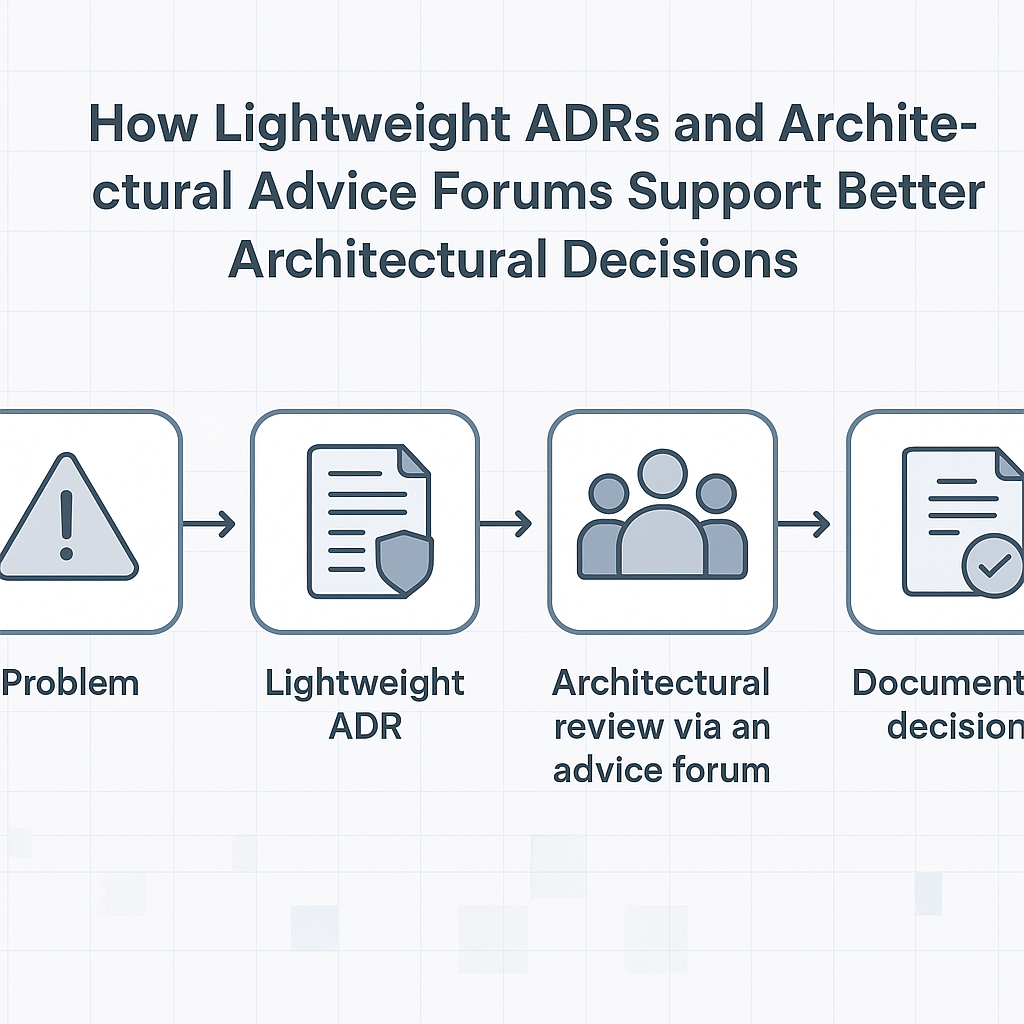
Lightweight ADRs are short, written notes that explain an architectural decision, the options considered, and the reason one choice won. Architectural advice forums are structured places, like design review groups or internal Q&A spaces, where engineers ask for input before they commit. That’s the plain version. No ceremony. No fancy fog.
The idea is simple, but the effect is strong. When I worked on large systems at Microsoft and later at Amazon, I saw the same mess again and again: a team would choose a queue, a database, or an API style, and three months later nobody could remember why. The code stayed. The reason vanished. That is how teams repeat the same mistakes.
A lightweight ADR fixes that by keeping the record short enough that people will actually write it. Martin Fowler has written about ADRs for years, and the point still holds: a decision log should be useful, not noble. You can read a good summary in places like the Martin Fowler ADR article and the ADR GitHub site. A forum adds another layer. It gives people a place to say, “Wait, have you thought about failure mode, cost, or team skill?” before the choice becomes painful.
Here’s the kicker. These tools are not about slowing teams down. They are about stopping stupid speed. Fast bad choices are still bad choices.
A forum can be as simple as a monthly architecture roundtable, a shared doc, or a GitHub discussion board. I’ve used all three. The format matters less than the habit. If the team can ask questions early, then the architecture grows with fewer cracks. That is good stewardship. It respects the work, the users, and the people who will maintain the mess later.
Core Benefits and Why They Matter
The payoff is practical.
1. Better memory for decisions
Teams forget. That is not a moral failure; it is just life. People move roles, get pulled into incidents, or leave the company. A short ADR keeps the record near the code, where it belongs. I’ve watched teams waste days debating old calls because nobody wrote the reason down. That hurts.
2. Faster alignment
A forum cuts down on private guesses. When engineers, product folks, and security reviewers can ask questions in one place, the answer gets sharper. In my Zulily days, I saw good ideas die because they were discussed in five side channels and never in the same room. A shared forum reduces that drift.
3. Cleaner trade-offs
Most architecture work is trade-offs, not magic. You pick latency over simplicity, or cost over scale, or speed over long-term neatness. A lightweight ADR makes the trade visible. That matters because hidden trade-offs become surprise bills later.
4. Lower risk in large systems
At Google and Amazon, I saw how small choices could snowball in big systems. A database table design, a retry policy, or an auth model can turn into a fire drill if the team lacks a paper trail. That paper trail is not bureaucracy. It is risk control.
5. Better onboarding
New engineers need context. Not slogans. Not “we always do it this way.” They need to see the reasoning behind a service split, a cache layer, or an event stream. ADRs are a map for the next person who joins the team.
6. More honest disagreement
Good forums make room for dissent without drama. I like that. The truth is, healthy disagreement is a gift. It prevents groupthink. In a Catholic sense, it treats each person as more than a mouth to be quieted; it respects conscience and judgment.
7. Less waste
Bad architecture wastes money, time, and energy. That may sound blunt, but it’s true. A small habit of writing and reviewing decisions saves days of rework later. Frankly, that is one of the best returns a team can get.
For readers who want a deeper look at decision habits, I’d also point to related writing on software engineering decision practices, supply chain security in development tools, and AI agent permission control. Those topics all touch the same nerve: choices made early shape damage later.
Step-by-Step Guide to Using ADRs and Advice Forums
This part should be boring. That is good.
1. Start with one decision
Do not build a grand system. Pick one real choice, like “Should this service use PostgreSQL or DynamoDB?” Write the question down. Keep it narrow.
2. Use a short template
I like this structure:
- Title
- Status
- Context
- Decision
- Options considered
- Consequences
That’s enough. No need for a twenty-page essay. The best ADRs fit on one page. When I led reviews, the ones people actually read were the short ones.
3. Put it near the code
Store ADRs in the repo. Not in a dusty folder that nobody opens. Put them where engineers already look. Git history is a fine home because it keeps the record tied to the change.
4. Create a small advice forum
You do not need a committee empire. Start with a weekly or biweekly review slot, a Slack channel with rules, or a GitHub discussion thread. The point is to ask: what am I missing? What cost am I ignoring? What happens under failure?
5. Ask for the right kinds of feedback
Do not ask vague questions like, “Thoughts?” That gets mush. Ask specific ones:
- Is the failure mode safe?
- Is the team ready to own this?
- Is the rollback simple?
- What breaks at 10x traffic?
- What is the maintenance cost?
6. Record the outcome
If the team changes the plan, update the ADR. If the choice stands, say why. I’ve seen too many review notes vanish after the meeting. That is sloppy. A decision without a record is just noise.
7. Revisit on a schedule
Some choices age well. Others rot. Mark review points for risky systems, especially security, auth, data storage, and third-party services. Microsoft’s own work on security-aware release practices shows why even small delays or checks can matter, like the Microsoft Tech Community coverage on extension safety and supply chain risk.
8. Keep the tone plain
Write like a human. Say what you mean. If the reason is cost, say cost. If the reason is staffing, say staffing. If the reason is reliability, say reliability. People respect plain speech.

Comparison Table: Lightweight ADRs vs. Big Governance Docs
| Feature | Lightweight ADRs + Advice Forums | Big Governance Docs |
|---|
| Length | Short, usually one page | Long, often many pages |
| Speed | Fast to write and review | Slow and heavy |
| Use | Captures one decision well | Tries to cover everything |
| Team Adoption | High, because it is easy | Low, because it feels like chores |
| Clarity | Clear trade-offs and reasons | Often buried in prose |
| Maintenance | Simple to update | Easy to abandon |
| Best For | Product teams, platform teams, startup and enterprise systems | Formal audits and high-control settings |
| Weakness | Can become too brief if careless | Can become stale and unread |
The point is not that big docs are useless. They are not. Some settings need them. But most engineering teams do not need a thick binder for every choice. They need a clear note that says, “We chose this, because of these facts, and we will revisit it if X changes.” That is the real value.
When I was at Google, I learned that precision matters, but so does friction. If a process is too heavy, people skip it. If it is too loose, people ignore it. Lightweight ADRs hit the middle. That middle is rare. It works because it fits how engineers actually behave.
Common Mistakes to Avoid
Most advice about architecture sounds wise and then falls apart in real teams.
1. Writing novels
Long ADRs are often a sign that nobody trusts the format. If it takes half a day to write one, people stop. Keep it sharp. Keep it small. The detail should serve the decision, not hide it.
2. Treating the forum like a debate club
A good advice forum is not a stage for clever people to win points. It is a place to surface risk. I’ve seen teams waste an hour arguing style when they should have asked about failure. That is a bad use of everyone’s time.
3. Letting the loudest voice win
Here’s the truth: seniority can crush better thinking if no one checks it. A junior engineer may spot a flaw that everyone else missed. Good forums protect that voice. That matches a simple moral rule: work should serve people, not ego.
4. Skipping the why
A decision log that only says “Use Redis” is useless later. Why Redis? Why not a local cache? Why not a managed queue? The reason is the thing that saves you later.
5. Not revisiting old calls
Some teams write ADRs and then freeze them like museum pieces. Bad idea. If the facts change, the decision may need to change too. Cost, load, security rules, and staff skill all shift over time.
6. Making it a compliance ritual
If the team writes ADRs only to satisfy some process check, the work turns fake. People can smell that from a mile away. I’m skeptical of any system that prizes paperwork over judgment. Good architecture is a habit of care, not a checkbox.
7. Ignoring human limits
I’ve seen companies expect perfect memory and perfect communication from tired people. That is nonsense. People get busy. Incidents happen. Tools fail. A simple record helps ordinary humans do solid work. That is why the dignity of labor matters in software too.
For more on how teams handle system risk and failure, the AWS Builders’ Library is a strong source, and the Martin Fowler site has good writing on system design habits. If you want the security angle, the NIST site is worth your time.
Frequently Asked Questions
What is the main purpose of an ADR?
The main purpose is to record an architectural decision, the options considered, and the reason for the final choice. That makes it easier for teams to remember, review, and revise the call later.
How long should a lightweight ADR be?
Short. Usually one page or less. It should be enough to explain the decision without turning into a report that nobody reads.
What is an architectural advice forum?
It is a place where engineers and other stakeholders can review ideas before they become fixed. It can be a meeting, a discussion channel, or a review doc. The format matters less than the habit.
When should a team revisit an ADR?
Revisit it when the facts change: traffic grows, costs shift, a security issue appears, or the team learns the old choice no longer fits. Good records are living records.
Final Thought
The best architecture work is humble. It admits that people forget, systems drift, and good intentions need a paper trail. I have seen that truth from Seattle to the big tech shops, and I keep coming back to it because it respects both the machine and the people who keep it alive. Ernie Castro would say the same thing in plainer words: write the reason down, tell the truth early, and leave the next engineer a fair chance.
That is not flashy. Fine.
It is better than flashy.