Developer News Roundup: Eight Changes Shaping Software Teams
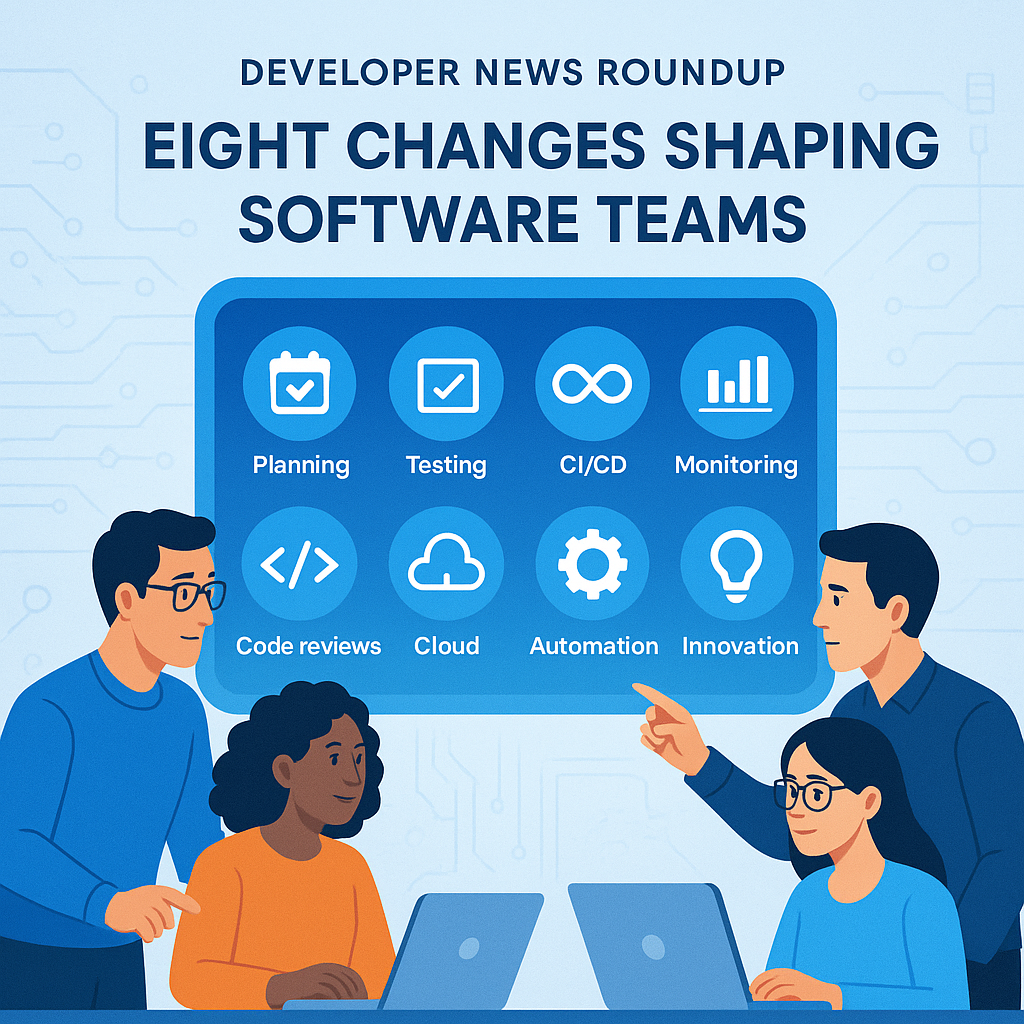
Eight developer headlines point to one practical theme: software teams are trying to make complex systems safer and easier to operate. The October 19–20 roundup covers GitHub Actions Runner Controller, Java, data platforms, AI tools, CI security, .NET, and NestJS. The details differ, but reliability, control, and maintainability connect them.
The list includes eight distinct items: a new ARC release, a Java news roundup, Pinterest’s use of event-time watermarks, a reported JEP 543 milestone, a multimodal EmbeddingGemma update, Buildkite security and agentic CI features, .NET 11 Release Candidate 2, and NestJS 12. I’m reading these as signals, not as proof that every feature is ready for every production system. That distinction matters. A headline can tell you what changed; it cannot tell you whether your workload, security model, and team are prepared to adopt it.
What Is This Developer News Roundup?
This is a snapshot of software engineering news spanning infrastructure, languages, developer tools, and application frameworks. It is not one product release or one vendor’s roadmap. The value comes from looking across the announcements and asking what practical problem each one appears to address. The supplied headlines suggest a familiar set of concerns: running jobs reliably, handling concurrency, processing data by event time, protecting credentials, and making modern application frameworks easier to use.
The first item concerns GitHub Actions Runner Controller (ARC), which manages self-hosted GitHub Actions runners in Kubernetes. The version headline says 0.15.0 targets reliability at scale. That gives teams a reason to inspect the release notes, but it does not establish that the update fixes a particular outage or fits every cluster. ARC is operational software. Its behavior depends on Kubernetes, runner configuration, network access, and the workloads it serves. GitHub’s ARC repository and documentation are the place to verify what the release actually changes.
The Java items cover several layers. JDK 28 proposals and the Structured Concurrency headline concern the platform and language ecosystem. Gatherers4j, Google ADK, Yupiik, and Apache Camel CVEs point toward libraries, agent development, and security maintenance. They should not be treated as a single Java feature. Each has a different owner, maturity level, and adoption path.
Other stories widen the picture. Pinterest’s watermarks headline concerns large-scale data processing; EmbeddingGemma’s expanded input types concern model capabilities; Buildkite’s scoped secrets and agentic CI tools concern pipeline operation; .NET 11 RC2 and NestJS 12 concern framework and runtime changes. Across teams I’ve worked with, these categories meet in one place: a production system must be dependable, understandable, and safe to change. A new feature is useful only when its failure modes are also clear.
Why These Headlines Matter to Engineering Teams
A release announcement matters when it changes the cost or risk of doing real work. The headlines here are worth watching because they touch important parts of a software delivery chain, from a developer’s local code to build infrastructure, data processing, and production services. That does not mean every team should adopt every tool. Frankly, a team that upgrades without a reason can create work rather than remove it.
- Runner reliability affects delivery. If CI jobs wait, fail, or run inconsistently, developers lose time and release schedules become harder to trust. Updates to ARC may matter to teams that operate runners in Kubernetes, especially where jobs start and stop often or cluster capacity changes. Check the release notes and test against your own queue patterns before assuming a new version solves your specific problem.
- Concurrency changes how code is structured. Structured Concurrency aims to make related tasks easier to manage as a group. That can help developers reason about task lifetimes and errors. The JEP page explains the proposal’s status and scope; consult JEP 543 rather than inferring final behavior from a headline. Java proposals can change during their development, so status is not a footnote.
- Event time is different from processing time. Data can arrive late or out of order. Watermarks help a streaming system decide when it has probably seen enough events to close a time window. Pinterest’s petabyte-scale headline signals the operational challenge, not a recipe any smaller team should copy. A good design balances completeness, delay, storage, and the cost of reopening old partitions.
- Secrets need narrow access. Buildkite’s scoped-secrets headline highlights a basic security principle: a job should receive only the credentials it needs, for only as long as it needs them. That reduces exposure if a build step or plugin behaves badly. New CI features still require careful permissions, audit logs, and safe handling of secret output.
- AI tools raise practical questions. An embedding model that accepts code, images, video, and audio may support new search or analysis workflows. An agent development kit may make tool-connected applications easier to build. Neither headline guarantees accuracy, privacy, or dependable output. Teams need a clear use case and a way to check results.
- Framework releases carry maintenance costs. .NET 11 RC2 and NestJS 12 give developers changes to evaluate, but an upgrade also touches packages, deployment images, tests, and support windows. The .NET 11 overview is a useful starting point for official details. Review release documentation before planning a migration.
I’ve seen teams spend more time celebrating an announcement than checking whether it solves an actual pain point. The better question is plain: what becomes safer, faster, or easier to understand if we adopt this? Work has dignity; so does the time of the people maintaining the system. Tools should serve that work, not create a parade of upgrades with no clear benefit.
A Step-by-Step Way to Evaluate the Announcements
A news roundup is a shortlist for investigation, not an upgrade order. I use a small review process to separate interesting news from changes that deserve engineering time. It is not glamorous. That is the point: most adoption failures begin with skipping simple checks.
- Match the headline to a real problem. Write down the issue in plain language: CI jobs are slow, secrets are too widely shared, a streaming window closes too early, or a framework dependency is nearing the end of support. If you cannot name the problem, keep the item on a watchlist instead of opening a migration ticket. “It is new” is not a business requirement.
- Find the primary source. Use the project’s release notes, documentation, advisory, or proposal page. For example, check the ARC repository for 0.15.0 details, the OpenJDK JEP page for status, and the Google ADK documentation for the kit’s intended use. Secondary coverage can help explain context, but primary sources settle version numbers, supported platforms, and known limitations.
- Check maturity and support. A release candidate is not the same thing as a final release. A proposal is not automatically a permanent language feature. A library may be experimental, narrowly maintained, or dependent on another package. Record whether the item is a preview, candidate, stable release, security advisory, or roadmap statement. Then check how your organization handles non-final software.
- Map dependencies and permissions. For runner controllers, inspect Kubernetes versions, controller configuration, runner images, and required permissions. For CI secret features, map which workflows can read which values. For model or agent tools, identify the data sent to the service and the actions an agent can take. For Java, .NET, or NestJS upgrades, list runtime versions, libraries, build tools, and deployment targets. Here’s the kicker: hidden dependencies often matter more than the headline feature.
- Try a narrow test. Build a small proof of concept using a non-production workload. Measure what matters before and after: queue time, failure rate, resource use, processing delay, build permissions, or test coverage. For a data watermark change, include late and duplicated events. For a concurrency change, test cancellation and error handling. For an AI feature, test expected inputs and awkward edge cases, not just a polished demo.
- Write down a rollback plan. Know how to return to the old runner image, dependency version, or pipeline configuration. Make sure a secret change does not strand a deployment, and that a data migration does not make older partitions unreadable. A test that has no safe exit is not a responsible test.
- Share the result with the people who operate it. Summarize the change, risk, measured benefit, and owner. Ask the on-call engineer and the security reviewer to look for gaps. I learned the hard way that a neat prototype can hide a rough handoff. The team that inherits a system deserves clear notes, not a mystery box.
Comparison Table: ARC and Buildkite Agents
The list’s strongest direct comparison is CI runner infrastructure. ARC and Buildkite agents can both run build work on infrastructure a team controls, but they belong to different CI ecosystems. They are not identical products, and the right choice depends on where your pipelines already live. The table describes their broad roles; verify current features in each project’s documentation before making a purchase or migration decision.
| Area | GitHub Actions Runner Controller (ARC) | Buildkite agents |
|---|
| Main context | Self-hosted runners for GitHub Actions, managed with Kubernetes | Agents that run Buildkite jobs on infrastructure you provide |
| Best fit | Teams already using GitHub Actions and operating Kubernetes | Teams using Buildkite that want control over agent placement and capacity |
| Operations to plan | Kubernetes upgrades, controller configuration, runner images, scaling, and job isolation | Agent installation, queues, infrastructure capacity, permissions, and agent maintenance |
| Security focus | Limit runner and cluster permissions; isolate untrusted workflows; protect credentials | Limit agent and pipeline access; scope secrets; review plugins and job permissions |
| Comparison question | Does Kubernetes-based runner management fit the team’s platform skills? | Does Buildkite fit the pipeline workflow and agent model the team needs? |
| Main caution | Kubernetes complexity can outweigh the benefit for a small or simple CI setup | Self-managed agents still need patching, monitoring, and capacity planning |
A practical comparison starts with your current delivery system, not a feature checklist. If all workflows already live in GitHub Actions and the team runs Kubernetes well, ARC may be a reasonable option to evaluate. If the organization uses Buildkite and has established agent operations, switching platforms just to chase a headline may be needless churn. I have watched teams underestimate the human cost of maintaining two CI systems. The bill shows up in duplicated permissions, different debugging steps, and confusing ownership—not just cloud charges.
Common Mistakes to Avoid
Mistake one: treating a headline as a full release note. News titles compress details. “Targets reliability at scale” does not tell you which limits changed, what bugs were fixed, or how to configure the software. “Finalizes” may have a precise project meaning, but you still need the official proposal and release context. Verify dates, support status, and version numbers before writing internal plans.
Mistake two: confusing a proposal, preview, and stable release. Java development uses formal proposals and staged delivery. A JEP title alone does not prove a feature is available in the JDK version your applications run. Likewise, a release candidate is meant for evaluation and feedback; it should not be casually treated as a finished production release. Track the project’s status page and test your own compatibility needs.
Mistake three: copying a large-scale architecture without the large-scale problem. Petabyte-scale partition management is an interesting engineering story. It does not mean a small analytics pipeline needs the same machinery. The right design depends on data arrival patterns, lateness, retention, query behavior, and the cost of corrections. Keep the useful principle—account for event time—without importing unnecessary complexity.
Mistake four: trusting AI output because the input types expanded. Support for images, audio, video, or code can open useful possibilities, but the model can still misread an input or return a confident mistake. Keep a human review step for high-impact decisions. Decide what data may be sent, how long it is kept, and whether the output is stored or used to train another system. Technology should respect the people whose information it processes.
Mistake five: calling scoped secrets “secure” and stopping there. Scope helps, but it does not fix unsafe logs, overpowered build steps, compromised dependencies, or exposed runner hosts. Review permissions from source to deployment. Rotate credentials, audit access, and test whether a job can read secrets from workflows that should not have them.
Mistake six: upgrading frameworks without a migration plan. A runtime or framework change can alter package compatibility, build behavior, diagnostics, and deployment requirements. Start with the official upgrade guide, run unit and integration tests, and check production-like workloads. I prefer a small, reversible upgrade to a giant weekend migration. That is not timid; it is basic care for the people who depend on the service.
Mistake seven: measuring adoption by activity. A prototype, a demo, or a new configuration file is not a result. Define a measure before you start. If CI reliability is the goal, compare failed jobs and time spent rerunning them. If faster data finalization is the goal, track delay and correction rates. If an agent saves time, measure the work it completes and the review it still requires. Most advice says “move fast.” My experience says move with evidence.
Frequently Asked Questions
What is GitHub Actions Runner Controller?
GitHub Actions Runner Controller is a Kubernetes-based system for managing self-hosted GitHub Actions runners. Teams can use it to operate runner capacity in a Kubernetes environment, but they must also manage the controller, cluster permissions, runner images, and workload isolation. The supplied headline identifies version 0.15.0 as focused on reliability at scale. Check the project’s release notes to learn exactly what changed and whether it fits your deployment.
What do event-time watermarks do?
A watermark gives a stream-processing system an estimate of how far event time has progressed. Events may arrive late or out of order, so the watermark helps a system decide when to finalize a time window or partition. The decision involves trade-offs: waiting longer can include more late data, while closing earlier can reduce delay and resource use. The right policy depends on the data and the cost of correcting results.
Should teams adopt a release candidate such as .NET 11 RC2?
A release candidate is useful for compatibility testing, finding bugs, and preparing an upgrade. It is not automatically the right version for a production deployment. Check the official support terms, release notes, dependencies, and internal policy. Teams that build libraries or maintain platform tooling may have a good reason to test early; teams with no upgrade need can wait for a final release and a clearer support window.
How should a team evaluate AI developer tools?
Start with one narrow task and test it with representative inputs, including difficult cases. Review the tool’s data handling, access controls, output quality, and failure behavior. Keep people responsible for decisions that affect customers, employees, or sensitive records. Compare the time saved with the time spent checking and correcting results. A tool that produces more output is not necessarily a tool that produces more useful work.
Final Thought
These headlines are worth reading because they show where engineering work keeps getting harder: more services, more data, more automation, and more choices about who or what can access a system. Yet the answer is not to install every new thing. A solid team asks what problem it is solving, checks the evidence, tests in a small space, and gives someone clear responsibility for operating the result.
When I look at a technology announcement, I try to separate curiosity from commitment. Curiosity is cheap: read the release note, ask a useful question, and learn what the tool can do. Commitment costs time, training, and risk. That deserves a careful case. The same rule applies whether the subject is a Kubernetes runner controller, a Java proposal, an AI kit, a data watermark, or a new framework release.
Good engineering is also a form of stewardship. People entrust teams with their data, their work, and sometimes their livelihoods. Treating that trust seriously means choosing tools with care, fixing unsafe defaults, documenting systems, and leaving the next person a path they can understand. That may not make the flashiest headline. It makes software more worthy of the people who rely on it.