AWS Graviton5 is now generally available, and that matters because it brings 192 CPU cores to a single instance while adding formally verified VM isolation. In...
AWS Graviton5 GA: 192 Cores, Stronger VM Isolation, and Why It Matters
AWS Graviton5 is now generally available, and that matters because it brings 192 CPU cores to a single instance while adding formally verified VM isolation. In plain terms, you get more compute per server and a stronger case for tenant separation. I’m Ernie Castro, and I’ve seen enough cloud claims to know the real question is not hype. It is whether the metal, the hypervisor, and the workload all behave under pressure.
Key Takeaways- Graviton5 pushes AWS ARM-based compute further with 192 cores.
- Formally verified VM isolation is the serious part, not the marketing gloss.
- Many workloads can cut cost and power use if they fit ARM.
- The best results come from testing, not faith.
- Security, efficiency, and fair stewardship of resources all point the same way.
What is AWS Graviton5?
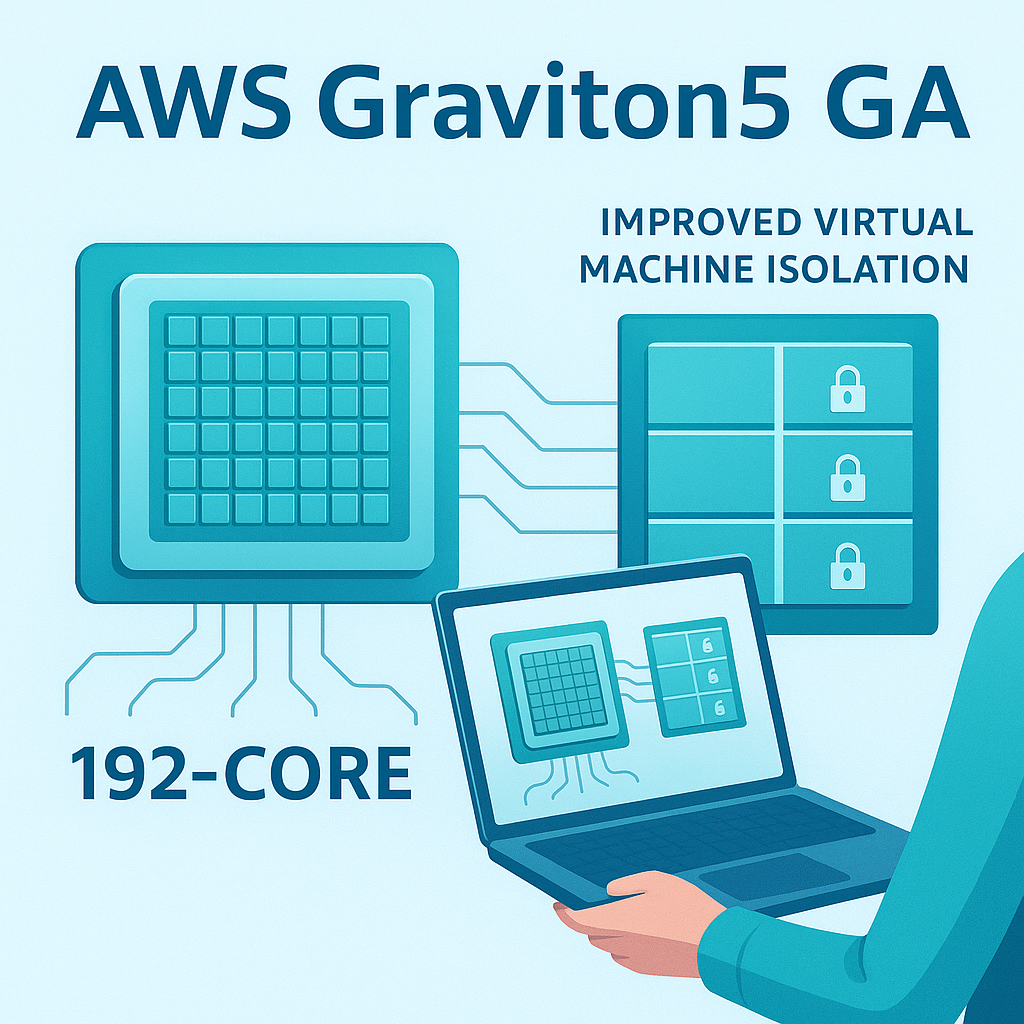
AWS Graviton5 is the newest family of ARM-based processors from Amazon Web Services for EC2 instances. It is built for cloud workloads that need a lot of CPU, strong efficiency, and solid isolation between virtual machines. The 192-core figure is the headline, but the deeper change is the security model. AWS says the VM isolation has been formally verified, which means the design was checked with rigorous methods, not just tested by feel. That is worth attention.
I have watched cloud teams chase bigger machines like kids chasing a shiny ball. They buy more CPU, then find the bottleneck sitting in memory, storage, or one ugly library call. Frankly, that happens all the time. When I worked at Google and later at Amazon, I learned the same dull lesson in different clothes: raw size means little if the system is sloppy. Graviton5 is interesting because it is not only about size. It is also about control.
AWS positions Graviton as part of a longer shift toward ARM in the data center, and that shift is no longer a side bet. It is real. It shows up in cloud economics, energy use, and the simple fact that many common workloads run well on ARM once the code is clean. For background on AWS’s own performance claims, see the official AWS Graviton page, and for the VM side, the security angle lines up with AWS News Blog coverage on new instance families.
The part people miss is trust. Cloud computing is built on shared machines, shared risk, and a lot of invisible fences. A strong VM boundary matters because it protects customers from bad neighbors and bad assumptions. In Catholic terms, stewardship is not just about saving money. It is about using resources with care, so the work of engineers serves people well and does not waste what they are given.
Core Benefits and Why It Matters
AWS Graviton5 matters for four plain reasons. It gives more compute, better density, better security claims, and often better cost efficiency for the right workloads. That is the short version.
- More CPU per instance. 192 cores is not pocket change. It lets teams pack more work into fewer servers, which can help batch jobs, analytics systems, and large scale services. I have seen teams spend weeks spreading work across too many tiny nodes when one larger machine would have been cleaner. Here, the math may finally work in the other direction.
- Better workload density. If your app can use the cores well, you can run fewer instances with less waste. That is useful for services with lots of parallel requests, build systems, test farms, and data processing pipelines. More density can mean less toil for ops teams too.
- Stronger isolation story. Formally verified VM isolation is the kind of phrase that makes security people sit up. Good. It should. Most ads talk about “secure by design,” but not many explain the proof method. Verification does not mean perfect, because nothing human-made is perfect. But it does mean the boundary got serious scrutiny.
- Possible lower cost and power use. ARM chips often do more work per watt than older server designs. I am careful here. You still need to benchmark your own stack. But for many services, especially those not stuck on x86-only dependencies, the savings can be real.
- A cleaner future path. Teams that move to Graviton families often get better habits: smaller images, clearer dependency lists, and less junk in the build. That is good engineering. It also fits a simple moral truth: do the work well, waste less, and keep the system honest.
When I worked at Microsoft and later at Zulily, I saw plenty of systems that were “fast enough” until traffic doubled and the cracks showed. Then everyone wanted miracles. No miracles. Just better planning. That is why the value of Graviton5 is not only raw speed. It is the chance to build saner systems before the pager starts screaming.
For teams studying ARM adoption, AWS’s broader documentation is worth reading alongside vendor claims. Start with Amazon EC2 docs, then compare real workload behavior against your current x86 fleet. Do not guess. Measure.
Step-by-Step Implementation Guide
Moving to Graviton5 should be treated like an engineering project, not a sales call. The mistake most teams make is rushing to benchmark one happy-path service and calling it done. That is weak. Better to plan it in steps.
- Inventory your workloads. List the services that can move first. Good candidates include stateless APIs, background workers, CI jobs, caches, and batch tasks. Bad candidates are the ones tied to weird native packages or old binaries you forgot existed.
- Check architecture support. Make sure your runtime, libraries, and container images support ARM64. For Java, Go, Python, Node.js, and many .NET workloads, this is usually fine. For some commercial software, not so much. Read the docs before you waste a sprint.
- Build multi-arch images. Use Docker Buildx or your CI system to publish both x86 and ARM images. That gives you a clean fallback and helps with gradual rollout. I have done this on teams where the first ARM build failed because one package assumed x86 flags. Of course it did.
- Benchmark real traffic. Synthetic tests are useful, but they can lie by omission. Run production-like traffic, the ugly stuff too. Measure latency, throughput, memory, boot time, and error rates. AWS’s instance type guide is useful, but your own data matters more.
- Check observability before launch. Add metrics for CPU saturation, memory pressure, GC time, and syscall behavior. If your dashboards are weak, fix them first. Otherwise you are flying blind and calling it strategy.
- Test security and isolation assumptions. Review your tenancy model, IAM rules, security groups, and encryption path. VM isolation helps, but it does not excuse sloppy controls. Good fences still need good gates.
- Roll out in slices. Move one service, then another. Watch for surprises in logs, throughput, and cost. If the first slice goes badly, stop. That is not failure. That is prudence.
- Document the lessons. Write down what worked, what broke, and what had to be patched. Teams forget fast. Bad memory is expensive.
I have found that the cleanest migrations are boring. That is a compliment. If everything feels dramatic, someone skipped a step. The best teams treat a CPU move the same way they treat a database change: carefully, with rollback, and with respect for the people who will be paged if it goes sideways.
Comparison Table
| Feature | AWS Graviton5 | Typical x86 Competitor |
|---|
| Architecture | ARM64 | x86_64 |
| Max cores highlighted | 192 | Varies by family |
| VM isolation | Formally verified | Strong, but verification details vary |
| Energy efficiency | Often strong for supported workloads | Often higher power draw per work unit |
| Cost efficiency | Can be very good | Can be higher depending on instance class |
| Software compatibility | Good, but must be checked | Broad, usually easier for legacy apps |
| Best fit | Cloud-native, parallel, modern stacks | Legacy binaries, x86-only tools |
| Migration effort | Medium | Low if already on x86 |
The table is blunt on purpose. Graviton5 is not magic. It can beat x86 on price and efficiency in the right case, but old software hates change. That is the price of history.
For a broader view of instance families, AWS’s own EC2 instance types page is the place to start. If you want context on ARM adoption beyond AWS, the Arm official site gives background on the architecture itself.
Common Mistakes to Avoid
Most advice on cloud migration sounds neat until the bills arrive. Then the story gets less cheerful. I have seen the same mistakes again and again, and they are easy to avoid if you stay awake.
- Assuming every workload will improve. No. Some apps run worse on ARM because of native dependencies, tuned binaries, or poor memory behavior. Benchmark first.
- Ignoring container base images. If your image uses old x86-only packages, the move will fail in odd ways. Update your base layers and test each stage.
- Chasing CPU count alone. More cores do not fix bad code. A slow lock, a noisy database, or a bad query will still hurt you. I learned this the hard way more than once.
- Skipping observability. If you cannot see latency, CPU steal, and memory pressure, you cannot tell whether Graviton5 helped. You are just guessing with a nicer rack.
- Trusting marketing too much. Vendors highlight peak numbers. Real apps live in the mess between peak and average. Here’s the kicker: your own traffic pattern matters more than the brochure.
- Leaving cost control out of the plan. Savings can vanish if teams overprovision or keep zombie instances around. Stewardship means cutting waste, not just buying better gear.
When I review cloud plans, I ask one boring question: what breaks first? That question saves money. It also respects the work of the people on call, which matters more than the slide deck. Good engineering should serve human beings, not the other way around.
For security practices that complement VM isolation, see AWS’s guidance on security groups and AWS Key Management Service. The fence is only as good as the lock.
Frequently Asked Questions
Is AWS Graviton5 better than previous Graviton chips?
Yes, for many workloads it should be. The big gains are more cores, stronger security posture, and likely better efficiency. But better depends on your app, not the press release.
Does formally verified VM isolation mean perfect security?
No. It means the isolation design was checked with formal methods, which is stronger than a casual review. But security still depends on patches, IAM, network rules, and sane ops.
What workloads fit Graviton5 best?
Cloud-native services, microservices, containers, batch jobs, and parallel workloads are the usual winners. Legacy x86-only software is the usual problem child.
Should every team switch right away?
No. Move if the numbers make sense. Good engineers respect evidence more than trends.
Final Thought
AWS Graviton5 is worth a serious look because it mixes scale with discipline. That combination is rare. I have spent years watching systems grow louder, pricier, and harder to trust, and I have also seen simpler hardware choices make teams calmer and more productive. That is not a small thing. Ermenildo V Castro would call that good stewardship, and I agree.
If your work is heavy on modern services, the path may be clear. If your stack is old and crusty, then the work is still worth doing, just slower. Either way, the point is the same: build with care, measure honestly, and respect the people who depend on your systems. That is decent work. It matters.