AI Code Review Is Changing: What Comes After Reading Every Line?
AI-era code review is shifting from reading every changed line to checking intent, evidence, and ownership. A layered trust model lets software agents argue locally, records requirements, turns repeated review notes into enforceable rules, and asks people to judge high-impact choices. It does not make human understanding optional; it changes where scarce attention goes.
At QCon San Francisco 2026, Ankit Jain, co-founder and CEO of Aviator, made a pointed claim: line-by-line review is already fading on many teams, whether or not their written process admits it. He disclosed that his company sells a solution in this area and told the audience to be suspicious of him. That warning matters. A vendor’s claims deserve scrutiny, especially when the product category benefits from a sense of crisis.
I’m Ermenildo Valdez Castro, Jr., and I’ve spent years working on software teams where a pull request could carry useful discussion—or become a queue of approvals. The central question is not whether people should stop caring about code. It is whether reading every line is still the best way to care for a system when machines can write and review changes at a scale that overwhelms human attention. Jain’s talk offers a practical answer: move from a single review step to several layers of trust, and keep human judgment where it can do real work.
What Is AI-Era Code Review?
AI-era code review is a way to check software changes when coding agents can write, test, and revise large parts of a patch. Instead of asking a person to inspect every changed line after the work is done, the process checks a change across several stages: what it is meant to do, which rules apply, what evidence supports it, and who owns the outcome. People still matter. Their attention moves toward decisions that require context and judgment.
That shift begins with a less comfortable fact about traditional review: finding defects was never the whole job. Jain pointed to a 2013 Microsoft study in which 44% of reviewers said finding defects was their reason for reviewing, while only 14% of their comments actually concerned defects. A 2018 Google study covering more than nine million reviews found a similar split. The studies suggest that reviewers often use comments to share knowledge, explain design choices, and improve code clarity—not just catch bugs. See the Microsoft study of modern code review and the Google code-review case study.
That role gets harder when patches grow. Jain cited a September 2026 Faros study of more than 4,000 teams: more than 75% of pull requests reportedly merged without human review, average pull-request size increased, and redo work rose 67% year over year. He also noted that earlier research found review quality drops sharply beyond about 400 lines, while the current median pull request is around 640 lines. Those figures are claims presented in the talk, not a guarantee that every team has the same results.
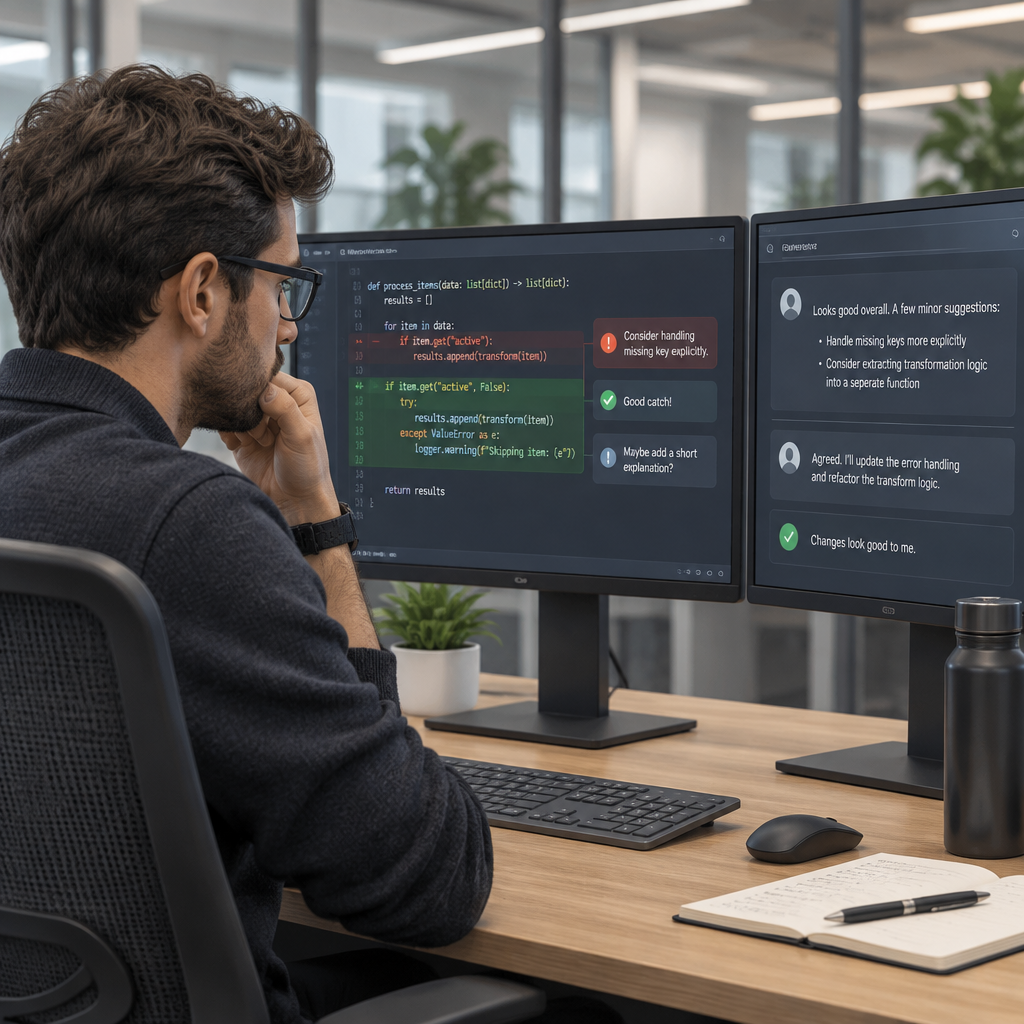
Here’s the kicker: a green approval can hide a weak process. If an agent writes the patch, another agent checks it, and a person skims the summary, the team may have approvals without much understanding. Jain called that review theater. AI-era review tries to replace the appearance of scrutiny with a record of intent, rules, test results, and accountable ownership.
In my engineering work, I have seen useful reviews turn into small lessons about a system’s unwritten rules. A comment such as “don’t call this service from a request handler” may be doing more than correcting a line; it may be sharing a rule the author did not know existed. If the same lesson appears in review after review, keeping it in a comment thread is wasteful. The team should write the rule down and make it checkable.
Core Benefits and Why They Matter
A layered review model is not valuable because it uses more tools. It is useful when it protects the parts of review that people need and removes work that only looks careful. The benefits depend on clear rules and honest evidence; add automation without those, and the team merely gets faster at producing noise.
- More attention for hard decisions. Agents can compare implementations, run checks, and report disagreements before a pull request reaches a human. People can spend their time on behavior, risk, and design instead of scanning a long patch for a familiar naming mistake. When I worked with large codebases, the most useful review conversations were often about why a change existed and what else it could affect. A diff alone rarely carried all of that context.
- Requirements stay attached to the change. Teams often discuss acceptance criteria in a ticket, a chat, or a planning meeting, then lose that context by the time code is ready. Capturing the intended behavior during the coding session gives reviewers a way to ask whether the result matches the request. It also helps a future maintainer understand why the code was written. That is basic stewardship: leave the system easier to understand than you found it.
- Repeated lessons become shared rules. Jain described mining 11,000 of Aviator’s own review comments and producing 64 proposed invariants. An invariant is a standing rule with a defined scope, a reason it exists, a way to verify it, and an owner. The point is not to turn every comment into policy. It is to notice when the team keeps paying for the same explanation and then make the rule visible and testable.
- Evidence becomes richer than a green check. A unit test can show that a narrow function behaves as expected. It cannot always show that a page looks right, that a request has acceptable latency, or that a database query uses an index. Screenshots, DOM snapshots, recorded network requests, timing data, and database logs can provide evidence closer to the actual behavior. Frankly, that matters even more when the agent that wrote the code also wrote its tests.
- Ownership gets clearer. Traditional review can leave responsibility split between the author and the approving reviewer, as if a click transfers the risk. A better model makes the team that owns a rule responsible for its scope and enforcement. That does not erase individual accountability. It makes the right people answerable for decisions about systems they maintain.
Jain reported that his nine-engineer team merged four times as many pull requests as a year earlier, still approved every one, and reduced reverts by about 40%. Those are his team’s reported results, not a promise that another organization will see the same gains. The useful lesson is to measure both output and harm. More merges mean little if more changes need to be undone.
I have watched teams treat review speed as a score to improve, then discover that the score rewarded shallow approvals. A better set of measures includes escaped defects, time to recover, change failure rate, repeated review comments, and whether the person on call can explain a change. This is where a little skepticism helps. A tidy dashboard can still measure the wrong thing.
A Step-by-Step Guide to Implementing Layered Review
Do not begin by disabling human review. Begin by making the current review process visible, then move one low-risk workflow at a time. Jain’s six layers—Argue, Capture, Codify, Prove, Debate, and Own—offer a useful sequence, but teams should adapt them to their code, customers, and risk.
- Argue before the pull request exists. Have agents or automated tools examine a proposed change locally and compare options before opening a PR. Ask them to raise disagreements about behavior, edge cases, and likely side effects, not to produce a wall of generic advice. The output should be a short record of the unresolved questions and the choices made. When I’ve reviewed complicated changes, a focused note about two competing approaches was more useful than a hundred-line summary of what the patch did.
- Capture intent and acceptance criteria. Write down the problem, the expected behavior, and what would count as failure while the work is underway. Keep that information with the pull request, not only in a ticket or chat thread that may disappear from the maintainer’s view. Behavior-driven development offers a familiar pattern: describe behavior in terms people can check. A clear example might say, “When a payment times out, the customer sees the pending state and is not charged twice.” That gives reviewers something specific to test against.
- Turn repeated comments into proposed invariants. Review comments can reveal rules about security, performance, data access, and design. Collect recurring comments, group them by theme, and ask the people responsible for that part of the system whether each rule is truly required. Give every accepted invariant a scope, a reason, a verification method, and an owner. Do not automatically promote every preference into a blocking rule. “I like this style” is not the same as “this endpoint must never expose account data.”
- Prove behavior with evidence that fits the risk. Unit tests matter, but they are only one kind of evidence. For a UI change, attach a screenshot or DOM snapshot. For a service, capture representative requests and latency. For a database change, inspect query plans and logs. The evidence should help a reviewer answer a real question about the change. NIST’s Secure Software Development Framework is a useful reference for treating security as a planned development practice rather than a last-minute checkbox. Evidence does not guarantee safety; it makes assumptions easier to inspect.
- Debate decisions instead of rereading every diff. A person should still look at the code when the change is risky, novel, or hard to explain. But for routine work that meets clear invariants and includes strong evidence, the human conversation can focus on the remaining trade-offs. Ask what could fail, what the change depends on, and whether the evidence covers the important path. In my experience, a ten-minute discussion about a migration plan can beat an hour of comments about formatting.
- Assign ownership and keep the escape hatch. Name the team that owns each invariant, who can change it, and how exceptions get approved. Start with a small service or a low-risk class of changes. Review failures and false alarms weekly, and make it easy to pause automation. Jain shared a failure in which a change passed every filter but caused an 18-minute outage because a query lacked an index. The post-mortem asked which rule was missing, rather than who clicked approve. That is useful only if the missing rule gets added and tested.
For rollout, establish a baseline first: review time, PR size, reverts, production incidents, and escaped defects. Then compare the same measures after each change. DORA’s software delivery research is a useful reminder to look at delivery performance as a group of measures, not a single speed score. Avoid treating every metric as a target; once a number becomes a quota, people find ways to raise the number instead of improving the work.
Keep some changes fully human-reviewed while the system earns trust. Jain specifically said critical areas such as security, authentication, and billing still receive line-by-line review on his team. That boundary is sensible. The goal is not to make review disappear; it is to match the amount and kind of scrutiny to the possible harm.

Comparison Table: Layered AI Review vs. Traditional Line-by-Line Review
Traditional review is not useless. It is a strong tool when a person has time, context, and a manageable patch. The problem is treating it as a universal safety net, even as PRs grow and code-writing tools multiply. A layered model is strongest when it adds dependable checks and preserves human judgment for work that needs it.
| Dimension | Layered AI-era review | Traditional line-by-line review |
|---|
| Main focus | Intent, team rules, evidence, risk, and ownership | Reading changed lines and leaving comments |
| Best use | Repeated, well-scoped work with clear acceptance criteria | Novel, sensitive, or complex changes needing human context |
| Knowledge sharing | Captures intent and converts recurring lessons into rules | Shares knowledge through comments and reviewer discussion |
| Evidence | Can include tests, screenshots, traces, logs, and query plans | Often relies on the diff, tests, and reviewer judgment |
| Scale | Automation can check many routine changes quickly | Reviewer capacity limits how many changes receive deep attention |
| Main failure mode | False confidence in weak rules or agent-generated tests | Rubber-stamping large patches or missing context in a rushed review |
| Human role | Decide trade-offs, inspect high-risk work, own rules | Author and reviewer carry most of the visible review burden |
Neither column wins in every case. An automated check can apply a clear rule consistently, but it can also enforce a bad rule consistently. A human can catch a subtle issue, but a tired reviewer can miss an obvious one. The real comparison is not machine versus person; it is a designed process versus a process that assumes everyone has unlimited time and attention.
The size of a change matters, too. Jain said review quality falls sharply after about 400 lines and cited a current median PR size near 640 lines. Even if those figures differ across organizations, the core warning is familiar: a large patch asks a reviewer to hold too much context at once. Breaking work into smaller changes remains useful, but it does not fix every problem. A sequence of tiny PRs can still obscure the overall behavior if the intent and dependencies are missing.
I would choose a hybrid approach for most teams. Let automation handle repeatable checks and gather evidence; let a person examine exceptions, risk, and system-level effects. Require stronger review for security-sensitive work and changes that are difficult to reverse. That division of labor respects the dignity of people’s work: reviewers should contribute judgment, not serve as ceremonial checkboxes.
Common Mistakes to Avoid
The loudest advice is often the least useful: “Just add an AI reviewer,” or “Require an approval on every PR.” Neither statement tells a team what the reviewer should know, what evidence is enough, or who owns a bad rule. Here are the mistakes that turn a sensible experiment into review theater.
- Confusing approval with understanding. A reviewer can click approve without knowing why a patch exists. Jain’s central concern is that teams already merge many changes without meaningful human review, then preserve approval steps that make the process look safer than it is. Ask reviewers to explain the intent or the main risk when a change is sensitive. If no one can, the team has a visibility problem, not an approval-count problem.
- Letting an agent grade its own homework. An agent that wrote code may also write tests that reflect its own assumptions. Passing tests are useful, but they are not independent proof that the right behavior was tested. Add evidence from different layers, such as integration checks, production-like traces, or human review of the expected behavior. The truth is, a green check is only as strong as the question behind it.
- Turning every opinion into a hard rule. If a team converts each comment into a blocking invariant, it will create a brittle maze. Rules need a reason, a scope, and a clear way to test them. Keep personal style preferences separate from requirements that protect customers, data, reliability, or maintainability. Review rules periodically; code and system boundaries change.
- Using PR size as the only quality signal. Smaller patches are often easier to inspect, but a tiny change can still be dangerous, and a larger change can be justified. Look at dependencies, rollout plans, reversibility, and user impact. A pull request’s line count is a clue, not a verdict. Large work should be split when that makes the behavior clearer, not merely to satisfy a metric.
- Removing humans from high-risk work too early. Jain said his team continues line-by-line review for areas including security, authentication, and billing. That is not a contradiction. Risk-based review means the process asks more from people when the cost of failure is high. NIST’s secure-development guidance also supports building security into development activities instead of hoping a final approval will catch every issue.
- Measuring output while ignoring harm. More PRs merged and shorter review time may look impressive. If reverts, customer problems, or emergency fixes rise, the team has traded quality for speed. Track both benefits and costs, then investigate incidents without turning the post-mortem into a hunt for one person to blame. A fair process asks what rule, signal, or assumption failed and who can improve it.
I’ve seen teams adopt a new tool before agreeing on what “good” looks like. They end up arguing over the tool’s output instead of improving the work. Start with one painful, repeated problem, define a checkable result, and run the change as an experiment. Let evidence—not a vendor pitch or a flashy demo—decide whether it helped.
Frequently Asked Questions
Is line-by-line code review dead?
No. It is still useful for risky, unfamiliar, or complex changes, and Jain said his team still reviews critical areas line by line. The concern is using that method as the only review tool when patches are large and human attention is limited. For routine work, a combination of intent, automated rules, independent evidence, and targeted human review may give better coverage. Keep the line-by-line review where it adds value, not simply because a process template says every patch needs the same treatment.
Can AI safely review code written by AI?
AI can help find issues, compare code with known rules, and summarize changes, but it cannot prove safety by itself. The same agent may share the assumptions that shaped the code and its tests. Use independent checks where possible, such as integration tests, runtime evidence, static analysis, and human review for high-risk behavior. Make the agent show what rule it checked and what evidence it used. Treat its output as a lead to investigate, not a final verdict.
What are code-review invariants?
Invariants are standing rules a team expects code to follow. A useful invariant has a defined scope, a reason, a method for checking it, and an owner who can update it. Examples include requiring authorization checks before reading account data or preventing a high-traffic query from running without an index. A rule should be clear enough to test and important enough to enforce. If it only captures one reviewer’s personal preference, it probably should not block a change.
Which changes still need human review?
Changes that could expose private data, weaken authentication, affect billing, change critical infrastructure, or cause hard-to-reverse customer impact deserve close human attention. Novel architecture and changes with unclear requirements also benefit from discussion. The exact boundary depends on the service and its risk. Teams should write down why a category needs deeper review, then revisit that decision when the system changes. Automation can strengthen the process, but it should not quietly become the only decision-maker for serious risks.
Final Thought
The most useful part of Jain’s argument is not that code review should vanish. It is that teams should stop confusing reading every line with understanding a change. A reviewer who scans a giant diff without knowing the goal may miss the one decision that matters. A well-designed process can preserve intent, test standing rules, collect evidence, and send people toward the questions that machines cannot settle on their own.
There is no magic six-step checklist that makes software safe. Rules can be wrong, tests can be narrow, agents can sound sure while being mistaken, and people can approve changes they barely understand. The answer is not blind trust in automation or blind trust in a human approval. It is a system that shows its assumptions, assigns responsibility, learns from failures, and makes it possible to challenge a decision before customers pay for it.
In my experience, good engineering is not measured by how many lines a person personally reads. It is measured by whether the team can explain what changed, why it changed, what evidence supports it, and who will respond if it fails. That is a matter of craft and stewardship, not ceremony. I’m Ermenildo Castro, and I’ll leave the closing thought where the talk left it: You can outsource your thinking. You cannot outsource your understanding.