Agentic Operations Platforms for Utilities: Add AI Without Giving It the Keys
An agentic operations platform helps utility teams connect operational signals, assess service impact, and recommend or carry out approved actions. The safe design keeps reasoning separate from authority: a model can suggest a change, but a versioned policy catalog and governed tool gateway decide whether that change may reach production.
Key Takeaways
- Keep agent reasoning separate from permission to change production systems.
- Define action risk and approval needs in a versioned catalog outside the model.
- Route every production action through one governed gateway with least privilege and an auditable record.
- Start read-only, expand in small steps, and revoke an action class when evidence no longer supports it.
Utility operations already have plenty of data. The harder work is connecting alerts, tickets, logs, metrics, and service dependencies quickly enough to make a sound decision. Agentic AI can help with that work, but it should not receive broad authority simply because it can produce a convincing explanation.
The pattern described here uses Amazon Bedrock AgentCore, Amazon Bedrock, retrieval over enterprise runbooks and incident history, and Model Context Protocol (MCP) tool interfaces. The details of each utility’s obligations differ, so the platform should support evidence and control; it should not claim that its presence creates compliance.
What Is an Agentic Operations Platform?
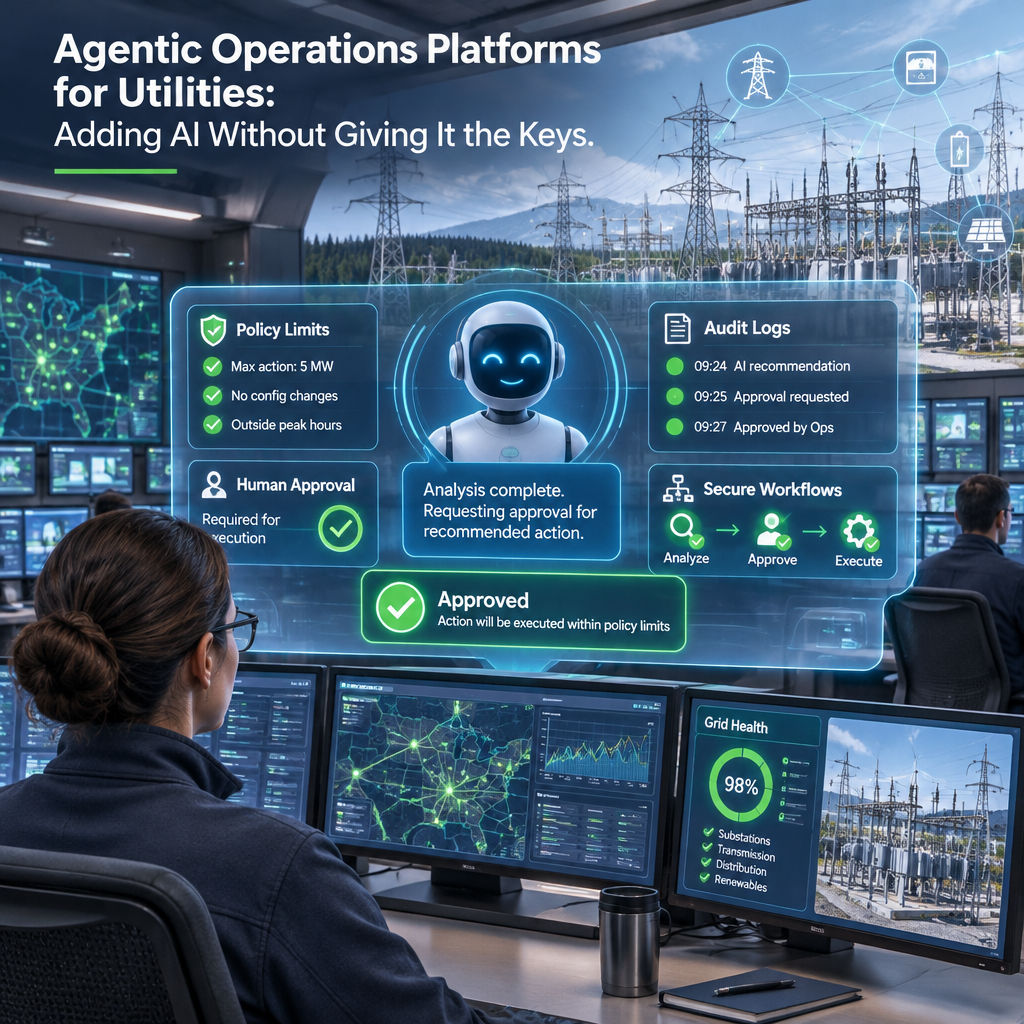
An agentic operations platform uses AI agents to reason across operational information and coordinate work through tools. In a utility setting, that might mean connecting a failed integration job with API errors, a recent deployment, a service ticket, and a runbook. The agent can explain what may be happening, identify likely business effects, and propose a next step. It does not get to decide on its own that the proposed step is safe to run.
That distinction matters. A conventional assistant returns text. An operations agent may also request information or ask a tool to perform a task. The more tools it can call, the more important it becomes to separate a model’s reasoning from production authority. A model can misunderstand a log, retrieve an old runbook, or confidently recommend a risky action. Confidence is not permission.
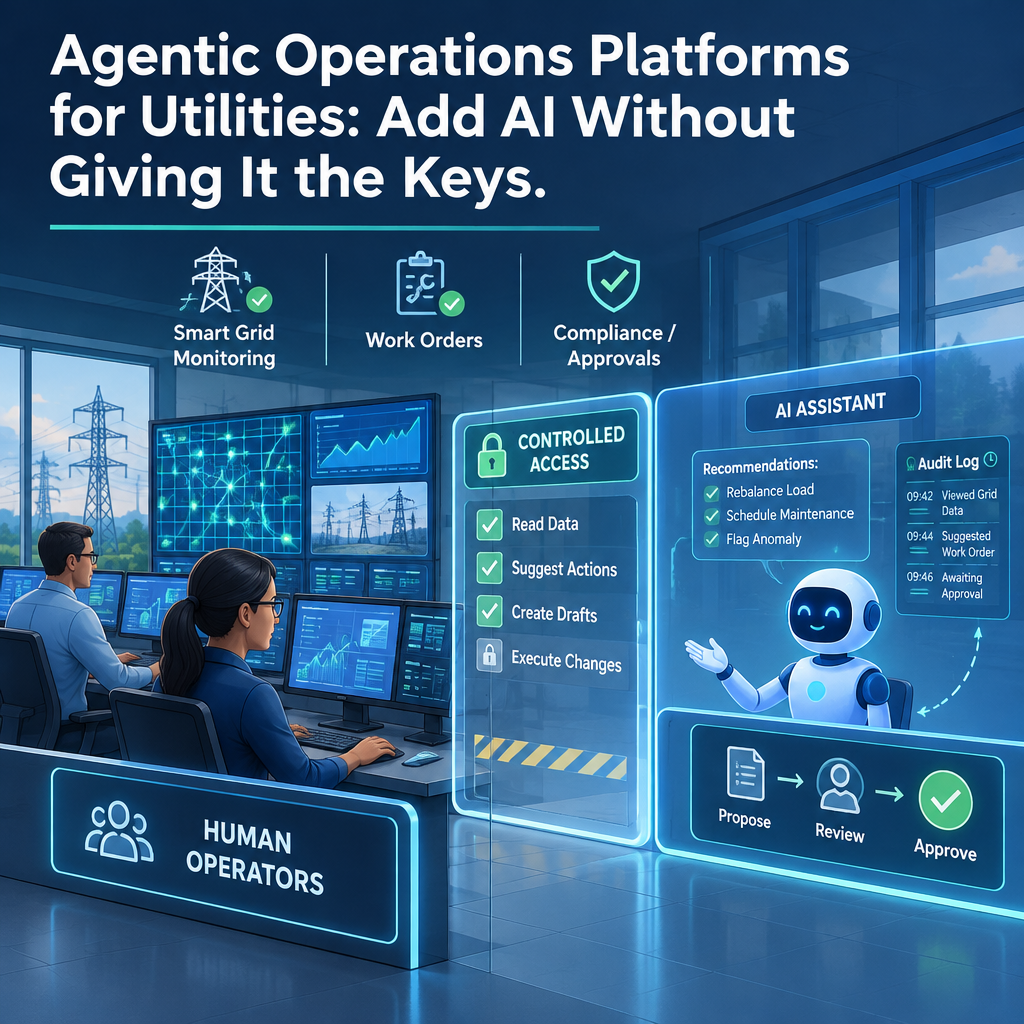
A sound design has several parts. Observability sources provide signals, such as logs, metrics, traces, security events, and job results. Retrieval supplies relevant runbooks, known errors, and prior incident notes. An agent combines that context and proposes an action in a structured format. A policy service checks the proposal against a predefined action catalog. A governed tool gateway is the only route from an approved proposal to a production system.
The catalog is not a prompt. It is a versioned policy artifact maintained outside the model. Each action has a defined scope, risk class, required checks, and approval path. For example, collecting diagnostic status may be read-only, while restarting a customer-facing service may require a human approver and a maintenance-window check. The precise categories are local decisions, not universal labels.
The gateway enforces those rules. It checks identity, authorization, approval, allowed parameters, and tool scope before calling a production interface. It also records what was proposed, what policy version applied, who approved, what tool ran, and what happened afterward. With MCP, tool interfaces can be presented through a common protocol; the protocol itself does not provide the organization’s authorization policy. See the MCP introduction for the protocol’s role.
The reference architecture can use Amazon Bedrock AgentCore and Amazon Bedrock for its agent and model components, alongside retrieval and MCP tool interfaces. AWS describes its agent services in its AgentCore overview. Those services can support an implementation, but the utility still owns its policy, access controls, system boundaries, and operational approval process.
I treat the model as an analyst, not a supervisor. The supervisor is the deterministic control plane: ordinary software that applies explicit rules, denies requests outside the catalog, and produces evidence that operators can review. That may sound less exciting than full autonomy. It is also much easier to test.
Core Benefits and Why the Controls Matter
The goal is not to replace skilled operators. It is to give them a clearer view of scattered evidence and safer ways to handle repeatable work. The benefits depend on keeping the system honest about what it knows and what it is allowed to do.
- Faster signal correlation. An agent can gather related information from monitoring, tickets, deployment records, and runbooks, then present one working explanation. I have seen incident discussions lose valuable time because each person was staring at a different dashboard. A shared evidence summary can shorten that back-and-forth, provided it links conclusions to the underlying records and marks uncertainty plainly.
- Better connection to business impact. A high CPU alert is a technical fact, not a complete service assessment. A useful agent can check which application depends on the affected component, whether a scheduled business process is due, and whether a related service is already degraded. That helps an operator prioritize. It does not mean the model can invent a customer impact that has not been confirmed.
- More consistent use of operational knowledge. Runbooks and incident notes are often scattered across knowledge bases, tickets, shared folders, and team memory. Retrieval can surface the relevant steps at the point of need. Here’s the kicker: a retrieved document may be stale or written for a different system version. The platform should display its source, date, and system scope, and should not treat every search result as an approved instruction.
- Safer repeatable action. Once a low-risk action has a tested tool call, narrow permissions, and clear rollback behavior, it may be suitable for guarded automation. The action catalog makes the rules visible and testable instead of burying them in prompt wording. In a design review, I would ask the team to show how a denied request is handled before discussing how quickly an approved request can run.
- Evidence assembled as work happens. A governed path can attach the request, decision, approval, execution result, and follow-up check to one record. That is more useful than rebuilding the story after an incident from chat logs and scattered tickets. It can support reviews, but it does not by itself prove that every applicable law, standard, or internal control has been met.
- A practical way to limit blast radius. Read-only access, scoped credentials, parameter checks, and action-specific approvals keep one mistaken recommendation from turning into a broad production change. The dignity of operational work includes giving staff clear accountability and tools that reduce avoidable risk, not asking them to trust an opaque system.
Those benefits are not automatic. A platform that correlates poor data may deliver a tidy but wrong summary. A gateway with overly broad permissions may simply automate the same old hazard. Better outcomes come from careful boundaries, useful evidence, and measured expansion.
Step-by-Step Implementation Guide
- Map the service and its risks. Begin with a specific operational service, its dependencies, owners, data sources, and change paths. Include business processes and customer effects, not just servers and APIs. List which systems are production, which are safety-related or otherwise sensitive, and what local rules apply. I prefer one well-understood service over a sweeping pilot that claims to cover the whole utility estate.
- Start with read-only signals. Connect a small set of trusted sources: logs, metrics, traces, alerts, tickets, and relevant deployment events. Confirm timestamps, identifiers, access rules, and retention behavior. A signal that arrives late or lacks a service identifier can mislead the agent. Test whether operators can trace each summary back to its source before allowing the system to request any change.
- Prepare retrieval material. Select current runbooks, architecture notes, known-error records, and incident reviews. Record ownership, version, effective date, and system scope. Exclude documents that should not be exposed to the agent. Test retrieval with real operational questions and with near-matches from other systems. If the agent retrieves the wrong procedure, fix the source or retrieval rules instead of asking the model to guess its way through.
- Define the action catalog. Give every candidate action a stable name, purpose, input schema, allowed target, risk class, and required approval. Include preconditions, limits, timeout behavior, expected result, and rollback or recovery steps. Keep the catalog versioned and reviewed like code. A model’s natural-language explanation may help a person understand a proposal, but it must not change the action’s assigned risk or approval requirement.
- Build the governed gateway. Make it the single production path for agent-requested actions. Apply least privilege with separate identities for separate tools, validate parameters, check the catalog, verify required approvals independently, and deny anything outside the approved scope. A tool connection is not a permission grant. MCP can standardize how tools are exposed, but the gateway and the systems behind it must still enforce identity and authorization.
- Test failure cases before live use. Use a non-production environment and include malformed requests, stale approvals, duplicate calls, timeouts, missing data, conflicting signals, and attempts to call tools outside the catalog. Test whether a retry could repeat a harmful operation. Confirm that denied requests remain denied even when the model argues that an emergency exists. Keep human approval independent of the model’s recommendation.
- Measure recommendations and outcomes. Begin with shadow or read-only operation. Compare recommendations with operator decisions, check whether cited evidence is relevant, and record false alarms, missed cases, and time saved. Then enable one low-risk action class with human approval. Expand only when the team has enough evidence about recommendation quality, execution success, and rollback safety. Autonomy should be easy to withdraw, not a one-way promotion.
- Keep governance tied to the real system. Assign owners for the catalog, gateway, model configuration, retrieval corpus, and incident response. Review changes to tools and policies before deployment. Keep records that connect actions to the controls and rules relevant to each system. NIST’s AI Risk Management Framework offers a useful risk-management reference, while requirements must still be assessed for the specific utility and jurisdiction. For applicable bulk-power contexts, review the relevant NERC CIP standards; do not assume every utility system has the same scope.
A design using Amazon Bedrock, AgentCore, retrieval, and MCP can follow this pattern, but product selection does not replace system-specific engineering. The control boundary must remain effective if the model changes, the prompt is edited, or an agent produces an unexpected request. That is the test that matters.
Comparison Table: Governed Agentic Operations vs. Rules-Based AIOps
Rules-based AIOps is the closest common alternative: software correlates known signals and runs predefined workflows. It remains useful, especially when conditions are clear and actions are stable. A governed agentic platform adds flexible interpretation across evidence and can propose steps for cases that do not match one fixed rule. It also adds new failure modes, so comparing capabilities without comparing controls is misleading.
| Dimension | Governed agentic operations platform | Rules-based AIOps workflows |
|---|
| Primary method | Agent interprets retrieved context and correlated signals; policy code controls execution | Fixed thresholds, event rules, and predefined workflow branches |
| Handling unfamiliar incidents | Can summarize mixed evidence and propose a response, with uncertainty and sources shown | Usually needs a new rule, manual review, or a known fallback path |
| Production authority | Action catalog and governed gateway authorize each permitted request | Workflow permissions and automation rules authorize configured actions |
| Human approval | Set per action risk and policy; approval is checked outside the model | Usually attached to specific workflow steps or change controls |
| Evidence | Can assemble proposal, sources, policy version, approval, tool result, and follow-up | Can record rule trigger and workflow results; evidence depth depends on implementation |
| Main risk | Incorrect reasoning, bad retrieval, or unsafe tool access if controls fail | Brittle rules, missed conditions, or unsafe predefined automation |
| Best fit | Cross-system investigation and carefully bounded, evidence-backed actions | Stable, repeatable conditions with clear thresholds and predictable responses |
The agentic approach is not a universal upgrade. A clear alert threshold with a stable response may be safer and cheaper as a conventional rule. Use an agent where context is spread across sources and an explanation helps the operator. Even then, let the deterministic boundary decide whether any action may run. The comparison is about choosing the right tool for the task, not declaring one winner.
Common Mistakes to Avoid
Giving the model authority through a prompt. A prompt can ask the agent to be careful. It cannot serve as a reliable access-control system. I have watched teams spend hours tuning wording while the underlying tool credentials still had broad permissions. Reverse that order: restrict the credentials, enforce policy in code, and then improve the instructions. The model should not be able to talk its way past a denied request.
Treating approval as a checkbox. Approval must match the exact action, target, parameters, and time window. An old approval for one restart should not authorize a different restart later. Verify it at the gateway, record who approved, and deny expired or mismatched approvals. Frankly, an approval that is not tied to the specific request is mostly theater.
Letting one agent use a shared, powerful identity. Broad credentials turn a mistake in reasoning into a much larger incident. Use least privilege, separate identities by tool and action class, and limit the target systems each identity can reach. Review how credentials are stored, rotated, and revoked. A single gateway is useful only if it does not become a single overpowered account.
Assuming retrieved knowledge is current. Search can return a procedure that is out of date, incomplete, or meant for another environment. Tag operational content with an owner, version, system scope, and review date. Show sources alongside recommendations. If the evidence conflicts, the agent should say so and ask for review rather than smoothing the disagreement into a confident answer.
Expanding autonomy because a demo looked good. A polished demonstration rarely covers stale data, duplicate events, partial outages, or failed rollbacks. Start in read-only mode, measure behavior in real operations, and promote one action class at a time. Track operator acceptance, execution success, unintended effects, and recovery time. If those measures deteriorate, revoke the action class while investigating. Autonomy is a setting, not a prize.
Claiming that logs equal compliance. Logs are useful evidence, but compliance depends on the rules that apply, the system’s scope, and how controls work in practice. A complete action record can support an audit or internal review; it cannot establish, by itself, that all requirements were met. Have the right control owners map the evidence to the actual obligations. Be precise about what the platform demonstrates and what it does not.
Frequently Asked Questions
What is an agentic operations platform?
It is a system that uses AI agents to interpret operational information and coordinate work through tools. In a utility environment, it may connect alerts, logs, tickets, runbooks, and service dependencies to explain an incident and propose a response. Production actions should still pass through independent policy checks, authorization, and any required human approval.
Can an AI agent safely make production changes?
It can make narrowly defined changes only when the organization has tested the action and placed it behind enforceable controls. The action should have limited scope, least-privilege access, validated parameters, clear approval rules, monitoring, and a safe recovery plan. Many teams should begin with recommendations or human-approved actions rather than unattended execution.
How does an action catalog differ from a prompt?
A prompt tells a model how it should behave. An action catalog is a versioned control artifact that defines which actions exist, their risk class, their allowed inputs, and their approval requirements. The gateway checks the catalog independently, so model wording cannot grant new authority or change an action’s approval level.
Does using Amazon Bedrock AgentCore or MCP make a utility compliant?
No. These technologies can be parts of an implementation, but compliance depends on the applicable rules, system scope, organizational controls, and evidence. A governed platform can help record decisions and execution details. Utility control owners must assess that evidence against the requirements that actually apply.
Final thought: In a regulated utility, a useful agent is not the one that acts most often. It is the one that connects evidence clearly, stays within a boundary operators can inspect, and stops when its permission or evidence runs out. Build that boundary first. Then let measured results, not sales claims, decide how much autonomy to grant. Good engineering is a form of stewardship: people depend on these systems, and their safety and service deserve controls that work when the model is wrong.