Agentic Operations in Utilities: How to Add AI Without Giving It the Keys
An agentic operations platform for a regulated utility uses AI agents to connect operational signals, explain likely impact, and recommend next steps. It keeps production authority outside the model: a versioned policy catalog and governed tool gateway decide which actions are allowed, who must approve them, and what evidence is retained.
Utility operations connect systems that customers and workers rely on. That makes speed useful, but unchecked speed can turn a small incident into a larger one. The sensible design is not an agent with broad access and a promise to behave. It is an agent that can reason freely while a separate, testable control decides whether any proposed change may reach production.
In enterprise engineering work, I have seen a familiar mismatch: teams collect plenty of telemetry, yet a person still has to piece together the incident from logs, tickets, dashboards, and a runbook. Agents can help with that reasoning work. The trick is to keep a clear line between advice and authority. Frankly, that line matters more than a clever prompt.
What Is Agentic Operations in a Utility?
Agentic operations uses AI agents to help understand and manage technology services. An agent can inspect approved information, retrieve relevant procedures, connect related events, and propose a sequence of steps. Depending on the system design, it may also request a tool to perform an action. That last ability is where governance stops being an abstract concern and becomes an engineering requirement.
A utility operations environment may include application logs, infrastructure metrics, API telemetry, security events, service tickets, scheduled job results, and alerts from business systems. One alert may show a delayed integration. Another may show a queue growing. A third may report that a business process is falling behind. Each signal is useful, but none may explain the full situation alone.
An agent can examine these signals together and look up approved operational knowledge, such as a runbook or a record of a similar incident. It can then describe what seems to be happening, state how certain or uncertain it is, and recommend a next step. Reasoning and execution are separate jobs. The model supplies a proposal; a deterministic policy layer decides whether that proposal is permitted.
That separation is essential. A model may produce a plausible answer that is still wrong, incomplete, or unsafe. It should not be able to grant itself permission, change the risk level of its own request, or bypass an approval rule through a tool call. Authority belongs to policy that exists outside the model and can be reviewed and tested.
The reference pattern discussed here uses Amazon Bedrock, Amazon Bedrock AgentCore, retrieval across enterprise runbooks and incident history, and Model Context Protocol (MCP) tool interfaces. These components can support agent, knowledge, and tool connections; they do not remove the need to design permission checks. AWS documents the AgentCore service in its Bedrock AgentCore overview, while the MCP specification describes a way for applications to connect models with tools and other context.
Here is the kicker: a tool interface is not a policy. MCP can provide a consistent way to expose a function, but the organization still has to decide which identity may call it, which inputs are acceptable, what approvals are required, and how the action is recorded. In utility operations, that distinction keeps a useful interface from becoming an open door.
The regulatory context also varies. NERC Critical Infrastructure Protection (CIP) requirements apply to defined in-scope Bulk Electric System cyber systems; they do not automatically describe every IT system at every utility. Customer services, billing, field operations, and other systems may have different requirements, depending on the program and jurisdiction. The NERC CIP standards page is a useful reference for the scope of those standards. Teams must map controls to the systems and rules that actually apply to them.
Core Benefits and Why the Architecture Matters
The benefit is not simply that an agent can write a summary. A good design helps an operations team move from scattered evidence to a reviewable decision, without pretending that a language model is a certified operator. The system supports people doing the work; it does not erase their responsibility.
- Faster signal correlation. The agent can bring together events from monitoring, service management, and approved knowledge sources. In incident reviews, I have seen engineers lose time because each tool showed only one slice of a service. A shared view can reduce that manual stitching, though it cannot guarantee that every relevant signal was collected.
- Clearer business impact. A technical symptom matters because of the service or process it may affect. An agent can connect an alert to a service map, an owner, or a documented dependency, then explain the likely impact in plain language. The team should still check that mapping; stale ownership data can mislead just as surely as a bad model response.
- More useful access to operational knowledge. Runbooks and incident lessons often live in different places. Retrieval can surface the relevant procedure near the alert, instead of asking an on-call engineer to remember which wiki page holds the current version. I have watched teams find the right instructions only after someone recalled the exact phrase used in an old ticket. That is a brittle search strategy.
- A controlled path from advice to action. A policy catalog can define each action’s risk class, required approval, limits, and allowed target systems. A gateway can then check the request against those rules before execution. This makes approval behavior predictable and testable, rather than dependent on the wording of a prompt.
- Better evidence for review. A single execution path can record the proposal, policy version, requesting identity, approval, tool input, result, and any rollback. That makes it easier to reconstruct what happened. It does not prove that every legal or regulatory duty has been met; evidence must still match the organization’s actual obligations.
- Safer growth in autonomy. A team can begin with read-only analysis, then authorize a narrow class of low-risk actions, such as a bounded retry, only after testing. The team can pause or withdraw that permission if results change. This is stewardship in a practical sense: use automation carefully, with attention to the people and services that depend on it.
These benefits depend on ordinary engineering discipline. Service ownership must be current. Runbooks need review dates. Tool identities need narrow permissions. Approval rules need a named owner. Without those basics, the agent can repeat old mistakes faster and with a tidier explanation. That is not progress.
A useful way to judge the design is to ask what an operator can verify. Can they see why the agent made a recommendation? Can they reject it without fighting the system? Can an auditor follow the action from request through outcome? If the answer is no, a polished summary does not fix the weakness.
Step-by-Step Guide to Implementing a Governed Platform
Implementation should move in small, observable steps. Do not begin by granting broad write access and hoping to add controls later. Put the authority boundary in place first, then grow the system only when evidence supports it.
- Choose a narrow service and define its limits. Start with one business or technology service whose dependencies, owner, and operational risks are understood. Record what is in scope and what is not. A pilot that spans everything will produce a fuzzy result and make it hard to assign responsibility. In my experience, a clear service boundary makes incident reviews more useful because people can tell which systems and actions were meant to be covered.
- Connect read-only signals before any write tools. Bring in the approved logs, metrics, alerts, tickets, and service relationships needed for analysis. Use identities that can read only the information required for the pilot. Keep access to production changes disabled. First check whether the agent can identify known incidents and explain its evidence; do not confuse a fluent answer with a correct one.
- Prepare the knowledge base. Select current runbooks, incident records, and relevant service documentation. Remove duplicates, mark retired procedures, and attach ownership and revision information. Retrieval should show which document supports a recommendation, not merely return a paragraph that sounds relevant. If a procedure is unclear to a person on call, an agent will not make it clearer by quoting it confidently.
- Create a versioned action catalog. List each possible production action as a separate, named entry. For every action, define its target, allowed parameters, risk class, preconditions, approval needs, limits, expected outcome, and rollback method. A request to restart one bounded service is not the same risk as a request to change a network rule or alter a business record. Keep these distinctions outside the model, in policy that can be reviewed before release.
- Make the governed gateway the only route to production tools. Agents should not hold direct production credentials or call side channels that skip authorization. The gateway receives a proposed action, checks the caller, validates the action against the catalog, verifies any required approval, and forwards only an allowed request. Use least privilege, separate agent identity from approver identity, and reject missing or malformed fields. The model must not be able to alter the gateway’s policy by changing its own instructions.
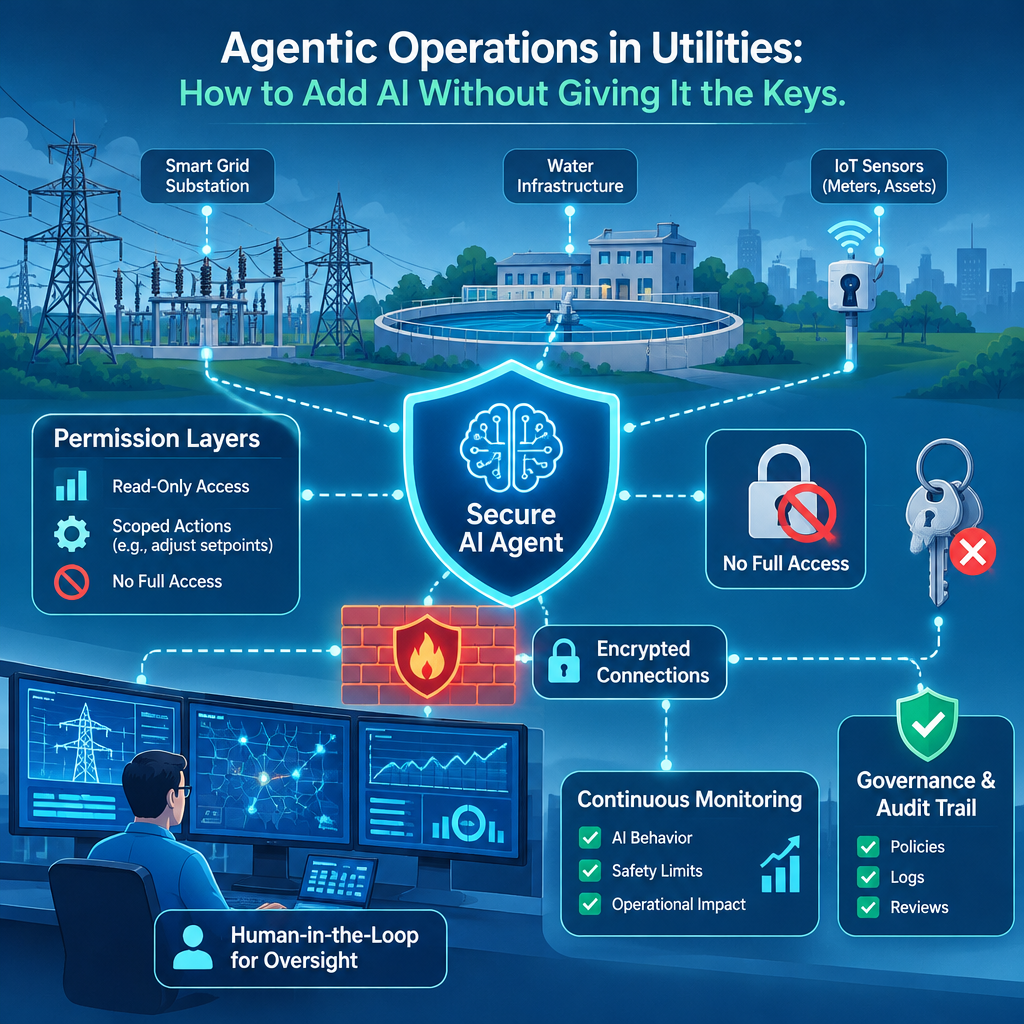
- Build approvals and evidence into the same flow. For actions requiring a person’s approval, show the operator the proposed change, the reason, the expected effect, the risk class, and the evidence used. Record the approver and the exact request they approved. Attach the policy version, tool response, timestamps, and final result to the action record. Approval should be independent of the agent that recommended the change.
- Test failure cases, not just successful demonstrations. Try a valid request, a request for the wrong target, a missing approval, an expired approval, an invalid parameter, a duplicate request, and a gateway outage. Test whether a model can persuade the system to use a tool outside its catalog. Test rollback and the response when the result cannot be confirmed. A system that passes only the happy path is not ready for production.
- Run in read-only or shadow mode and measure quality. Compare recommendations with operator decisions and known outcomes. Track whether the recommendation was useful, whether people accepted it, whether the proposed evidence was sound, and whether the agent made unsupported claims. Prediction can be explored here, but it must be treated as uncertain, especially when a precursor has not been observed often enough to validate it.
- Expand one action class at a time. Allow a low-risk, bounded action only after the organization has set thresholds for recommendation quality, operator acceptance, execution results, and rollback safety. Review every result. If the action begins to fail, revoke the permission through policy instead of asking the model to be more careful. Autonomy is a permission setting, not a personality trait.
- Keep governance attached to change management. Version the prompts, retrieval sources, action catalog, gateway rules, and model configuration that affect operations. Review changes before deployment, preserve test results, and set an owner for each control. NIST’s AI Risk Management Framework offers a risk-based structure for considering and managing AI risks; it is a framework, not a substitute for utility-specific obligations.
This sequence may look slower than a quick tool demo. That is deliberate. In a regulated service, a controlled pilot teaches the team where the design fails while the system still has little authority. A fast launch without a reliable off switch is just a larger experiment with customers and workers standing nearby.
Comparison Table: Governed Agentic Operations vs. Rule-Based Automation
The closest familiar alternative is rule-based automation: a fixed condition triggers a predefined action. It is often the right choice for stable, well-understood events. Agentic operations adds the ability to gather context across sources and explain a proposed response, but that flexibility also creates new risks. The following comparison describes common design patterns, not a measured comparison of products.
| Area | Governed agentic operations | Rule-based automation |
|---|
| How it interprets events | An agent can connect evidence from several approved sources and describe a likely situation. | A defined rule checks for a known condition, such as a threshold crossing or matching event. |
| Handling unfamiliar combinations | It may suggest a response based on retrieved knowledge, but the suggestion needs verification. | It usually does nothing unless the condition was explicitly encoded. |
| Action authority | A separate catalog and gateway decide what can execute and whether approval is required. | The automation’s configured rule and service permissions determine what runs. Those permissions still need governance. |
| Predictability | More flexible, but model output can vary and may be mistaken. Testing and policy checks are essential. | Easier to predict for the conditions covered by the rule, though bad rules and stale assumptions remain possible. |
| Explanation | Can present a natural-language rationale and supporting evidence, which operators should verify. | Often shows the matched condition and configured action; context may need to be assembled by a person. |
| Best fit | Cross-system triage, knowledge retrieval, and recommendations where context is spread across tools. | Repeated, stable actions with clear triggers, limits, and known outcomes. |
| Main caution | Never let the model set its own permissions or bypass the execution gateway. | Do not mistake fixed behavior for safe behavior; a rule can still cause harm at scale. |
There is no prize for using an agent where a simple rule is safer. For a well-defined event with one proven response, a rule may be cheaper to test and easier to explain. An agent may be more useful when evidence is spread across systems or the next step depends on context. Many teams will use both: rules for narrow triggers and agents for triage, evidence gathering, and carefully approved proposals.
The important comparison is not “smart AI” versus “old automation.” It is whether the selected method fits the work and whether its authority is controlled. A mature design may route a verified rule through the same gateway as an agent proposal, so both paths face consistent checks and leave comparable evidence.
Common Mistakes to Avoid
Most advice says to add guardrails. That phrase is too vague to be useful unless a team can point to the exact check, owner, and failure behavior. Here are the mistakes that tend to hide behind reassuring language.
- Letting the model decide its own permission. A prompt that says “ask for approval” is not an authorization system. The approval requirement belongs in a policy catalog and must be checked by software outside the model. I have seen teams rely on an instruction because it worked in a demo. A demo does not test an agent that is confused, misled, or given incomplete context.
- Giving the agent direct access to production credentials. Broad credentials turn a recommendation tool into a powerful operator with a weak boundary. Put the gateway between every agent proposal and production action. Keep credentials out of prompts and use narrowly scoped identities.
- Treating a tool protocol as a security control. MCP can standardize how a tool is described and called; it does not, by itself, establish that a caller is authorized or that an action has been approved. Security still depends on identity, policy enforcement, input checks, and logging around the tool.
- Calling a prediction a fact. A model may spot a pattern that deserves investigation, but a predicted incident is not a confirmed incident. Show the evidence and uncertainty. Do not trigger a high-impact action solely because a model says an event is likely.
- Assuming a complete log equals compliance. An action record is useful evidence, not a certificate. Requirements differ by system, organization, and jurisdiction. Map the evidence to the applicable controls with the people responsible for those obligations. NIST’s SP 800-53 control catalog is one reference for security and privacy controls, but it does not replace a system-specific compliance assessment.
- Starting with the most impressive action. Autonomous remediation sounds good in a presentation, but risky changes make poor first tests. Begin with read-only analysis, then select a narrow action with clear bounds and a tested rollback. If the team cannot explain how to stop it, it is too early to automate it.
- Ignoring stale runbooks and service maps. Retrieval does not repair old information. It may make a retired procedure easier to find. Assign owners, review dates, and a process to remove obsolete content. In operations, a crisp answer based on a dead document is still a bad answer.
- Making autonomy hard to withdraw. If revocation requires a model update or a lengthy release, the control is in the wrong place. Turn action classes on and off through the policy layer. Keep the system useful in read-only mode when write permissions are suspended.
Frankly, the goal is not to prevent every mistake by asking the model to be perfect. The goal is to limit the damage a mistake can cause, make decisions visible, and give operators a dependable way to stop the system. That is a more realistic standard—and a more respectful one for the people accountable for the service.
Frequently Asked Questions
What is agentic operations in a utility?
It is the use of AI agents to help operations teams interpret signals, retrieve approved knowledge, and recommend or request actions across technology services. In a regulated utility, the agent should not decide what it is allowed to do. A separate policy layer and governed gateway control whether a proposed production action can proceed, and whether a person must approve it.
Is autonomous remediation safe for utility systems?
It can be appropriate for carefully bounded, tested, low-risk action classes, but safety is not automatic. Start with read-only use, measure recommendation quality, and test execution, approval, failure, and rollback paths. Expand permissions gradually. Keep a direct way to revoke them. High-impact or uncertain actions should remain subject to the applicable human review and operating controls.
How do MCP and Amazon Bedrock AgentCore fit into the design?
In the reference pattern, Amazon Bedrock provides model capabilities, AgentCore supports agent-related building blocks, and MCP provides a standard way to connect agents with tools and context. These pieces can help structure the system, but none should be treated as the authority boundary by itself. A separate gateway must check identity, action policy, required approval, and evidence before a production tool runs.
Does an agentic operations platform make a utility compliant?
No. A platform can help apply controls and retain records that support oversight, but compliance depends on the requirements that apply to each system and on how the organization operates and verifies its controls. NERC CIP applies to defined in-scope BES cyber systems; other utility services may be governed by different requirements. Compliance teams and system owners must determine the right scope and evidence.
Final Thought
An agent can help an operator see more of the incident at once. It can bring an alert beside a runbook, point out a related failure, and propose a next step in plain language. That is valuable work. But the more useful the agent becomes, the more important it is to keep the authority boundary outside the model.
I would judge a utility operations platform less by how many actions it can take than by how clearly it handles the ones it should not take. Can the operator inspect the evidence? Is approval independent? Does a denied action stay denied? Can permission be withdrawn promptly? Can someone later reconstruct the decision without relying on a memory or a chat transcript? Those are practical questions, not paperwork.
Start with read-only help. Put every write action behind one governed path. Add only the permissions that have passed testing, and preserve a safe way to turn them off. When systems support essential services, the dignity of the work includes protecting the people who depend on those services and the staff who are responsible for them. Autonomy should be earned through evidence, one action class at a time.