Agentic DevOps at AWS is the use of AI agents to help with incident response, deployment checks, log triage, and other ops work that usually eats the day. It...
Agentic DevOps at AWS: What It Is, Why It Matters, and How Teams Can Use It
Agentic DevOps at AWS is the use of AI agents to help with incident response, deployment checks, log triage, and other ops work that usually eats the day. It is not magic. It is a practical way to cut noise, reduce toil, and keep people focused on the work that actually needs judgment — Ermenildo Castro.
Key Takeaways
- AI agents can handle repetitive DevOps tasks.
- AWS services make agent workflows practical.
- Human review still matters for safety.
- Start small and keep the scope tight.
- Good systems protect both time and people.
When I first saw agent workflows in action, I did not think, “Wow, future.” I thought, “Finally, something that can read logs without complaint.” That may sound cranky, but it is honest. Most DevOps pain is boring pain, the kind that shows up in alerts, retries, and 3 AM pages. AI agents can help with that, if you keep them on a short leash.
AWS is a strong place for this work because it already has the pieces: Amazon Bedrock for model access and agent building, Amazon CloudWatch for metrics and logs, AWS Systems Manager for operational actions, AWS Lambda for tool execution, and AWS Step Functions for orchestration. Put those together with guardrails, and you have the bones of something useful.
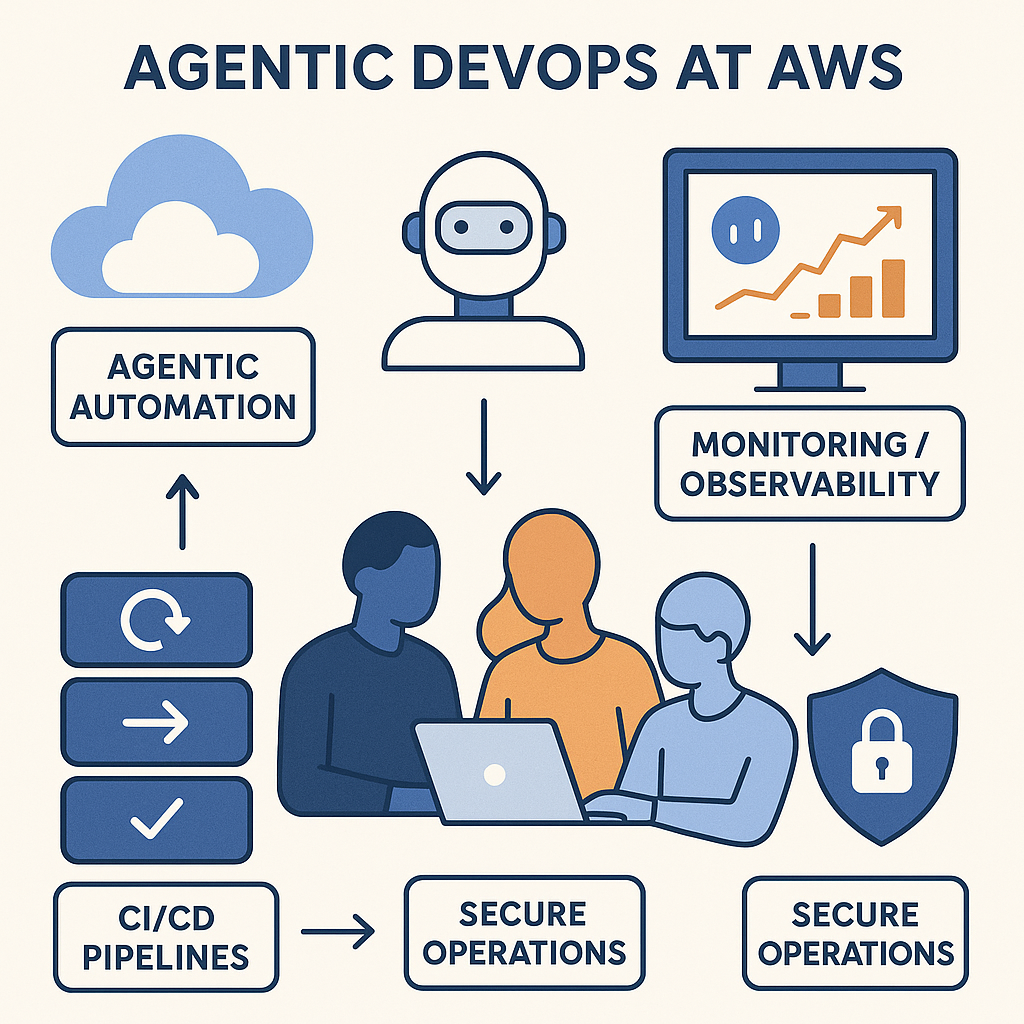
Here is the real point. The best DevOps teams do not worship automation for its own sake. They use it to serve people, because work has dignity and engineers should not be stuck doing machine chores all day. That is plain common sense, and it also happens to be good stewardship.
What is Agentic DevOps at AWS?
Agentic DevOps at AWS means using AI agents inside cloud operations and delivery workflows so they can observe signals, reason over logs and metrics, call tools, and carry out limited actions with guardrails. Instead of asking a model a one-off question, you give it a role, a toolset, and a rulebook. That makes it far more useful for real operations work.
The phrase sounds trendy, and yes, some of the hype is silly. But the idea itself is solid. An agent can take in CloudWatch alarms, trace data, recent deploys, and ticket notes, then decide what to inspect first. That is not the same as a simple script. A script follows one path. An agent can choose among paths, which matters when the evidence is messy.
Most teams already use automation in pieces. They have scripts for restarting services, CI checks for tests, and alarms for outages. Agentic DevOps adds reasoning on top of that stack. It can connect the dots between a failed deployment and a spike in latency, then suggest a rollback or draft a summary for the on-call engineer.
I have seen enough production systems to know that the hardest part is not a lack of tools. It is the junk in between the tools. One dashboard says green, another says red, Slack is on fire, and the runbook is five months stale. An agent can help sort that mess, but only if you control what it sees and what it may do. Frankly, that is the difference between a helpful assistant and a very expensive accident.
For a broader view of how AWS is shaping this area, the company’s own materials on AWS News Blog and AWS generative AI show how the platform is moving from model access toward full workflow support. That matters because DevOps needs more than chat. It needs actions, logs, approvals, and traceability.
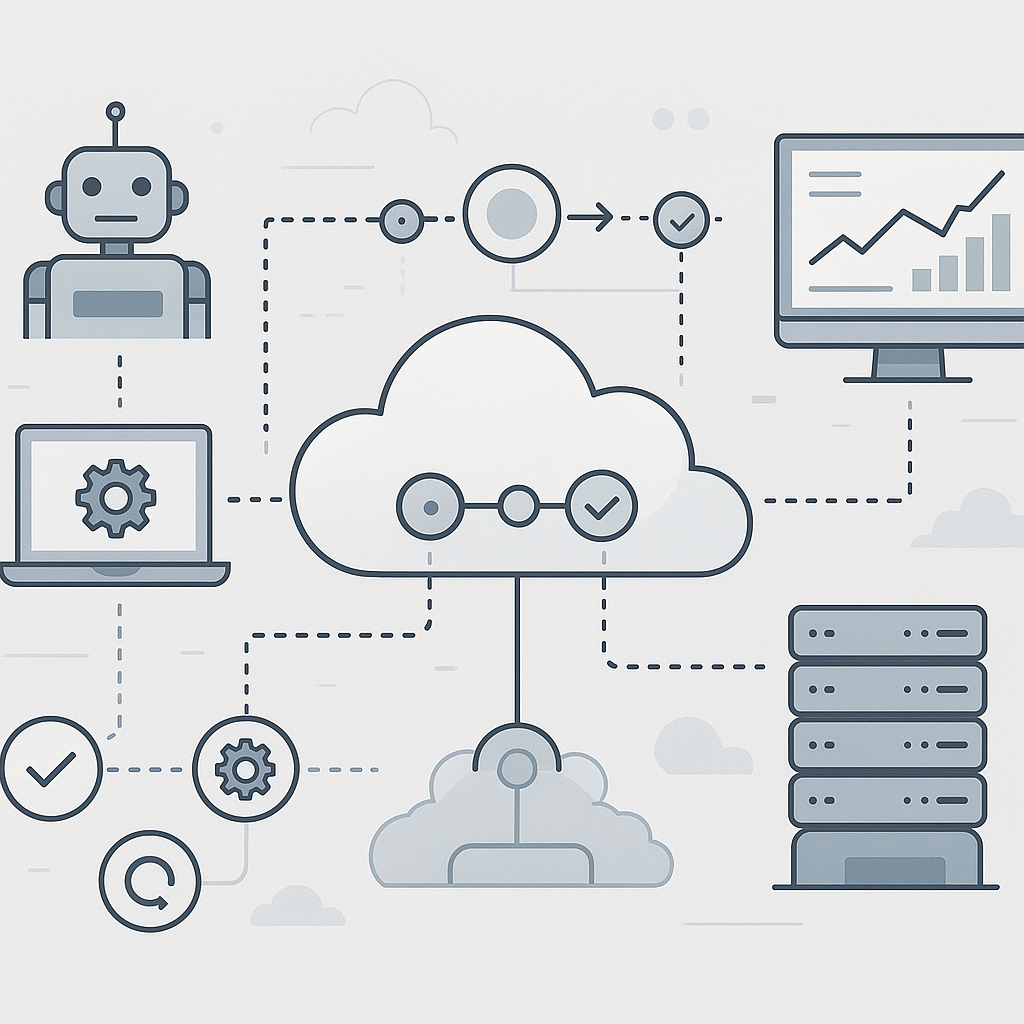
The short version? Agentic DevOps is software that can think a little, act a little, and stop before it gets stupid. That last part is important.
Core Benefits of Agentic DevOps at AWS
The biggest benefit is speed. Not flashy speed. Useful speed. When an alert fires, an agent can pull logs, summarize the issue, check recent deployments, and hand the on-call engineer a cleaner starting point. That cuts the time wasted on hunting. In incident work, hunting is where the hours go to die.
- Faster triage: Agents can group related alerts, gather context, and point to likely causes. That means less tab hopping and less blind guessing.
- Less toil: Repeated tasks like log collection, status checks, and simple restart workflows can be handled by the agent, if the task is tightly scoped.
- More consistent response: People forget steps when they are tired. Agents do not get sleepy, though they can still make dumb choices if the data is bad.
- Better documentation: Agents can draft incident notes, timeline summaries, and follow-up tickets. That saves time after the fire is out.
- Safer routine changes: An agent can prepare a rollback plan or a pull request while a human approves the final action.
I learned the value of this the hard way. At one company, a simple alert about a build failure kept triggering at odd hours. The real fix was not glamorous. It was collecting the right logs, spotting a flaky dependency, and standardizing the retry logic. A good agent would have shortened that mess by an hour or two. That may not sound noble, but at 3 AM, an hour matters a lot.
The second big benefit is consistency. Humans improvise. Sometimes that is brilliant. Sometimes it is sloppy. Agents, when constrained well, follow the same playbook every time. That is especially useful in teams with mixed experience, because the agent can act like a steady hand. The trick is to keep the playbook short and sane. Long runbooks are where good intentions go to rot.
The third benefit is focus. Every hour spent on low-value ops noise is an hour not spent on architecture, testing, reliability work, or customer-facing improvements. That is not just a productivity issue. It is a matter of fairness. People should not be buried under avoidable busywork when they could be solving harder problems with more lasting value.
For teams comparing cloud options, it helps to read the practical guidance in AWS Well-Architected Reliability Pillar. That framework lines up nicely with agentic DevOps because both care about safe systems, clear recovery steps, and reduced blast radius.
The kicker is that agents also create a better memory for the team. They can collect common failure patterns and feed them back into the process. Over time, that leads to fewer repeat incidents. A mature team does not just fight fires. It learns why the same dry grass keeps catching.
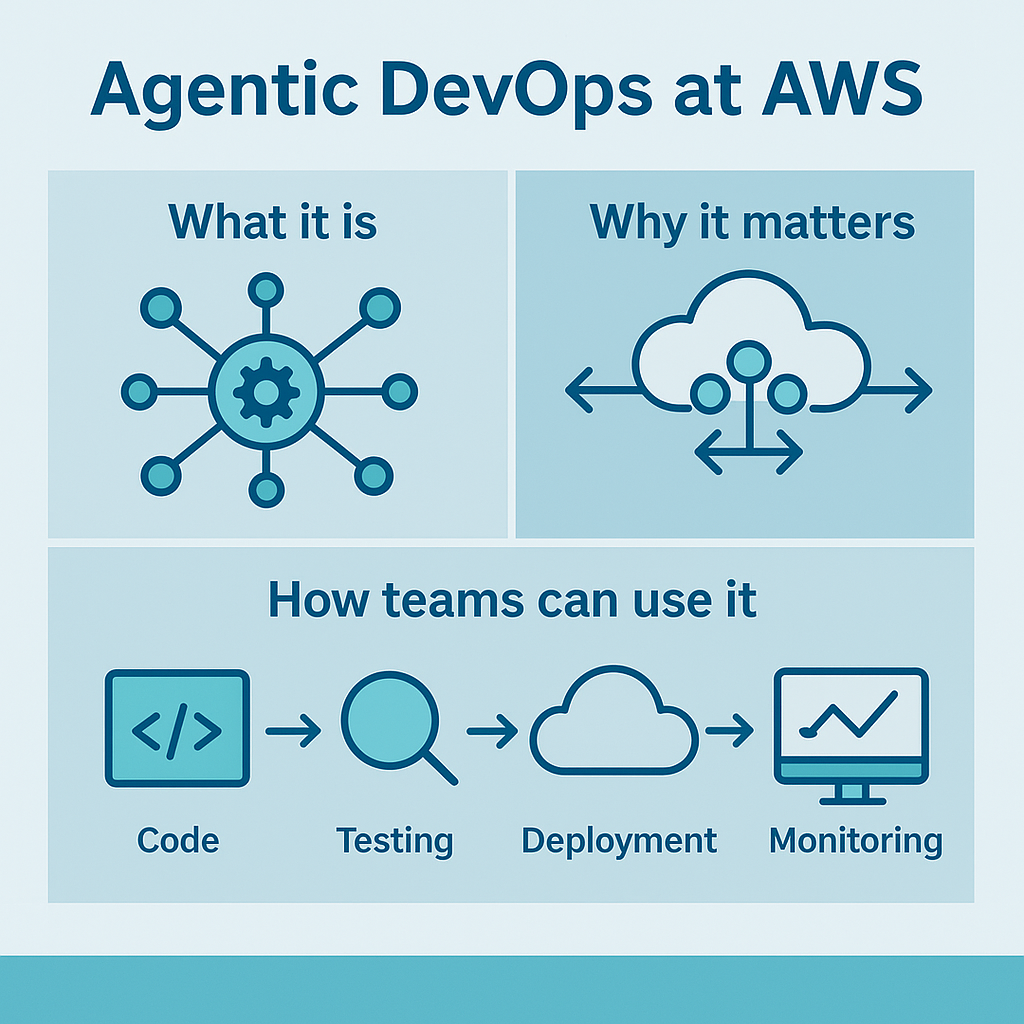
That is the real win. Not fewer people. Better use of people.
Step-by-Step Guide to Implementing Agentic DevOps at AWS
Start small. Really small. The mistake I see again and again is teams trying to make the agent do everything on day one. That is how demos become cautionary tales. Pick one narrow task, one clean signal, and one clear outcome.
- Choose a boring task. Good first choices include log collection for one alert type, deployment status summaries, or ticket classification. If the task is already easy for a script, do not force an agent into it. Use the right tool.
- Write the agent’s job in plain words. Define what it can read, what it can do, when it must ask for help, and what it must never touch. Loose scope is how smart systems become trouble.
- Connect trusted sources. Use CloudWatch, traces, deployment metadata, ticket systems, and approved runbooks. The agent needs facts, not gossip. Bad input is still bad input, even when the model speaks nicely.
- Give the agent tools, not freedom. Use Lambda, Systems Manager, Step Functions, or approved APIs as controlled actions. The agent should act through specific doors, not roam the building.
- Add approval gates. Any destructive action, like a rollback or scaling change, should require human approval. You want speed, not recklessness.
- Test in a sandbox. Replay real incidents, fake failures, and edge cases. I have watched teams skip this step and then act shocked when the agent did exactly what the prompt allowed. That is not mystery. That is bad testing.
- Track the numbers. Measure time to triage, time to recovery, alert reduction, and hours saved. If the gain is not measurable, it may just be theater.
- Expand only after proof. Once one task works, add another. Maybe summary generation. Then maybe rollback suggestions. Step by step. Slow is fine when the result is durable.
When I worked on large systems at Google and later at Microsoft, the teams that won were the ones who treated process as part of the product. They did not throw tools at chaos and call it progress. They defined the boundary first. That lesson matters here more than ever.
The same careful thinking applies to identity and permission design. Read the official AWS IAM documentation before you give any agent access to real systems. Permissions are not paperwork. They are the guardrails that keep useful automation from turning into a mess.
The rollout path should also include observability. You need logs for the agent’s decisions, the tool calls it made, the time it took, and the human override points. Without that, you cannot trust the workflow. And if you cannot trust it, you should not ship it. Simple as that.
The best teams also write human-readable runbooks for the agent’s behavior. That sounds old-school, but old-school is often what works. Make the process clear enough that a tired engineer can follow it at 2:30 AM without getting fancy.
One more thing. Keep the agent’s tone out of the critical path. Cute personalities are fine in demos. In operations, clarity beats charm every time.
Comparison Table
Here is the blunt comparison. Agentic DevOps at AWS is not a replacement for older automation. It is a layer on top of it.
| Area | Agentic DevOps at AWS | Traditional DevOps Automation |
|---|
| Reasoning | Can interpret context across logs, metrics, tickets, and traces | Follows fixed rules and scripts |
| Flexibility | Adapts to new patterns with guardrails | Breaks when the script does not match |
| Setup | Needs model access, tools, policy, and monitoring | Usually simpler to start |
| Best use case | Triage, summaries, limited remediation, code assistance | Repeatable, known tasks |
| Human role | Review, approval, oversight, exception handling | Mostly monitoring and maintenance |
| Risk | Higher if permissions are sloppy | Lower, but less intelligent |
| Speed to value | Fast for targeted problems | Fast for exact repeats |
The comparison is pretty clear. Traditional automation is great when you know the path in advance. Agentic systems are better when the path changes and the clues are scattered. That said, the older method is still useful. Do not toss out scripts just because a new tool is shiny. I have seen more bad tech decisions come from fashion than from evidence.
If you want to understand where AWS fits in the bigger cloud picture, the AWS Well-Architected Framework is worth a look. It keeps the focus on reliability, security, performance, and cost — the unglamorous stuff that keeps systems alive.
There is also a human comparison hiding in this table. Traditional automation often treats people as operators. Agentic DevOps can treat people more like reviewers and decision-makers. That is a better fit for skilled work. It respects human judgment instead of burying it.
Still, the agent only earns trust by doing dull tasks well. No one should hand over a pager to a model because the demo looked slick. Build trust the hard way. That is the sane path.
Common Mistakes to Avoid
The biggest mistake is giving the agent too much power. People hear “agent” and picture a tireless teammate. That is nonsense. It is software. It can reason, yes, but it can also make confident mistakes. Tight scope is not optional. It is the whole point.
- Starting with the wrong problem: If the task can be solved with a small script or better alert tuning, do that first. Not everything deserves a model.
- Using junk data: If your logs are messy and alerts are noisy, the agent will produce polished nonsense. Fancy output does not cure bad input.
- Skipping human review: Letting an agent push changes to production without a human check is a bad habit with a short life expectancy.
- Ignoring failure modes: Test what happens when APIs fail, permissions break, or the model gets confused. Happy-path demos are cheap. Reality is not.
- Forgetting the team: The point is to reduce toil, not to replace judgment. If the rollout makes engineers feel pushed aside, the design is wrong.
Most advice online says to “move fast and experiment.” Fine, but that line gets abused. In operations, fast without restraint is just a clean way to make a bigger mess. I have sat through enough postmortems to know that the damage usually comes from overconfidence, not from lack of ideas.
Another mistake is not logging the agent’s reasoning. If the agent suggests a rollback or flags a root cause, you need to know why. Not because the model deserves a trophy, but because the team needs a paper trail. That is how you audit mistakes and improve the process.
It also helps to keep the moral frame straight. We are not building machines to impress the room. We are building systems that serve customers and honor the people who maintain them. That means clear accountability, fair access, and no hidden tricks. A system should not make people smaller.
One more trap: confusing speed with wisdom. An agent can get to an answer quickly, but quick wrong answers are still wrong. In my experience, the best teams are the ones that know when to slow down and ask a better question.
If you want a deeper baseline on safe cloud practice, the AWS Well-Architected Security Pillar is a solid reference. It will not solve everything, but it reminds you that permissions, traceability, and least privilege are not decoration.
Frequently Asked Questions
What is agentic DevOps?
It is the use of AI agents to help with DevOps tasks such as incident triage, troubleshooting, ticket handling, and limited remediation.
How is it different from normal automation?
Normal automation follows fixed rules. Agentic systems can reason over context, choose tools, and handle more varied situations within guardrails.
Is agentic DevOps safe for production?
It can be, but only with tight permissions, clear approval steps, strong observability, and careful testing in a sandbox before production use.
What AWS services are useful here?
Amazon Bedrock, Lambda, CloudWatch, Systems Manager, Step Functions, and IAM are common building blocks for this kind of workflow.
Should agents replace on-call engineers?
No. Agents should reduce toil and support engineers, not remove human judgment from critical systems.
These are the questions people keep asking because the topic touches both speed and trust. That is the hard part. It is not enough for the tool to work. It has to work in a way that lets humans remain responsible for the final call.
Final Thought
Agentic DevOps at AWS is not about making software look clever. It is about removing junk work, improving response time, and giving skilled people room to think. I have spent enough years around cloud systems to know that the best tools are the ones that disappear into the work and leave only the result behind. That is the goal. Quiet help, clear guardrails, and more time for the work that matters — Ermenildo V Castro.