Agentic AI architecture adds AI agents to cloud-native systems so they can interpret requests, gather useful context, and take bounded actions through tools. It builds on microservices rather than replacing them, but it changes how teams design, test, and oversee software whose answers can vary from one request to the next.
For years, most cloud systems followed a familiar bargain: software received data, applied known rules, and returned a result. Large systems could be difficult to understand, but engineers could often trace a request through services and reproduce the same result. AI agents change that bargain. They can interpret open-ended instructions and choose among tools, yet their outputs are not perfectly predictable.
That change does not make established engineering useless. It makes careful boundaries more important. In my work on cloud software, I have learned that a clean interface and a useful log can save a team hours; with AI, they can also reveal why a model made a poor choice. The goal is not to give a model the keys to everything. It is to let software handle useful knowledge work while protecting users, data, and the business.
What Is Agentic AI Architecture?
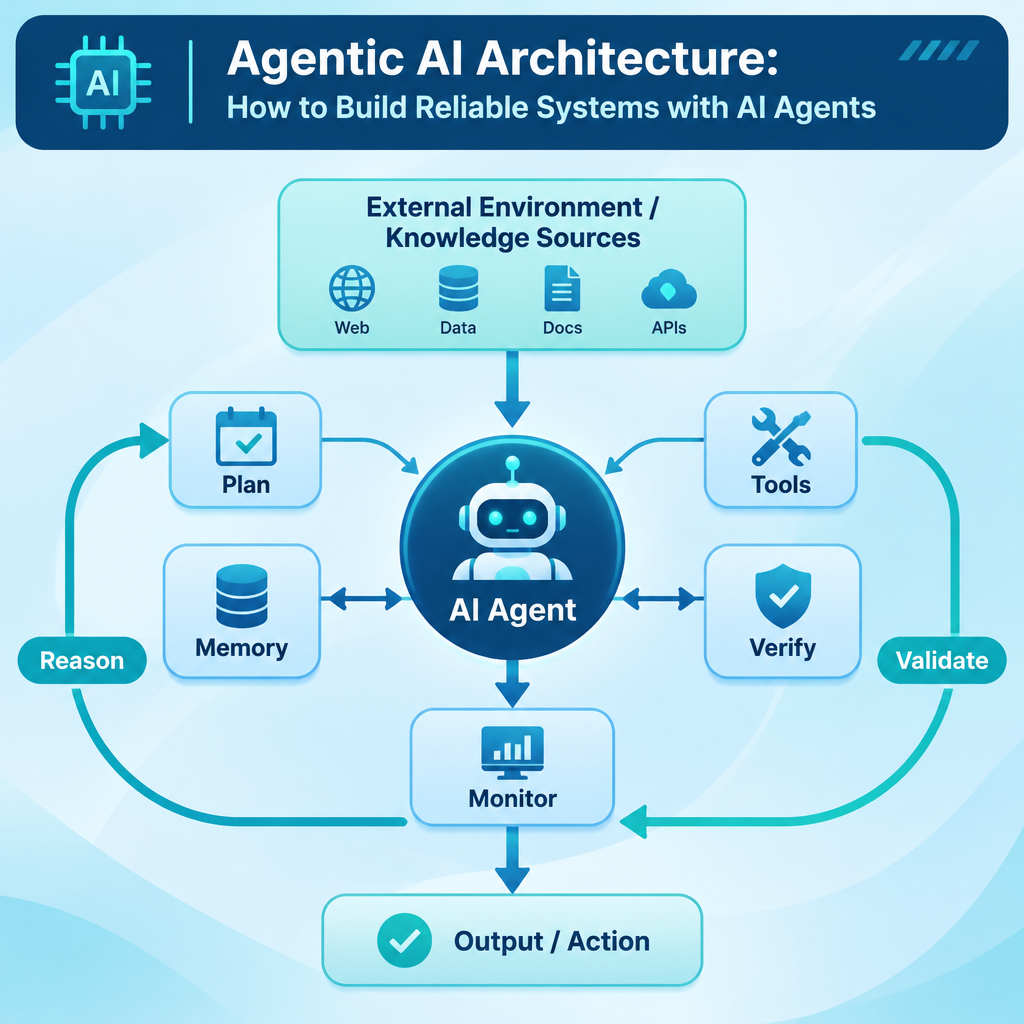
Agentic AI architecture is a way of designing software where one or more AI agents use language models, context, and approved tools to complete tasks. An agent might read a request, look up relevant records, call a service, check the result, and explain what it found. The surrounding application sets its limits and decides when a person must approve an action.
A language model alone is not an agent architecture. The model supplies a capability: it can interpret text, summarize information, or suggest a next step. The software around it supplies the rules of the road, including which data it may see, which tools it may call, what counts as success, and what to do when it is unsure. Without those controls, a model is simply a powerful component with an unclear job.
The architecture still uses familiar pieces. Microservices can provide business functions through APIs. Cloud infrastructure runs services and stores records. Identity systems manage access. Monitoring tracks health. The new pieces often include an agent or orchestration service, a model gateway, a context-building process, retrieval-augmented generation (RAG), tool definitions, and tests for model behavior.
Agents have grown from simple prompt-and-response calls into workflows with steps, branches, and handoffs among agents. More agents do not automatically mean better results. A small workflow may be easier to test, cheaper to run, and less confusing to operate than a large multi-agent design. Anthropic’s guide to building effective agents makes a similar practical case: start with simple patterns and add complexity only when it earns its keep.
Here’s the kicker: the model does not hold the whole system together. The quality of its context, the tools it can use, the guardrails around those tools, and the way the application handles failure all matter. Context engineering is the work of selecting and shaping useful information for a model call. It can include system instructions, user input, retrieved documents, recent conversation, and tool results. More context is not always better; irrelevant text can bury the facts that matter.
Progressive context disclosure can help. Rather than loading every manual, policy, and customer record at once, the system can start with a short index and fetch detailed material only when a request calls for it. RAG can retrieve relevant passages from approved sources, but teams still need to check that the passages are current, relevant, and allowed for the user to see. Google Cloud’s overview of retrieval-augmented generation describes how retrieval can connect model responses to external information.
Core Benefits and Why They Matter
The main benefit is support for work that does not fit neatly into a fixed form. Many useful tasks begin with an incomplete question, a pile of documents, or several steps that require judgment. An agent can help gather evidence, summarize a case, draft a response, or suggest the next action, while ordinary services handle the parts that must be exact.
- Less routine knowledge work. An agent can search approved material, bring related facts together, and prepare a summary for a person to review. In one internal support-tool design I worked through, the pain was not the lack of data; it was that staff had to open several screens and piece the answer together. A grounded summary could reduce that busywork without pretending to replace the staff member’s judgment.
- More useful interfaces. Users can state a goal in everyday language instead of learning a long menu of filters. The application can ask a follow-up question when a request lacks a needed detail. This is especially helpful when users know what they need but do not know which database field or service owns it.
- Better use of existing systems. Agents can call established APIs rather than copy every business rule into a new model prompt. A service can still validate an order, check a permission, or calculate a fee in ordinary code. That keeps clear rules in a form engineers can test and maintain.
- A path from data to practical knowledge. A system can combine records with approved policies and explain how they relate to a request. This can help a worker find an answer faster, but the application must show sources and make uncertainty visible. A confident-sounding answer without evidence is not a benefit.
- Flexible task flows. A fixed workflow may break when a request arrives in an unexpected order. An agent can choose among a limited set of steps, such as search, compare, and draft, while the system still controls which actions are allowed.
Let’s be real: these benefits depend on doing the unglamorous work. Data access has to be correct. Documents need owners. Tool permissions need limits. A model that saves a few minutes but exposes private records or invents a policy has made the system worse, not smarter.
I have seen teams focus on impressive demonstrations and skip the daily user’s actual task. A demo can make a model look sharp with a polished prompt and a handpicked example. In production, users send incomplete requests, old documents disagree, and a downstream API times out. Start by measuring the real work: time to finish, correction rates, escalation rates, and whether users can verify the result. Keep a person in control where mistakes could harm someone or affect an important decision. That is sound engineering, and it respects the dignity of the people who rely on the system.
Step-by-Step Guide to Implementing Agentic AI Architecture
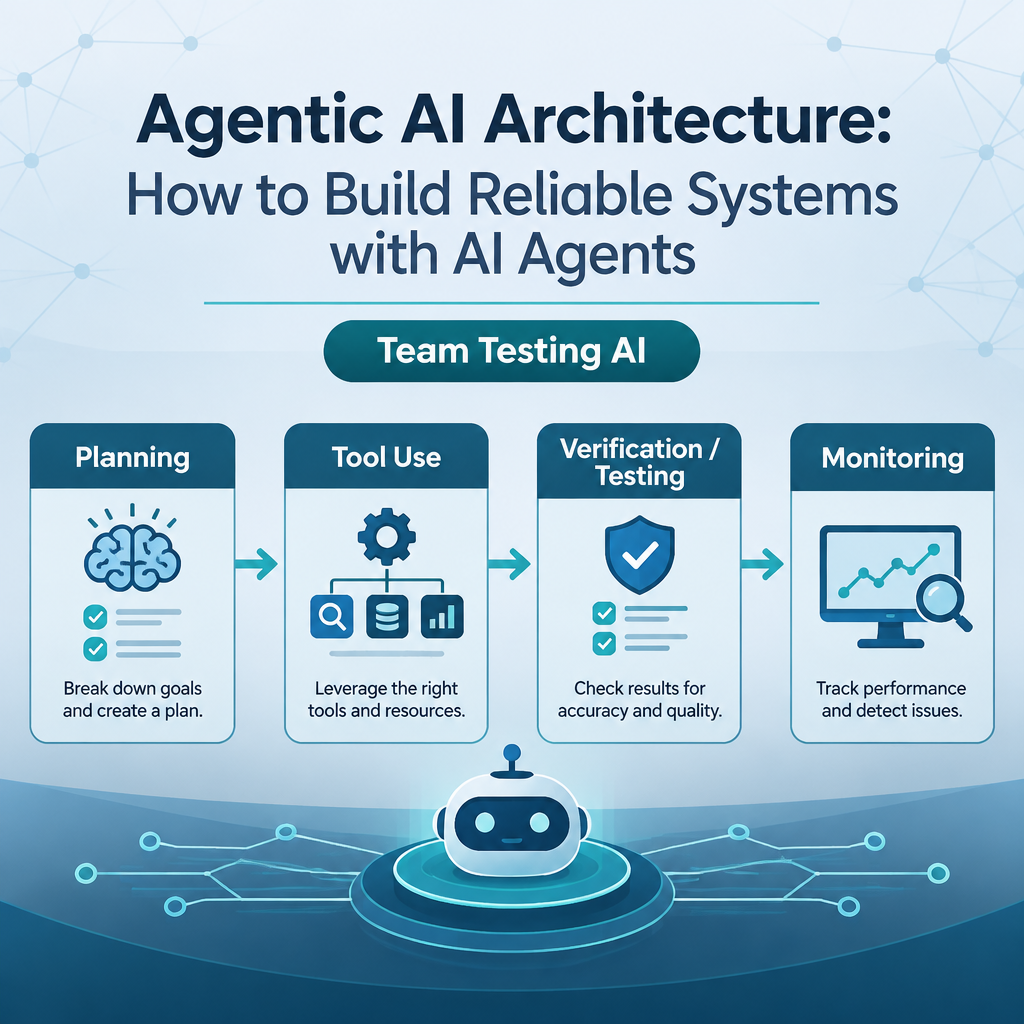
A measured rollout beats a grand redesign. Begin with one task, one clear owner, and a result you can check. I have watched well-meant architecture work stall because a team began with a broad goal such as “add an agent” instead of a specific user problem.
- Choose a bounded task. Find work that is frequent, time-consuming, and possible to check. Drafting a summary from a small set of approved documents is a better starting point than letting an agent change any customer account. Write down what the user gives the system, what it should return, and what must never happen.
- Decide which parts need a model. Separate flexible language tasks from fixed rules. Use code for arithmetic, permissions, required fields, and business policies that have a precise answer. Use a model where it helps interpret text, find a likely next step, or organize information. OpenAI’s practical guide to building agents also emphasizes clear tasks, tools, and safeguards.
- Design the agent’s tools narrowly. Give the agent only the functions it needs, such as searching a permitted knowledge base or preparing a draft. Define typed inputs and outputs. Have the service validate every request, and use access checks based on the signed-in user. A tool that can read everything or make broad changes is a security problem, not a shortcut.
- Build the context deliberately. Choose the instruction, user request, retrieved material, and history the model needs. Keep sources separate from the model’s own interpretation. Add citations or record identifiers so a user can check important claims. Store reusable context carefully, with a clear owner, review date, and retention rule. Avoid feeding the model whole databases or large document dumps merely because the context window allows it.
- Set the control flow. Decide when the agent can continue, when it must stop, and when a human must approve. For example, it may prepare a payment change but not submit it without review. Limit retries, tool calls, time, and cost. Set a safe fallback for missing evidence, model errors, and service outages.
- Test with real and difficult cases. Build a set of typical requests, vague requests, conflicting sources, and attempts to get data outside a user’s access. Check not only whether the answer sounds good, but whether it cites the right evidence, uses the right tools, follows permissions, and admits when it cannot answer. Because outputs can vary, run tests repeatedly and compare behavior across model or prompt changes.
- Observe the whole path. Record the request, selected tools, retrieved source identifiers, timing, errors, and final result, subject to privacy and retention rules. Keep sensitive data out of logs when it is not needed. A trace should help an engineer find whether the problem came from retrieval, the model, a tool, or a policy check.
- Release in stages. Start with a small group, then review corrections, user feedback, and operational failures. Use shadow or read-only mode where practical before allowing actions. Expand only when the system meets agreed quality and safety checks. NIST’s AI Risk Management Framework offers a useful structure for identifying, assessing, and managing AI risks throughout a system’s life.
The truth is, a strong prompt cannot fix a weak service boundary. Keep business services responsible for data changes and policy enforcement; let the agent request an action, while the service checks whether that action is allowed. This division makes it easier to test, audit, and replace model components without rewriting the business system.
I once reviewed a design where the agent was expected to answer a user, update a record, and send a notice in one go. Splitting that into a read-and-draft step followed by an approved write made the system less flashy, but much easier to reason about. That is often the right trade: a clear boundary is worth more than a clever demo.
Agentic AI Architecture vs. Traditional Microservices Architecture
The biggest competitor to an agentic design is not another AI framework. It is the traditional, deterministic architecture that already serves many business needs. That design remains the better choice whenever a system must apply exact rules to structured data, such as checking a balance or validating a required field.
| Area | Agentic AI architecture | Traditional microservices architecture |
|---|
| Main unit of work | An agent interprets a request and may select among permitted steps. | A service follows explicit code and rules for a defined request. |
| Input | Often includes natural language, documents, and changing context. | Usually structured API requests, events, or records. |
| Result | Useful for flexible summaries or recommendations; can vary. | Usually repeatable for the same input and system state. |
| Knowledge | Can use retrieved material and tool results as context. | Knowledge is commonly encoded in services, data stores, or rules. |
| Testing | Needs examples, quality checks, safety cases, and repeated evaluation. | Often relies on unit, integration, contract, and load tests. |
| Failure handling | Must consider unsupported answers, bad tool choices, and model limits. | Often focuses on service errors, timeouts, and invalid data. |
| Best fit | Open-ended tasks with clear limits and human review where needed. | Precise transactions and rules that must be applied consistently. |
This is not a winner-takes-all contest. A practical system often uses both: a model interprets a request, then calls a service that performs a precise operation. If the user asks for an explanation of a policy, an agent may retrieve and summarize approved text. If the user asks the system to change a policy-controlled setting, an existing service should validate the change.
Traditional systems are not magically safe just because their behavior is deterministic. Bugs, stale data, and poor access controls can still cause serious harm. But deterministic components are usually easier to reproduce and test against exact expected results. Agentic components need additional ways to check quality because the same request can produce different wording or take a different path.
Here’s the kicker: the best architecture may contain no agent at all. Anthropic’s discussion of agent design favors simple, composed solutions when they meet the need. A plain search feature, a rules engine, or a small workflow can be cheaper and more reliable. Add an agent when its ability to interpret varied requests or choose a useful next step solves a real problem, not because a roadmap says every feature needs one.
Common Mistakes to Avoid
Giving the agent too much freedom is a common mistake. Teams may let it call broad APIs or make important changes before they understand how it behaves. Start with read-only access or draft-only actions. Add narrow permissions only after testing shows that the step is safe and useful. Require approval for actions that affect money, access, private records, or someone’s rights.
Treating a longer prompt as better context is another trap. A large prompt can repeat instructions, include stale material, and bury the key facts. I have watched a team add more reference text after a weak answer, only to make the next answers less focused. Retrieve the smallest useful set of current information, label its source, and check whether it actually improves results.
Assuming RAG prevents hallucinations is wishful thinking. Retrieval can supply evidence, but the model can still misunderstand it, use the wrong passage, or answer beyond it. Test retrieval quality separately from answer quality. Ask whether the source supports the claim, whether it is current, and whether the user is allowed to see it. When evidence is weak, the system should say so or ask a person.
Building a multi-agent system too early adds moving parts. Every agent handoff can add latency, cost, and new failure points. Use multiple agents only when tasks have distinct roles or when a simpler design cannot meet a measured need. Start with one agent or a direct workflow, then compare the result with a simpler baseline.
Testing only the happy path hides the trouble that appears in real use. Try unclear prompts, conflicting documents, unavailable tools, unusual accents or wording, and requests that cross permission boundaries. Track incorrect answers and unsafe attempts, not just successful demos. Model updates can change behavior, so run the evaluation set again before and after meaningful changes.
Ignoring privacy, security, and upkeep creates risks that can outlast the initial build. Decide what data can be sent to a model, where logs live, how long data is retained, and who can inspect traces. Protect against prompt injection in retrieved documents and user input; treat external text as data, not instructions that overrule system policy. NIST’s AI risk framework is a reminder that oversight is ongoing work, not a launch-day checkbox.
Frankly, no checklist makes an agent trustworthy by itself. Trust comes from clear limits, useful evidence, careful access control, honest fallback behavior, and people who are accountable for the system’s effects. Stewardship means using the team’s time and the users’ information with care, not chasing the newest feature.
Frequently Asked Questions
What is the difference between an AI agent and a chatbot?
A chatbot mainly responds to a person’s message. An AI agent may also choose from approved tools, gather information, and take steps toward a defined task. The line is not always sharp: some chatbots use tools, while some agents only recommend actions. What matters is the behavior, permissions, and checks around it—not the product label.
Does agentic AI replace microservices?
No. Microservices can still own data, enforce rules, and perform reliable operations. An agent can call those services when natural-language understanding or flexible task planning helps. Keeping business rules in services often makes them easier to test and apply consistently.
How do teams reduce hallucinations in agentic systems?
Use relevant, current sources; show evidence for important claims; keep the agent within a defined task; and allow it to say it does not know. Test answers against examples and verify that cited sources support the claims. These steps reduce risk, but they cannot guarantee every answer is correct, so high-impact actions need stronger review.
When should a business avoid agents?
Avoid an agent when a small rule-based service already solves the task, when errors would be hard to detect or reverse, or when the data and access controls are not ready. Also reconsider the design if users cannot verify the output and no human review is possible. A simpler tool is often the more responsible choice.
Final Thought
Agentic AI architecture is not a license to hand business decisions to a model. It is a way to add flexible language and task support to systems that still need careful rules, dependable services, and responsible people. The strongest designs give agents a narrow job, provide relevant evidence, and make it easy to stop when the facts are not clear.
In my experience, good engineering is less about choosing the most impressive component and more about choosing the right limits. A small agent that helps a worker find an answer, shows its sources, and leaves the final decision with the right person can be more valuable than a grand system that acts without oversight. Build for the people who will use and maintain the software. Make failures visible. Keep the predictable parts predictable.
That is the standard I would use for any new AI feature: does it help someone do worthwhile work, can they check the result, and do we know who is responsible when it goes wrong? If the answer is yes, an agent may belong in the design. If not, more code, more agents, or a larger model will not repair the basic problem.