Agentic AI architecture is a way to build software in which AI agents interpret goals, use approved tools, and take steps toward a result. It extends familiar...
Agentic AI Architecture: How to Build Systems That Can Act Safely
Agentic AI architecture is a way to build software in which AI agents interpret goals, use approved tools, and take steps toward a result. It extends familiar cloud and microservice systems with model-driven decisions, changing how teams handle testing, security, oversight, and failures. The design challenge is not adding a chatbot; it is making action dependable.
I have watched engineering teams move from a tidy diagram of services to a prototype that could call APIs, retrieve documents, and draft a useful answer in a single afternoon. Then the hard questions arrived: What happens if the agent calls the wrong tool? Who approves a payment or a customer account change? How do you tell whether a bad result came from the model, the data, or the workflow? Those questions are why agentic architecture deserves careful design, not a rushed launch.
The shift is real, but predictions about its speed should be treated with caution. Plenty of software will remain ordinary, deterministic software, and that is often the right choice. The strongest designs will combine reliable code for rules that must not vary with agents for work that benefits from context, language, and flexible reasoning. This is an engineering change—and a responsibility to make systems serve people well.
What Is Agentic AI Architecture?
Traditional software follows instructions written in code. A service accepts a request, applies its rules, reads or updates data, and returns a result. It may be very complex, but its expected path can usually be described before it runs. An agentic system adds a different kind of component: an AI agent that can interpret a goal, choose among allowed actions, observe what happened, and decide what to do next.
That does not mean the agent has unlimited freedom or human-like judgment. It means the software gives a model a defined task, useful context, and access to selected tools, then checks what it does. A tool might search a company knowledge base, open a support ticket, query a database, or prepare a draft. A well-designed agent cannot simply reach any system it wants. Its tools and permissions should be deliberately constrained.
An agentic AI architecture is the wider software structure that supports these agents at useful scale. It includes model access, agent runtimes, tool interfaces, data retrieval, identity and permissions, orchestration, monitoring, evaluation, and human approval. It also includes the ordinary cloud pieces that keep products running: APIs, queues, databases, deployment systems, and security controls. In other words, it extends familiar architecture instead of discarding it.
A workflow can be simple: an agent receives a question, searches trusted documents, checks whether the answer is supported, and responds with citations. Another workflow might involve several agents or steps, with one gathering information and another checking a result. More moving parts do not automatically make a system better. Anthropic’s article on building effective agents makes a useful point: teams should prefer the simplest design that meets the need, adding complexity only when it earns its keep.
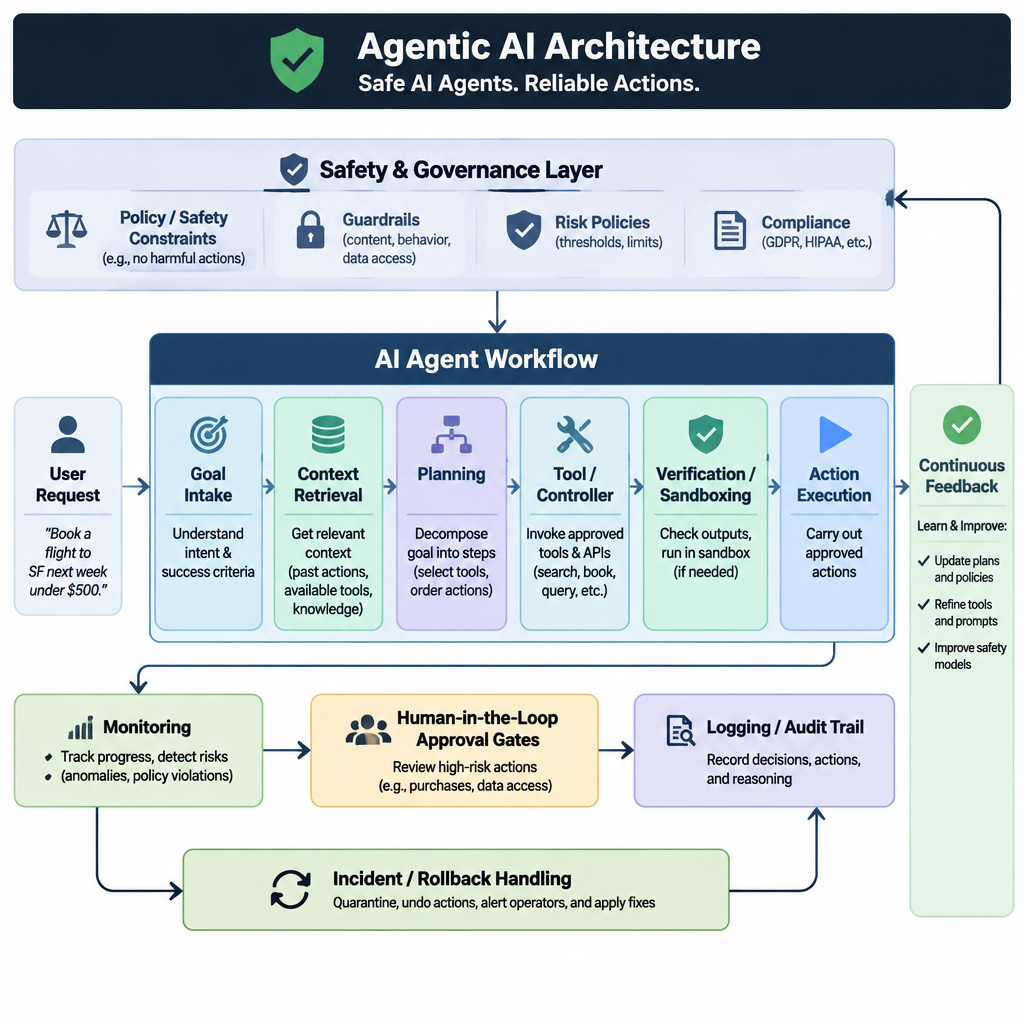
I once saw a prototype produce a polished answer while quietly relying on an outdated document. The interface looked finished; the underlying source was wrong. That is the difference between a convincing demo and a dependable product. Agentic architecture must make the source of information, the agent’s choices, and the limits on its actions visible enough to inspect.
Core Benefits and Why It Matters
Agentic systems can help when a task involves scattered information, many possible next steps, or natural-language requests that are hard to capture with a long list of fixed rules. They do not make every process faster, cheaper, or smarter by default. Their value depends on whether the task suits them and whether the system can verify the result.
- Less manual information gathering. An agent can search approved sources, bring together relevant details, and prepare a concise response. A person still checks high-impact decisions, but does not have to open six systems just to assemble a first draft. In my experience, this is often a better starting point than letting a model make a final decision.
- More flexible ways to ask for help. A user can describe a need in ordinary language rather than learn a complicated menu or query format. The software can turn that request into a limited sequence of retrieval and tool calls. This can help employees who know the work but are not experts in each internal system.
- A practical way to handle exceptions. Fixed workflows are excellent when every case follows the same steps. They become clumsy when the input is messy or an unusual case needs more context. An agent may gather evidence and suggest the next step, while firm business rules still decide what is allowed.
- Better support for knowledge work. Agents can summarize documents, compare records, draft messages, classify requests, or prepare a case for a specialist. These are useful aids, not proof that the specialist is no longer needed. The point should be to give people more room for judgment, not to make important work invisible.
- A common place to manage model use. A shared model gateway and agent runtime can help teams apply access controls, record usage, monitor cost, and update models without rebuilding each feature from scratch. This is especially valuable when several products need similar capabilities.
Here’s the kicker: a model’s fluent answer can hide a weak process. I have seen teams celebrate a fast prototype before checking how often it failed on odd inputs, how much it cost to run, or whether a user could correct it. Speed matters, but only alongside accuracy, safety, and a clear way to recover from mistakes.
The human value matters too. A system that handles routine searching can make skilled work less tedious, but the gains should not come at the cost of dignity, fairness, or accountability. Good architecture treats those as design requirements. It gives people understandable choices, a way to challenge an output, and a human decision-maker when the stakes call for one.
Step-by-Step: Implementing Agentic AI Architecture
Start with a real task, not a fashionable diagram. A narrow workflow provides a way to test whether agents add value and to learn where they fail. Here is a practical sequence.
- Choose a task with clear boundaries. Identify work that takes time, uses information from known sources, and has an outcome you can check. Drafting a first response from approved help documents may be suitable. Sending a refund or changing access rights without review is a much riskier first project. I have found that teams learn more from a small, well-measured task than from a grand assistant that claims to do everything.
- Write down what success and failure mean. Define what a good result looks like, which cases must be sent to a person, and what errors are unacceptable. Build a test set from real examples, with private details handled appropriately. Include routine requests, incomplete information, conflicting records, and attempts to steer the agent away from its task. Without this baseline, a smooth demo can fool everyone in the room.
- Use deterministic code for firm rules. Set limits in regular software wherever the outcome must be consistent: authentication, financial thresholds, permissions, required approvals, and data validation. An agent may prepare a recommendation, but fixed code should enforce hard boundaries. This division is not old-fashioned. It is how teams keep flexible reasoning from becoming a loophole around policy.
- Give the agent only the tools it needs. Expose narrow, well-named operations rather than a broad connection to an entire database or internal platform. Make read and write access separate. Require extra approval for actions that could affect money, privacy, access, or a person’s service. Record who asked for an action and what the agent attempted. A tool call is a real system action, not harmless text.
- Provide trusted context. If the agent needs company information, retrieve it from approved sources and show where it came from. Retrieval-augmented generation, or RAG, connects a model to selected material at answer time; it does not guarantee that the material is correct or current. The original RAG research explains the approach in detail. In practice, source quality, access rules, and document freshness matter as much as retrieval itself.
- Choose the simplest control flow that works. A single model call may be enough for a summary. A fixed sequence can suit a repeatable task. Use a looping agent or multiple collaborating agents only when the work genuinely needs it. More agents bring more handoffs, more chances for errors, and more places to spend tokens. A complicated graph is not a badge of engineering skill.
- Add review, logs, and recovery before launch. Define which outputs need human approval, how a person can reject or correct them, and what happens if a tool times out or returns bad data. Log the request, retrieved sources, model and prompt versions, tool calls, approvals, and final outcome while respecting privacy rules. Add timeouts, retry limits, and safe stopping behavior. If an action can be undone, document how to undo it.
- Test and operate it like a product. Run evaluations before changes reach users, then monitor quality in production. Track task success, unsupported claims, user corrections, tool errors, response time, and cost. Keep an easy way to disable an agent or fall back to a regular workflow. The NIST AI Risk Management Framework offers a useful structure for identifying and managing AI risks throughout a system’s life.
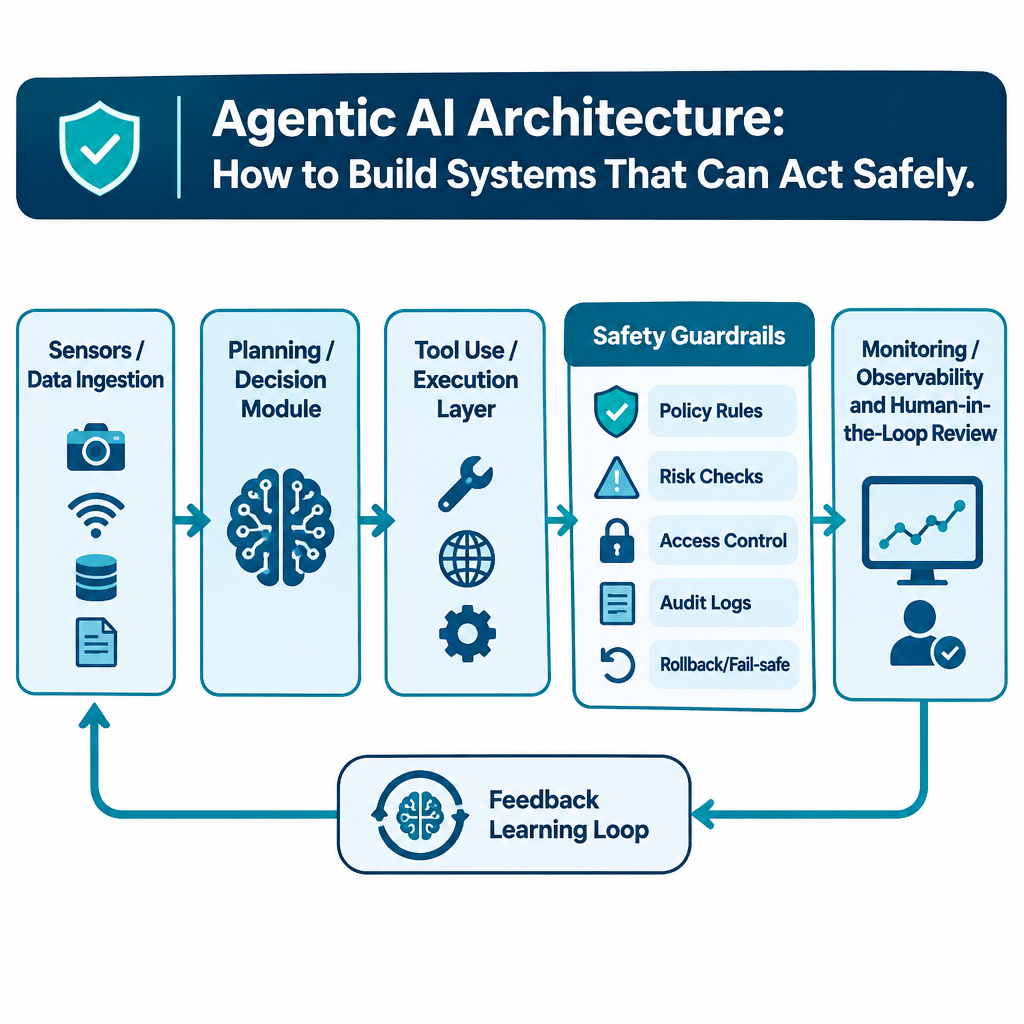
When I have reviewed AI prototypes, the most revealing test was often not a clever trick but a plain, incomplete request from a busy user. If the system asked a sensible follow-up instead of guessing, that was progress. If it made a confident change without checking its authority, it was not ready. Keep a person in the loop where the consequences justify it, and make that review meaningful rather than a rubber stamp.
Comparison: Agentic AI Architecture vs. Microservices
Agentic AI architecture and microservices are not direct competitors in the usual sense. Microservices describe a way to split software into services that communicate through defined interfaces. Agentic AI describes a way to add model-based components that can choose actions within limits. A product can—and often will—use both.
| Area | Agentic AI architecture | Conventional microservices architecture |
|---|
| Main strength | Handles tasks needing context, language, or flexible action selection | Handles defined operations with predictable rules and outputs |
| Typical control flow | Model may select a tool or next step from allowed choices | Code generally specifies the steps and conditions |
| Results | Can vary with prompts, context, and model behavior | Usually more repeatable for the same inputs and state |
| Testing | Needs example-based evaluations and checks for unsafe behavior | Commonly uses unit, integration, and contract tests |
| Failure concerns | Wrong tool choice, unsupported output, prompt injection, model or data changes | Service faults, bad inputs, network failures, or incorrect business logic |
| Best fit | Bounded tasks involving unstructured content and uncertain paths | Stable rules, transactions, and operations requiring exact behavior |
Frankly, replacing microservices with agents would be a poor plan for most teams. A payment service should still enforce its own rules. A permission check should not depend on a model guessing what a user probably meant. An agent can gather information and prepare a request, while a conventional service validates and carries out an approved action.
The difference also affects how teams test. A conventional endpoint can often be checked against expected input and output pairs. An agent needs those tests too, but it also needs evaluations across varied examples, checks on its tool use, and monitoring for changes in answer quality. The OpenAI guide to building agents discusses agent components and guardrails; it is a practical reference, not a reason to make every workflow agentic.
Think of the architecture as an addition, not a clean break. Microservices, queues, databases, and cloud controls still matter. Agents belong where flexible interpretation helps—and behind firm boundaries where it does not. For years, many useful products will mix both styles.
Common Mistakes to Avoid
Giving an agent broad authority too early is the most dangerous shortcut. Teams may connect a model to tools that can update records, contact customers, or alter access because the demo needs to feel impressive. But a successful demonstration is not a safety case. Begin with read-only tools, then add limited actions only after you have tested the workflow and added approval where needed.
Using an agent for a simple rule-based job wastes time and introduces uncertainty. If a short function can sort a request or check a known threshold, use the function. A model may still help interpret messy text before that check, but keep the rule itself in code. The truth is, not every problem needs AI, and there is no shame in a boring solution that works.
Assuming a strong prompt solves security is another common mistake. Prompt wording can help guide behavior, but it cannot replace authorization, input handling, or limits on tools. Retrieved documents and user-provided content may contain instructions designed to manipulate the agent. OWASP’s Top 10 for LLM Applications describes risks such as prompt injection. Treat all content the model reads as potentially untrusted, and enforce security outside the prompt.
Building a multi-agent system before proving the task makes debugging harder. Each extra agent creates another handoff, another prompt, and another place where context can be lost. I have seen teams split work across several agents because the design looked elegant, only to find that one carefully designed workflow was easier to test and maintain. Add agents when separate roles or independent checks measurably improve results.
Ignoring evaluation and production monitoring leaves teams unable to tell whether the system is improving. A few hand-picked examples do not reflect all users, documents, or edge cases. Evaluate against representative examples, review failures, and watch for changes after model, prompt, or data updates. Record useful measures such as task completion, human correction rates, tool errors, and cost. Avoid collecting more personal data than the work requires.
Treating human review as a checkbox can create the appearance of safety without the substance. Reviewers need enough context to understand what the agent did, what evidence it used, and what happens if they reject its suggestion. If the process pressures people to approve every output at speed, the review step is just decoration. A responsible design gives people authority, time, and a clear route to correct the system.
Frequently Asked Questions
What is agentic AI architecture?
It is a software architecture that includes AI agents able to interpret a bounded goal, use approved tools, and choose among possible next steps. It also includes the surrounding systems for data, identity, orchestration, monitoring, evaluation, and human oversight. The word agentic does not mean the software can act without limits. Well-designed systems give each agent a narrow role and restrict what it can read or change.
How is agentic AI architecture different from microservices?
Microservices split an application into smaller services with defined interfaces, and their behavior is generally determined by code. Agentic architecture adds components that use models to interpret context and select from permitted actions. They can work together: an agent can prepare a request, while a microservice checks the rules and performs an approved operation. The right choice depends on whether the task needs flexible interpretation or predictable execution.
Is agentic AI ready for production?
It can be suitable for production when the task is bounded, the system has been tested with realistic cases, and failures have safe outcomes. Read-only search, summarization, and draft preparation are often easier places to begin than actions that affect money, privacy, or access. Production readiness is not a property of a model alone; it depends on controls, monitoring, support, and the consequences of an error.
How should a team start adopting agentic AI?
Choose one task with a clear result and known information sources. Establish a baseline, use ordinary code for strict rules, and limit the agent to a small set of tools. Test both normal and troublesome inputs, include human approval for consequential actions, and monitor quality and cost after launch. Expand only when the results show that the agent helps more than a simpler workflow.
Final thought. The systems that last will not be the ones that give models the broadest reach. They will be the ones that pair useful flexibility with clear limits, careful measurement, and respect for the people affected by the software. That is not a timid approach. It is sound engineering and good stewardship of the tools and trust placed in a team’s hands.
Agentic AI will sit beside conventional software for a long time, and the boundary between them will keep changing as the tools improve. I would rather ship a small agent that can explain its sources and stop when uncertain than a grand one that acts first and asks questions later. Build the parts that help people, keep the rules that protect them, and let evidence—not excitement—decide what comes next.