Agentic AI architecture combines familiar software systems with AI agents that can interpret requests, gather context, use approved tools, and complete parts...
Agentic AI Architecture: How to Add AI Agents Without Losing Control
Agentic AI architecture combines familiar software systems with AI agents that can interpret requests, gather context, use approved tools, and complete parts of a task. It does not replace every service with a model. It adds model-driven work where flexible reasoning helps, while keeping clear rules around data, permissions, and human decisions.
Key Takeaways- Agentic AI architecture builds on microservices and cloud-native systems; it does not make them obsolete.
- Use agents for tasks that benefit from flexible language or knowledge work, not for every routine operation.
- Good context, limited tool access, monitoring, and human review matter as much as the model.
- Start with one narrow workflow and measure its results before adding more agents.
The practical change is not simply that software can produce fluent text. An agent can also select a tool, retrieve relevant information, pass work to another component, and continue toward a goal. That can help with support requests, document review, internal research, and other work where the next step depends on what the system finds. It can also create new failure paths. A model may misunderstand a request, retrieve the wrong record, or take an action that a conventional service would never attempt.
I have watched teams get excited about a clever demonstration, then discover that the real work was permissions, data quality, and making errors visible. Frankly, the architecture deserves more attention than the demo. This guide explains what agentic AI architecture means, where it can help, how to introduce it safely, and why conventional services remain essential. The goal is useful software that supports people’s work, not autonomy for its own sake.
What Is Agentic AI Architecture?
Agentic AI architecture is a software design in which AI agents perform meaningful parts of a product’s work. An agent receives a goal, uses a language model to reason about a next step, and may call approved tools or retrieve information before returning a result. Some systems use one agent. Others coordinate a chain or group of agents.
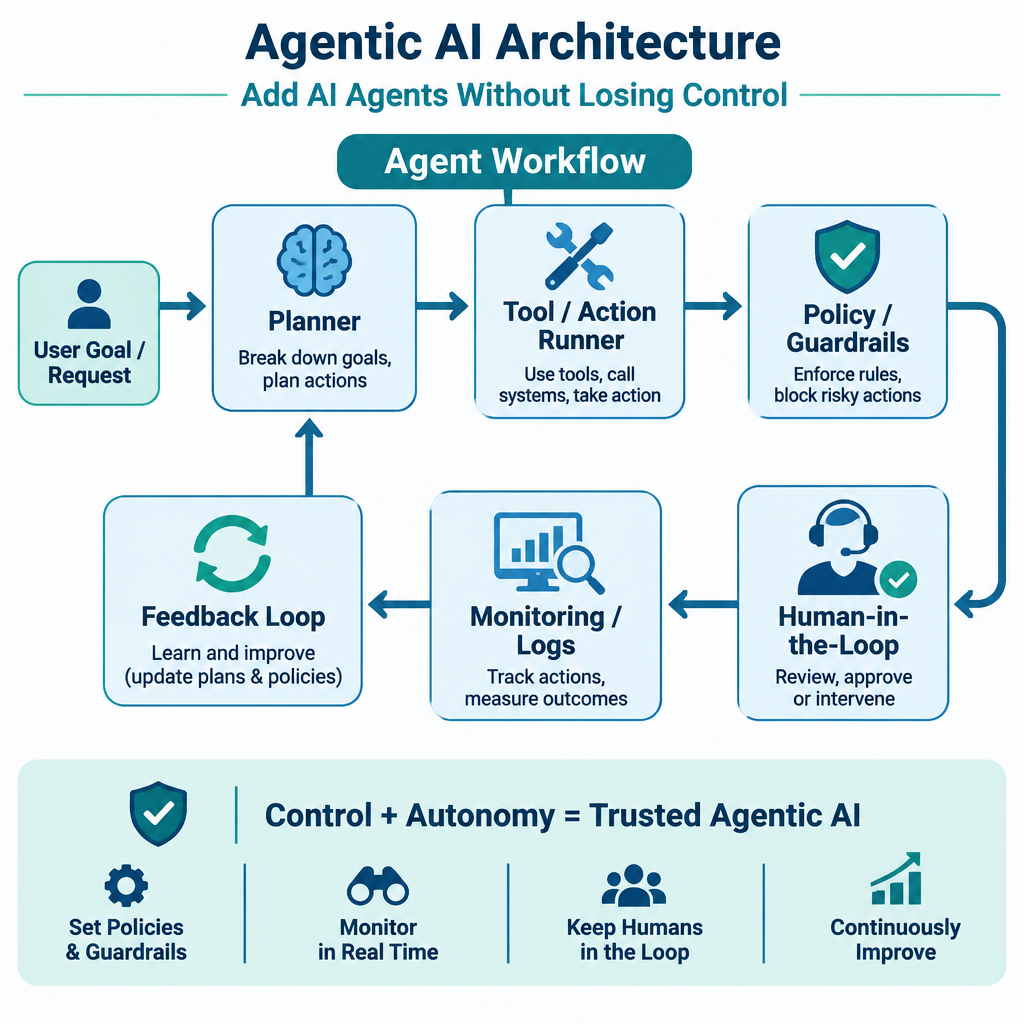
That does not mean every agent is a free-roaming digital worker. In a well-designed product, the agent operates inside a defined boundary. The application decides which model it can call, which records it may see, which tools it may use, and which actions require a person’s approval. The agent can propose or perform steps, but the surrounding system still sets the rules.
Traditional services are mostly deterministic: given the same inputs and state, they follow programmed logic. A model response is probabilistic. The same prompt can produce different wording or, at times, a different result. This difference matters. A payment calculation should remain a normal service with exact rules. A request to summarize a long case history may be a good fit for a model, because flexible language understanding can reduce manual effort.
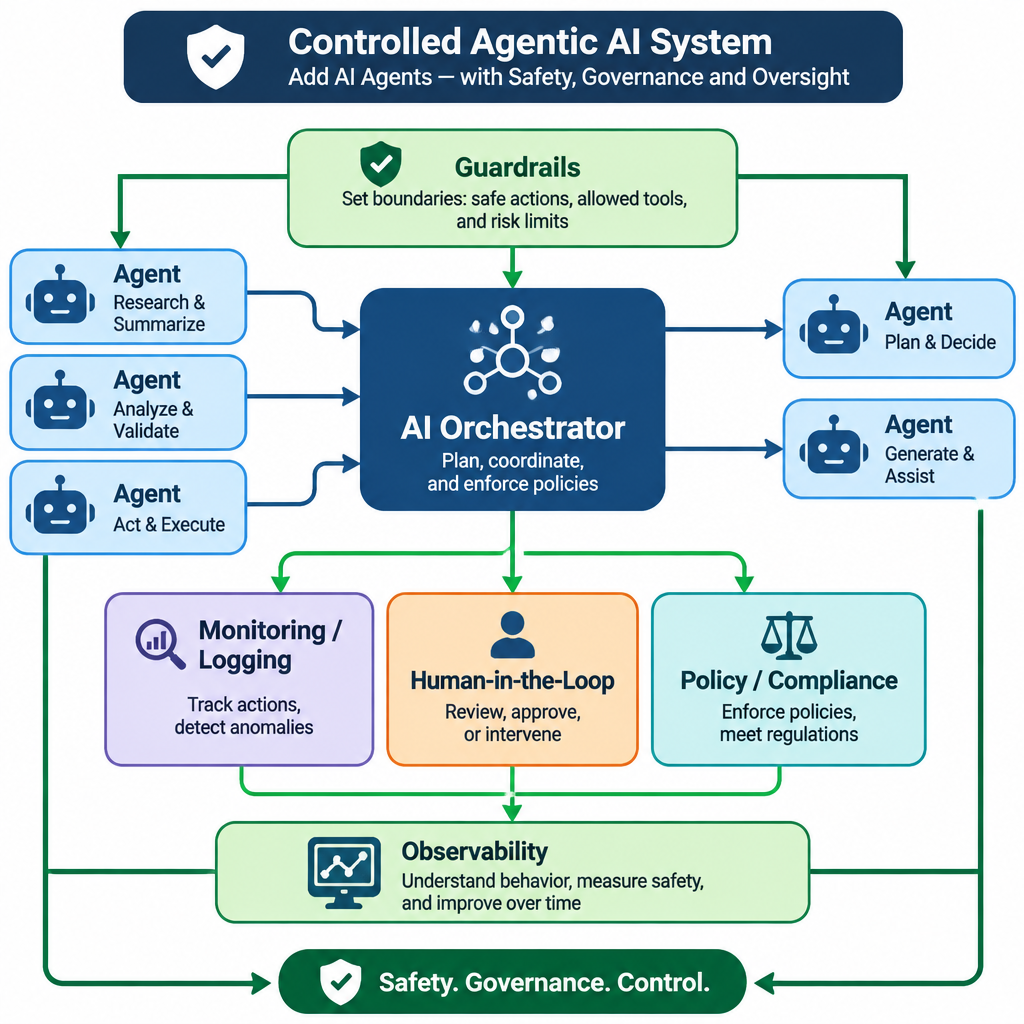
A practical architecture usually has several parts: a user-facing application; existing APIs and microservices; an agent runtime; a model gateway; a retrieval layer for relevant records; approved tools; and systems for logging, evaluation, and human review. The agent runtime controls the steps. The model supplies language-based reasoning. Business services remain responsible for authoritative data and actions.
Context is central. A model can only make useful decisions from the information it receives, so teams need a deliberate way to select, organize, and refresh that information. Retrieval-augmented generation (RAG) is one common approach: the application finds relevant content and supplies it with the prompt. The AWS overview of retrieval-augmented generation explains how retrieval can connect model responses to external information.
In practice, I treat the agent as one component in a larger workflow, not as the whole system. A service still owns the customer record. A policy still defines what may be shared. A person still handles a sensitive decision when the cost of a mistake is high. That division makes the system easier to test and easier to explain.
The word agentic can cover very different designs, from a single model call that selects one tool to multiple agents handing off work. More components do not automatically make a system smarter. Anthropic’s guide to building effective agents recommends starting with simple, composable patterns rather than adding complex agent structures without a clear need. That is sound engineering advice, not a lack of ambition.
Core Benefits and Why the Architecture Matters
The strongest case for agentic AI is work that depends on language, context, and judgment within clear limits. Many business processes involve reading information, connecting related details, and preparing a useful next step. Conventional code can do parts of this, but encoding every variation as fixed rules can become costly and brittle.
It can reduce repetitive knowledge work. An agent may gather material from several approved sources, draft a summary, and identify missing details. A support worker can spend less time copying text between screens and more time resolving the customer’s actual problem. The model does the first pass; a human checks the important parts.
It can make information easier to use. A business may store useful knowledge across documents, tickets, databases, and internal procedures. RAG can retrieve a small set of relevant passages for a particular request rather than asking a worker to search several systems by hand. This is not magic: stale or poorly labeled information still leads to poor answers. But it can make existing knowledge more accessible.
It can handle requests that are hard to fit into a fixed menu. A user may describe a need in ordinary language rather than choose a preset option. An agent can interpret the request, ask a follow-up question, and route it to a suitable workflow. This helps when user requests vary but the approved actions remain limited.
It can connect steps across services. An agent may gather details, call a search tool, and prepare a response using established APIs. The services continue to own their data and business rules. The agent coordinates a task rather than replacing every service with a large prompt.
I have seen a team spend more time debating the perfect model than deciding which work should be removed from a person’s queue. The second question is more useful. If a workflow has clear inputs, exact rules, and a low cost for automation, a normal service may be simpler. If it involves reading varied material and preparing a recommendation, an agent may help.
There is also an important human benefit. Software should respect the people whose work it touches. A system that gives staff time to handle difficult cases, rather than pushing them into a stream of low-value copying, can support the dignity of work. That only holds if the tool is honest about uncertainty and does not quietly shift risk onto workers or customers.
These benefits depend on measurement. Track whether the agent completes the task, how often a person corrects its work, how long the full process takes, and whether it produces harmful or unsupported answers. Do not count fluent output as success. The product is better only when the real workflow improves without creating new costs that the team has ignored.
Step-by-Step Guide to Implementing Agentic AI Architecture
1. Pick one bounded task
Start with a workflow that has a clear beginning and end. Examples include summarizing a case file, classifying a request for review, or drafting a response from approved knowledge. Avoid starting with a vague goal such as automate customer service. A broad goal hides important questions about permissions, quality, and responsibility.
I once saw a proof of concept try to answer questions, edit records, and send messages in one pass. It looked impressive in a meeting. In testing, no one could tell which step had gone wrong when the final result was poor. A narrow first task would have made the failure easier to find.
2. Map the existing process
Write down how the task works today. Identify the inputs, systems, people, decisions, and handoffs. Mark which steps follow firm rules and which depend on reading or interpreting information. Keep the deterministic steps in ordinary services wherever they fit. Agents should not be asked to guess a rule that the business can state exactly.
Also identify what a successful result looks like. Is it a correct summary, a useful draft, a safe route to a human, or fewer minutes spent searching? Set a baseline before implementation. Otherwise, a polished demonstration can distract from a workflow that has not improved.
3. Define the agent’s boundaries
Give the agent a specific role, a short list of allowed tools, and explicit limits. Decide what data it may access and which actions it may take. Reading a record is different from changing it. Drafting a message is different from sending it. Keep those distinctions visible in the architecture.
For high-impact steps, require a human to approve the action. Make the approval screen show the information behind the recommendation, not merely a button marked approve. OpenAI’s agent guide describes building blocks such as tools and guardrails; the application still needs to choose controls that fit its own risks.
4. Engineer the context
Choose what the model needs for this task and leave out material that does not help. Context may include the user’s request, relevant business rules, retrieved documents, and the results of earlier steps. Too little context can produce vague answers. Too much can bury the useful facts or include sensitive information unnecessarily.
Use retrieval for changing or large bodies of material, and keep source information visible where possible. Store useful context elements in ways that make them easy to update and reuse. Test retrieval quality separately from the answer. If the system supplies the wrong policy page, a stronger model will not repair the underlying mistake.
5. Build the smallest useful workflow
Begin with one agent and the minimum number of tools. Add a second agent only when a clear boundary improves the work, such as separating research from review or assigning different data access. Chains and multi-agent systems can help with specific tasks, but each handoff adds another place for errors, delay, and confusion.
Anthropic’s advice to favor simple patterns is worth remembering here. Let the workflow grow because evidence shows a need, not because a diagram looks more advanced. A small design is easier to test and explain to the people who will depend on it.
6. Test behavior, not just example prompts
Build a test set that includes common requests, incomplete requests, unusual wording, missing records, conflicting information, and attempts to use tools improperly. Check whether the agent gets the right information, chooses an allowed action, and admits when it cannot complete the task. Have people who understand the work review the outputs.
Measure the full task, including corrections and human review. Compare results with the existing process. A model that gives a quick answer but causes staff to spend longer checking it may not be an improvement. Record model version, prompt changes, tool calls, retrieval results, and errors so the team can trace what happened.
7. Launch with limits and monitoring
Release the agent to a small group or a low-risk part of the workflow first. Use access controls, rate limits, clear failure paths, and a way for staff to report bad results. Keep an audit record of decisions and tool actions, while protecting personal information and limiting retention to what the business needs.
The NIST AI Risk Management Framework offers a useful structure for identifying and managing AI risks. Treat risk review as part of product work, not a document written after launch. Set a rollback plan before expanding access. Then review results with the people using the system and change the design when the evidence calls for it.
Agentic AI Architecture vs. Traditional Microservices
The closest competitor to agentic AI architecture is not one product. It is the familiar approach built from deterministic applications, microservices, rules, and human judgment. Both approaches can solve valuable problems. The right choice depends on the work, its risk, and the cost of failure.
Microservices remain strong when a task has stable rules and exact outputs. They are easier to test against known inputs, and teams can often trace a failure to a particular service or rule. An agent can handle a less structured request, but its response may vary. That can be useful for summarizing a document and risky for calculating a charge.
| Area | Agentic AI architecture | Traditional microservices |
|---|
| Best fit | Language-heavy work with varied inputs | Stable rules and exact processing |
| Main control | Agent runtime, context, tools, and review | Programmed logic and service contracts |
| Output | Probabilistic; needs evaluation | Usually repeatable for the same state |
| Change effort | Prompt, retrieval, tool, and model changes | Code and configuration changes |
| Common risks | Unsupported answers, unsafe tool use, weak context | Integration failures, rule gaps, service outages |
| Human role | Review or approval for uncertain actions | Define rules, handle exceptions, operate services |
| Good design choice | Add where flexible interpretation helps | Keep where exactness and repeatability matter |
The best production design is often a hybrid. A model can read a request and suggest an action. A conventional service can verify eligibility and enforce business rules. A human can approve a consequential change. The agent contributes flexible interpretation; deterministic components protect facts and limits.
Here’s the kicker: comparing an agent with a microservice as though one must replace the other is the wrong question. Ask which part of the process needs language-based reasoning, then place that capability beside services that already work. Keep the data owner clear. Keep the action rules in code where exact rules are needed. Do not move a stable calculation into a model just because the model is new.
Common Mistakes to Avoid
Giving the agent too much authority. Broad access can turn a small misunderstanding into a real business action. Start with read access or draft-only behavior when possible. Add the ability to write or send only after the team has evidence that the workflow is reliable and the controls are ready. Frankly, a tool permission list is more important than a confident system prompt.
Treating a prompt as a safety plan. Prompts can describe desired behavior, but they are not a replacement for access controls, validation, or human approval. A prompt that says never change a record does not provide the same protection as a tool that cannot change records. Put critical limits in the application and the tools themselves.
Loading every document into context. More text is not automatically better. It can make the useful details harder to find, increase cost, and expose information the task does not need. Retrieve a focused set of material, check whether it is current, and show which sources supported the answer. Context engineering is a quality and privacy practice, not just prompt polishing.
Building a swarm before proving one agent. Multiple agents may make sense when tasks have distinct roles or data boundaries. They also make the system harder to debug. Each agent can misread a handoff or repeat work. Start small and add coordination only when test results show a concrete benefit.
Testing only happy paths. A clean demo request does not represent the range of real work. Users leave out details. Records conflict. A search may return nothing. A tool may fail halfway through. Test those cases, and decide what the system should do when it cannot proceed. Often the right answer is to ask a question or hand the task to a person.
Skipping evaluation after launch. Models, prompts, data, and user behavior can change. Keep a set of examples for repeated checks, review corrections, and watch for patterns in failures. NIST’s AI Risk Management Framework can help teams think about governance and ongoing risk, but a framework cannot substitute for operational follow-through.
Calling a fluent answer a correct answer. A smooth paragraph can still be wrong. Check facts against source records, measure task completion, and make uncertainty visible. I have seen teams celebrate the response that sounded most polished, even when a plainer answer was more accurate. The truth is, users need dependable work more than impressive wording.
Frequently Asked Questions
What is agentic AI architecture?
It is a software architecture that uses AI agents for parts of a product or business workflow. Agents may interpret a request, retrieve information, call approved tools, or pass work to another step. They operate within boundaries set by the surrounding application. Existing services, data stores, and human decisions remain important parts of the design.
How is agentic AI architecture different from microservices?
Microservices usually run defined logic with clear service contracts. Agentic systems add model-driven steps that can interpret varied language and select from approved actions. Their outputs may vary, so they need evaluation and stronger attention to context. In most cases, the two approaches work together: agents handle flexible interpretation while services enforce exact rules.
When should a team use an AI agent?
Consider an agent when a task involves varied language or documents, and a useful result can be checked before a high-impact action occurs. First see whether a normal service or simpler model call can solve the problem. Avoid an agent when exact, repeatable behavior is required or when the team cannot give it safe access to the information and tools it needs.
What is context engineering in agentic AI?
Context engineering is the practice of choosing, organizing, and managing the information given to an AI agent. It may include user input, business rules, retrieved documents, and results from earlier steps. Good context helps the model answer the task with relevant evidence. Teams should also manage context for privacy, freshness, size, and reuse.
Final Thought
Agentic AI architecture is not a reason to throw away sound software engineering. It is a reason to apply it to a new kind of component. Keep the services that protect your data and enforce your rules. Add an agent where flexible language work saves real effort, then measure whether it helps the people who use the product.
I remain skeptical of claims that a team needs a large network of agents to be modern. A narrow system with useful context, limited tools, and clear review can be more valuable than an elaborate one that nobody can explain. That is not a timid choice. It is a responsible one.
The hardest part is rarely writing the first prompt. It is deciding what the system may know, what it may do, and who takes responsibility when the answer is wrong. Make those choices plain. Give people a way to question the result and correct the record. When software handles work that affects someone else, care and accountability belong in the design from day one.