Agentic AI Architecture: How to Build Systems That Can Reason, Act, and Stay Under Control
Agentic AI architecture adds AI agents to software systems so they can interpret requests, choose tools, and complete multi-step work. It builds on cloud-native services and microservices, but introduces a new concern: software behavior can vary with model output, context, and tool results. That changes how teams design, test, and operate products.
The important shift is not that every service suddenly becomes intelligent. It is that some software can now work with messy requests and information that once needed a person to interpret, summarize, or route. That can help knowledge workers, but it also makes failures less predictable than a conventional API bug.
I have seen teams get excited about an agent demo and then discover that a polished answer is not the same as a reliable workflow. The useful question is not whether a model can perform a task once. It is whether the full system can do it safely, repeatedly, and with enough evidence for a person to trust the result.
What Is Agentic AI Architecture?
Agentic AI architecture is a software design in which AI agents handle meaningful parts of a product’s work by interpreting goals, gathering context, selecting tools, and taking actions. An agent commonly combines a language model with instructions, a set of permitted tools, access to relevant data, and rules for when to stop or ask a person for help. The model supplies flexible reasoning; the surrounding software supplies boundaries and dependable operations.
A chatbot usually responds to a prompt. An agent may do more: inspect a request, search a knowledge base, call a service, check the result, and decide whether another step is needed. That is a useful distinction, but not a reason to call every workflow an agent. A fixed sequence of API calls is often just a workflow, and that may be the safer, cheaper design.
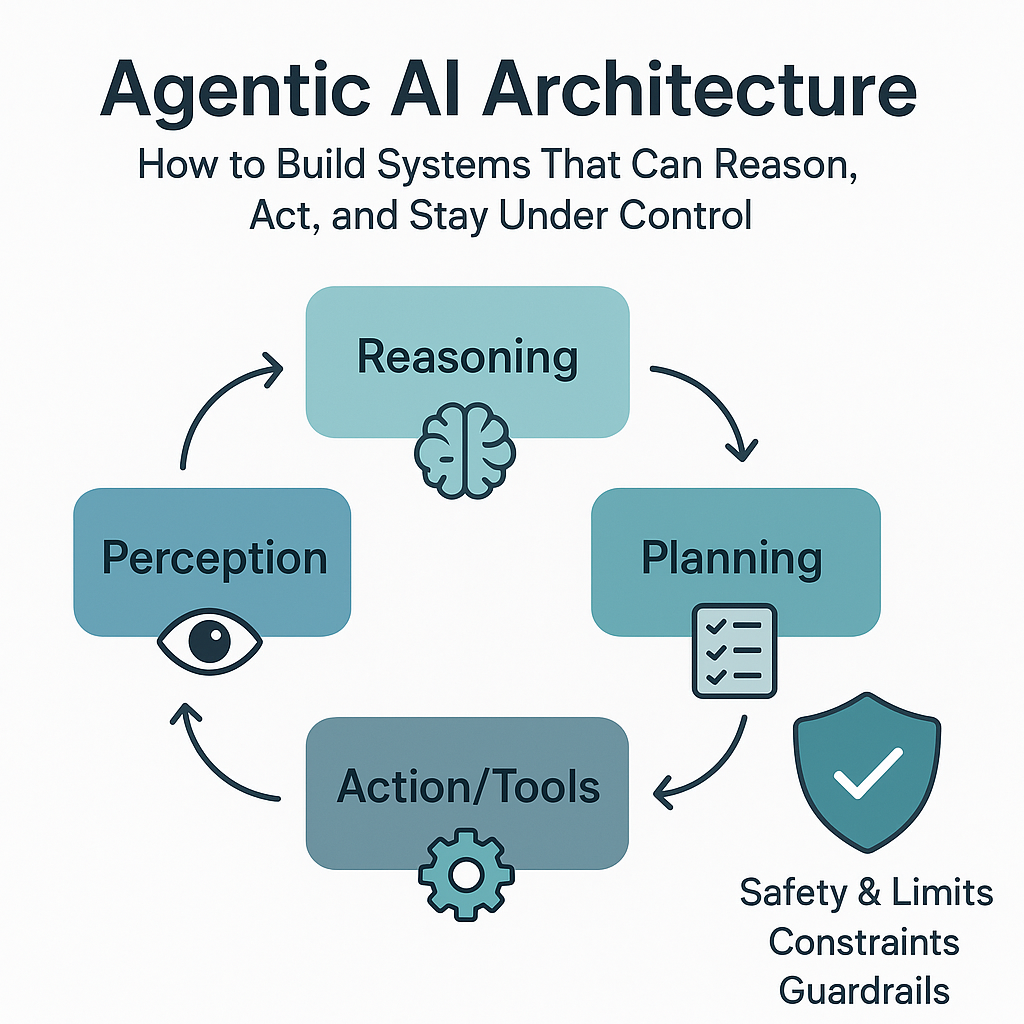
The basic cycle is straightforward. The system receives a goal, assembles a focused context, asks a model to choose an action, validates that action, runs an approved tool, and evaluates the result. The cycle may repeat until the task is done, a limit is reached, or a human must decide. The model does not magically gain authority over a database or payment service; the application grants specific access through tools and permissions.
This architecture builds on familiar components: APIs, queues, databases, identity systems, observability, and cloud infrastructure. It adds model serving, prompt and context management, retrieval-augmented generation, tool schemas, evaluation datasets, and safeguards against unreliable or harmful outputs. Memory can also help an agent use prior facts or procedures, though stored information must be governed like any other sensitive data.
The uncertainty matters. In a conventional service, the same code and input generally produce the same path, while an LLM may produce different wording or decisions across runs. Even when output appears sound, the agent can misunderstand intent, retrieve stale material, or call a tool with the wrong parameters. In my experience, teams make better choices when they draw the agent’s limits on the architecture diagram, rather than treating the model as a mysterious box.
Anthropic’s guide to building effective agents makes a practical point: begin with the simplest design that can do the job, and use more elaborate agent patterns only when they add value. That advice is not glamorous. It is also good engineering.
Core Benefits and Why They Matter
Agentic systems are useful when work involves interpretation, a changing sequence of steps, or information spread across multiple systems. They do not make every process better. The gains depend on whether the agent can work within clear rules and whether the cost of reviewing its output is lower than the time it saves.
- Handling natural requests. People often describe a need in ordinary language instead of choosing the perfect form field. An agent can interpret a request such as a support question, identify the likely task, and gather the right information. That can make a product easier to use, especially for tasks users do only occasionally.
- Connecting separate steps. A service desk request may require checking a knowledge base, looking up an account, drafting a reply, and routing the case. An agent can coordinate those steps through approved tools. The key is to keep each tool narrow and auditable, rather than handing the agent broad access to internal systems.
- Working with unstructured information. Documents, messages, and notes do not always fit neatly into tables. Models can summarize them, extract likely facts, and compare information in ways that conventional rules struggle to cover. Retrieval and citations help, but a fluent summary still needs checks when decisions carry real consequences.
- Reducing repetitive cognitive work. An agent can prepare a draft, identify missing fields, or assemble a short briefing so a person can focus on judgment and exceptions. When I have watched teams try this, the most valuable early feature was often not a fully automated decision. It was a first draft that removed tedious copying and let a human review the substance.
- Adapting to varied tasks. A rigid workflow can break when users ask for the same outcome in different ways. An agent may handle that variation without adding a separate code path for every phrase. That flexibility is useful only if the system can still show what it did and refuse requests outside its authority.
Here’s the kicker: productivity is not the same as headcount reduction or fewer clicks. A system that saves a minute but adds ten minutes of review has not helped. Measure completion time, correction rate, escalation rate, tool errors, and user satisfaction together. In one design review, a team’s best result came from using AI to prepare a concise case summary while leaving the final account change to an employee. The task became faster without pretending that a model should own the decision.
There is a responsibility here, too. Good software should respect the people affected by its decisions, protect their data, and give workers a fair way to correct mistakes. Treating careful review as part of the product is not a drag on innovation; it is stewardship of the tools and trust a team has been given.
Step-by-Step Guide to Implementing Agentic AI Architecture
A sound implementation begins with a small, measurable problem. Teams get into trouble when they begin with a model choice, draw a complicated agent diagram, and only afterward ask what the product needs to accomplish. Start with the work, the risks, and the existing systems.
- Choose a bounded task. Pick work that is frequent, time-consuming, and possible to check. Examples include summarizing a support case, finding relevant policy documents, or preparing a draft response. Avoid starting with a task that moves money, changes access, or makes a consequential decision without review. Write down what success means and what failure costs.
- Map the current process. Record the inputs, decisions, data sources, rules, and handoffs. Separate stable rules from judgment calls. If a business rule is clear—such as an allowed status transition—keep it in ordinary code. In projects I have reviewed, teams sometimes gave an LLM a rule that a small validation function could enforce exactly. That added uncertainty without adding useful flexibility.
- Decide whether an agent is needed. A deterministic workflow may be enough if the steps are known in advance. Use an agent when the system must interpret varied requests, select among tools, or adjust its next step based on results. Anthropic’s agent design guidance and OpenAI’s agents documentation both offer useful patterns for deciding how much autonomy a task needs. Do not add autonomy for decoration.
- Define tools as narrow contracts. Give each tool a clear name, a typed input, a limited purpose, and a predictable result. A search tool should search; a change tool should change one specific thing. Validate parameters before execution, check authorization in the service itself, and record the request. The model’s tool description helps it choose an action, but it is not a security boundary.
- Prepare context with care. Provide only information needed for the next decision: relevant instructions, user intent, retrieved records, and the results of earlier actions. Retrieval-augmented generation can find useful material, but permissions must carry through retrieval, and the system should show where important claims came from. Avoid stuffing every document into the prompt. Too much context can bury the signal and increase cost.
- Set stop rules and human review. Specify a maximum number of steps, time limit, retry policy, and conditions that require escalation. Require confirmation before actions with lasting effects, such as sending an external message or changing a customer record. I once saw a prototype repeatedly retry a failing tool because no one had defined when it should stop. A simple limit and clear error path would have prevented that loop.
- Build evaluations before release. Create representative examples, difficult edge cases, and known failure cases. Score whether the agent chose the right tool, used the correct data, followed policy, and reached a useful result—not just whether its final prose sounds confident. Run the same cases across model or prompt changes. Include a human review set for work where mistakes could harm customers or employees.
- Add monitoring and a rollback path. Log model version, prompt version, tool calls, retrieval results, latency, errors, and human overrides, while minimizing sensitive data in logs. Watch for changes in task success, cost, and escalation. Keep a way to disable agent actions or return to a conventional workflow. The operational plan matters because a model provider, data source, or tool can fail independently.
- Expand only after evidence. Begin with a pilot, compare it with the existing process, and ask the people doing the work what went wrong. If a single agent cannot meet the goal, first check whether better context, a clearer tool, or a fixed workflow solves the problem. Add multiple agents only when separate roles or parallel work show measurable benefits. More moving parts mean more failure modes.
Agentic AI Architecture vs. Traditional Microservices
Agentic AI architecture and traditional microservices are not rival products. Most agentic systems rely on ordinary services for identity, data access, business rules, and transactions. The real comparison is between a system whose key behavior is mostly deterministic and one that delegates part of its work to a model-guided agent.
| Area | Agentic AI architecture | Traditional microservices architecture |
|---|
| Main behavior | Model interprets goals and may choose among approved actions | Code follows defined rules and service contracts |
| Best fit | Variable requests, unstructured data, and flexible task routing | Stable processes, exact rules, and repeatable transactions |
| Predictability | Output and action choices can vary; needs evaluation and limits | Usually more consistent for the same input and version |
| Data handling | Often combines retrieval, context, model input, and tools | Usually reads and writes through explicit APIs and queries |
| Testing | Requires scenario tests, evaluations, and human review | Commonly uses unit, integration, and contract tests |
| Failure response | May need to stop, retry carefully, or ask for help | Often follows known error handling and retry behavior |
| Access control | Tools must enforce permissions outside the model | Services enforce permissions through established controls |
| Operating cost | Includes model, retrieval, tool, and review costs | Mostly compute, storage, network, and maintenance costs |
The table can make the agentic option look more complicated because, frankly, it is. A conventional service is usually the right choice for a payment calculation, an access check, or a fixed approval rule. An agent can help assemble information for a person making a judgment, but it should not quietly replace the authoritative rule engine.
The strongest production design is often hybrid. An agent can interpret an email and draft a structured request; deterministic services can validate the request, enforce permissions, and commit the change. That split gives the model room to handle language while leaving exact rules to code that can be tested directly. It also keeps a clearer record of what the agent suggested and what the system actually did.
For an architecture review, ask where the model is allowed to influence a result, what data it can see, which tools can change state, and who can reverse an action. If those answers are fuzzy, the diagram is not ready. A helpful reference for risk planning is the NIST AI Risk Management Framework, which organizes work around governing, mapping, measuring, and managing AI risk.

Common Mistakes to Avoid
The first mistake is treating a successful demo as proof of reliability. A demo may use clean inputs, a friendly user, and a person standing nearby to rescue it. Production brings ambiguous requests, outdated records, service outages, adversarial prompts, and users who do not know what the agent can do. I have seen a prototype look brilliant in a meeting and struggle once real data and real edge cases arrived. Test ordinary mess, not just the happy path.
Another mistake is reaching for a multi-agent system too early. Multiple agents can divide work by role, compare answers, or handle parallel tasks, but each handoff adds latency, cost, and another place to lose context. Start with a clear single-agent loop or a conventional workflow. Add coordination only when measured results show that separate agents solve a problem a simpler design cannot.
A third mistake is giving the model broad tools and hoping instructions will keep it safe. The model can misunderstand a request or be influenced by untrusted text found in a document. The OWASP Top 10 for LLM Applications describes risks such as prompt injection and insecure handling of model outputs. Keep permissions in application code, validate every tool call, separate read and write access, and make sensitive actions require confirmation.
Teams also confuse a long prompt with good context. More text is not automatically more knowledge. Irrelevant history can crowd out the facts needed for a decision, while poor retrieval can surface stale or unauthorized records. Build retrieval with access checks, track source documents, and test whether the agent can distinguish evidence from guesses. Give it a way to say that the available information is not enough.
Do not evaluate only the final answer. A polished response can hide a wrong lookup, an unauthorized tool attempt, or an invented source. Keep traces of the steps that matter, and score tool selection, data grounding, policy compliance, and completion. At the same time, avoid logging everything indiscriminately; logs can expose personal or business information. Decide what to retain, who can see it, and when to delete it.
Finally, do not automate the human handoff out of the design. Some tasks need a person because the evidence conflicts, the action is hard to reverse, or the consequences are serious. Define how the agent explains uncertainty, what it sends to the reviewer, and how a correction improves the process. Let’s be real: a system that knows when to stop is often more useful than one that keeps talking.
Frequently Asked Questions
What is agentic AI architecture?
Agentic AI architecture is a software design that uses AI agents to interpret goals, gather context, choose approved tools, and carry out one or more steps. It combines models with application code, data access, permission checks, monitoring, and stop rules. The model can help with flexible language and decisions, while ordinary services should continue to enforce exact business rules. The term does not mean that every component is autonomous or that a model should act without limits.
How is agentic AI different from microservices?
Microservices are independently deployable services that expose defined capabilities through APIs or other contracts. Their behavior is generally controlled by code and data. An agentic system can use microservices as tools, but adds a model that interprets requests and selects among permitted actions. The two approaches work together: the agent handles variable language or task routing, while services manage transactions, identity, validation, and stable business rules.
When should a company use an AI agent?
Use an agent when a task involves varied requests, unstructured information, or a sequence that depends on intermediate results—and when the outcome can be checked. Begin with low-risk work, such as research assistance, case summaries, or draft preparation. Keep high-impact decisions and irreversible actions under stronger controls or human review. If a fixed workflow can solve the problem more simply and reliably, use the fixed workflow instead.
How do you test and secure an AI agent?
Test with realistic examples, including ambiguous requests, missing data, tool failures, and attempts to exceed the agent’s authority. Measure whether it selected the right tools, relied on valid evidence, followed policy, and stopped when needed. Enforce access control in the tools and services, not only in prompts. Monitor model and tool behavior, protect logs, require approval for sensitive changes, and maintain a rollback or fallback path.
Final Thought
Agentic AI architecture is worth taking seriously, but it is not a reason to discard the engineering habits that made software dependable. Clear interfaces, least privilege, careful testing, good operational records, and honest failure handling still matter. The difference is that teams must now test not only what their code does, but also how a model behaves when requests, retrieved facts, and tool results change.
I have learned to distrust the urge to make a system look clever before it proves useful. Begin with a small task, give the agent only the access it needs, and make its work visible to the people who rely on it. Keep deterministic rules deterministic. Let humans decide where judgment, accountability, or care cannot be delegated safely.
The best architecture will not be the one with the most agents or the grandest diagram. It will be the one that helps people do worthwhile work, gives them a clear path to correct mistakes, and respects the consequences of each action. That is a practical standard, not a slogan. And it is a good place to start.