Agentic AI Architecture: How Context, Memory, and Knowledge Make Agents Reliable
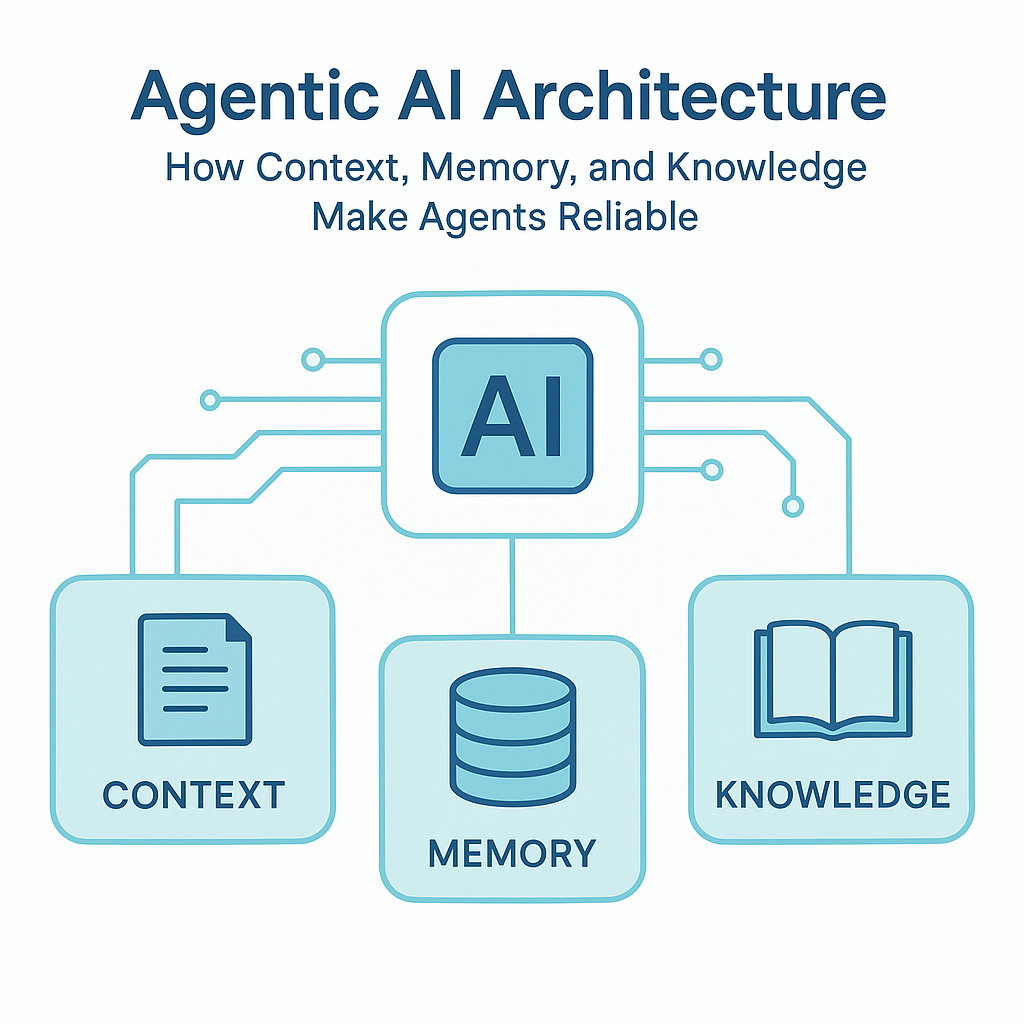
Agentic AI architecture is the design of the systems that let AI agents use tools, follow rules, and act on information over time. Its hardest problem is not merely finding data; it is deciding what belongs in the current task, what should persist as memory, and what must remain an authoritative rule. Get those boundaries wrong, and an agent can confidently do the wrong thing.
These distinctions sound tidy on a diagram. Production systems are messier: records change, users have different permissions, tools return partial results, and long prompts can bury the one fact the model needs. I have seen teams spend days improving prompts when the real defect was a stale policy record or an overstuffed retrieval result. That is not a model problem alone. It is an architecture problem.
The goal is not to give an agent a perfect memory of everything. People do not recall every fact at every moment, and a useful system should not either. If I am making an omelet, I need the ingredients, the user’s dietary limits, and perhaps the stove setting; I do not need a lesson on kneading bread. Good architecture selects the right information for the job, keeps it within the proper authority, and records enough evidence to explain what happened.
What Is Agentic AI Architecture?
Agentic AI architecture is the set of components and rules that lets an AI system observe a task, decide what to do, call tools, interpret results, and continue or stop. Unlike a basic chatbot that mostly returns one answer, an agent can carry out a sequence of steps: check a record, compare it with a policy, request approval, and then take an allowed action. The sequence needs guardrails, not just clever wording.
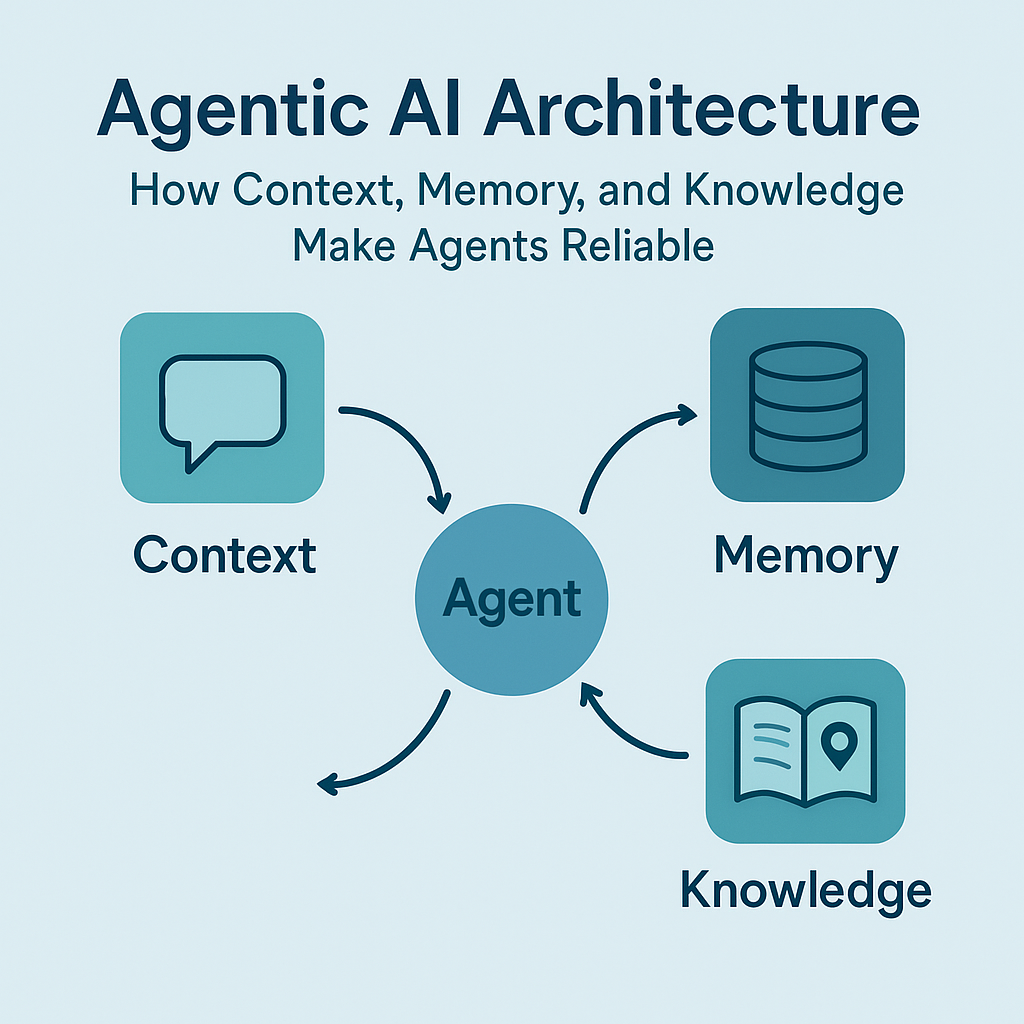
A useful design separates context, memory, and knowledge. They work together, but they are not interchangeable. Confusing them causes predictable trouble: a temporary instruction may be kept too long, an old preference may override a current request, or a model’s general training may be mistaken for an official business rule.
Context is the active information the model can use right now. It may include system instructions, the current user request, selected conversation history, tool results, and retrieved documents. It is like working memory or RAM: useful for the present task, limited in size, and generally not a reliable place for permanent storage. Context should answer: what does the agent need to see to complete this step safely?
Memory is stored information that may be used after the current interaction ends. It can include a user’s saved preference, a summary of an earlier case, or the status of a multi-step job. Memory is not automatically true just because it was saved. It needs a source, a timestamp, a purpose, an access rule, and a way to update or delete it. A system that stores every conversation is not necessarily remembering well; it may simply be hoarding data.
Knowledge is the vetted reference layer: approved policies, product facts, procedures, and domain records. It can live in a database, document store, API, or carefully managed model training data. For rules that change, an authoritative external source is usually safer than hoping a model’s training remains current. In an omelet task, the recipe may be knowledge; the user’s egg allergy may be memory; the request to cook breakfast now is context.
An organization can govern these layers through a control plane: shared rules for identity, permissions, policy versions, tool access, retention, and audit. The term is an architectural pattern, not a magic product or universally fixed standard. In practice, the control plane needs to tell each agent who is asking, what the agent may do, which sources count as authoritative, and when a person must approve an action.
That separation matters because a model predicts likely text; it does not automatically know which company rule is current or whether a user may see a record. The NIST AI Risk Management Framework treats AI risk as something organizations must govern, map, measure, and manage. That is a sound starting point. A reliable agent is not just a model with tools attached. It is a governed software system with explicit state, permissions, and failure handling.
Why Context, Memory, and Knowledge Matter
The three layers matter because agents make decisions from the information they can access, not from the information an architect meant to provide. A neat prompt cannot rescue a system that mixes stale customer details with current policy. Nor does a large knowledge base help if retrieval hands the agent an irrelevant page. Frankly, volume is easy; disciplined selection is the hard part.
- More relevant answers: When a system retrieves a small set of current, task-specific facts, the model has less room to confuse unrelated material. I once reviewed an assistant that cited a general refund page for a special warranty case. The page was real; it was simply the wrong authority for that customer’s situation. Separating policy sources by scope would have prevented the mistake.
- Safer actions: A control plane can restrict tool calls based on identity, role, task, and risk. An agent may be allowed to draft a refund request but not issue the refund without approval. That boundary protects customers and staff, and it gives the system a clear stopping point.
- Useful continuity: Memory can spare users from repeating stable preferences or re-explaining a long-running task. But a saved preference should not overrule a direct instruction today. A current request to use a different shipping address should take priority over an old default.
- Lower cost and less delay: Every unnecessary document or repeated history token consumes time and money. A small, targeted context often performs better than a prompt stuffed with every possibly relevant detail. The research paper Lost in the Middle reports that language models can perform worse when useful information appears in the middle of long contexts. Bigger prompts are not a free lunch.
- Better accountability: Provenance makes it possible to ask where a claim came from, which policy version applied, and what tool result supported an action. In engineering reviews, I have found that a simple record of retrieved document IDs and timestamps often settles disagreements faster than another round of prompt edits.
- More respectful data handling: Memory should serve a clear purpose, not collect personal details just because storage is cheap. Data minimization reflects stewardship and respect for people’s dignity. If the system does not need a detail to do its job, it should not keep it by default.
These benefits depend on design and testing. Memory can preserve a bad inference, retrieval can return a document the user cannot access, and a tool can fail halfway through an action. The system should treat every layer as fallible. A sensible agent checks, records, and asks for help when the evidence is weak.
Step-by-Step: Building a Reliable Agentic AI Architecture
Start with the task, not with a model shopping list. Teams often begin by asking which model or vector database to use, then discover that nobody agreed on what the agent is allowed to do. I have seen architecture discussions move faster once the team wrote down the real task, its risks, and its stop conditions first.
- Define the job and its boundaries. Write the task as a sequence of observable outcomes. For example: classify a support request, find the relevant account record, check the approved refund policy, draft a recommendation, and request human approval before payment. Name forbidden actions too. “Help with refunds” is vague; “never issue money without a verified case and an authorized approval” is testable.
- Map the information by authority. List what the agent needs and identify the owner of each fact. Mark each item as context, memory, or knowledge. A current request is context. A saved language preference may be memory. The official refund policy is knowledge. Do not let the model’s general training stand in for a policy database, especially when a wrong answer could harm a person or create a legal problem.
- Set identity and permissions before retrieval. Determine who is asking, what records that person may access, and which tools the agent can call. Apply access checks before private data reaches the model, not merely after the model drafts an answer. For high-impact actions, separate read, draft, and commit permissions. A useful rule is that the agent should not have broader power than the person or process it serves.
- Build a deliberate retrieval path. Search only approved sources, filter by user access and task scope, and return documents with useful metadata: title, owner, date, version, and source location. If two records conflict, the agent should follow an explicit precedence rule or report the conflict. The guidance in Anthropic’s overview of building effective agents favors simple, composable designs over needless layers of orchestration. That is good engineering advice: add complexity only when a measured need justifies it.
- Choose what memory may retain. Define memory types and rules. A short-lived task state may expire after a job ends; a user preference may persist until changed; an incident record may need a formal retention schedule. Store the source, time, confidence, and reason for saving each item. Give users a way to inspect or correct personal memories where appropriate. The MemGPT paper explores managing information across limited active context and longer-term memory. Its core lesson for system designers is practical: memory needs explicit movement and management, not wishful thinking.
- Assemble context for each step. Give the model only the instructions, relevant memory, selected knowledge, and recent tool results needed for the next decision. Keep the authoritative rule visible when the model must act on it. Put important constraints near the point of use; do not bury them in a long transcript. A task may need different context at each stage, so treat context construction as an explicit function in the architecture.
- Make tool use observable and recoverable. Validate tool inputs, check outputs, set timeouts, and handle retries carefully. A successful API response does not prove that the result is correct or complete. Record the requested action, the tool response, and the final decision. For actions that cannot be undone, require confirmation or a second check. If an operation fails halfway through, the agent needs a safe recovery path rather than an improvised guess.
- Test the whole system, not just the prompt. Create test cases for stale policies, conflicting memories, missing records, malicious instructions in retrieved text, denied permissions, and tool outages. Measure task success, wrong-action rates, citation quality, latency, and cost. The OpenAI prompt engineering guidance offers practical advice on clear instructions and structured inputs, but prompt quality is only one part of the test plan. Include humans who understand the work and the people affected by mistakes.
- Set a clear stop and handoff rule. Agents should know when evidence is thin, sources disagree, a user asks for something outside policy, or the requested action has high impact. A good handoff says what is known, what remains uncertain, and what a human must decide. “I cannot safely finish this step without approval” is better than a confident guess.
Agentic AI Architecture vs. a Traditional RAG Chatbot
A traditional retrieval-augmented generation chatbot, or RAG chatbot, usually retrieves documents for a question and drafts an answer. It can be effective for support search, product documentation, and other information tasks. Agentic architecture may use RAG too, but adds planning, tools, state, permissions, and decisions about whether to continue, stop, or ask a person. It is not a replacement for every chatbot.
| Capability | Agentic AI architecture | Traditional RAG chatbot |
|---|
| Main purpose | Complete a bounded task using reasoning and tools | Answer a question using retrieved documents |
| State across steps | Can track task state and selected persistent memory | Often focuses on one question or a short exchange |
| Tool use | May call APIs, databases, and workflow tools | Usually retrieves content and generates a response |
| Permissions | Needs explicit checks for data access and actions | Commonly has lower action risk, though access still matters |
| Human review | Can pause for approval before consequential actions | Often relies on a person to act on the answer |
| Main risks | Wrong actions, stale memory, tool failure, excess autonomy | Irrelevant retrieval, unsupported answers, stale content |
| Best fit | Multi-step work with clear limits and measurable outcomes | Search and answer tasks where no action is needed |
The two patterns can share the same retrieval service and knowledge base. The difference is in what the system is asked to do after retrieval. A RAG chatbot may explain a refund policy; an agent might check a case, prepare a refund, and route it for approval. The second system needs more controls because its output can change the world.
Do not call a system “agentic” just because it uses a tool once. That label does not tell you whether its state is reliable, its permissions are safe, or its work can be audited. The Anthropic discussion of agent design is useful here because it stresses simple patterns and careful evaluation. Start with the least complex design that completes the job, then add planning or memory only when the task needs them.
Common Mistakes to Avoid
Treating memory as truth. A saved statement can be mistaken, stale, or written by the wrong user. Store provenance and dates, and check important facts against an authoritative source. I have watched teams promote a brief model-generated summary into a permanent profile without checking it. That is not learning; it is turning a guess into policy.
Putting every document in the prompt. More text can increase expense and make relevant facts harder to spot. Search with filters, rank results, and keep a limit on what enters the active context. Long-context studies such as Lost in the Middle are a reminder that models do not always use every part of a long input equally well. Measure retrieval quality instead of celebrating a large token count.
Letting the model decide who may see data. Access control belongs in dependable application code and service policies, not in a request asking the model to “be careful.” Enforce permissions before retrieval and before tool execution. Then test denied access as carefully as successful access. Frankly, a friendly refusal in the prompt is not a security boundary.
Saving too much personal information. Memory can improve continuity, but it can also create privacy and retention problems. Decide what is necessary, how long it is kept, who can inspect it, and how it can be removed. A system should remember for a reason and forget when that reason ends. This is sound stewardship as well as sound engineering.
Confusing a smooth answer with a correct action. An agent can speak clearly while using an outdated rule, misreading a tool response, or skipping a required check. Validate the underlying steps and outcomes. Track whether the correct source was retrieved, whether the action was permitted, and whether the system stopped when it should.
Giving an agent broad autonomy too soon. Teams sometimes jump from a demo to live write access because the demo looked convincing. Start in read-only mode, then allow drafts, then approve narrow actions, and only later consider limited automation. Use human review when the cost of a wrong action is high. This is not timidity; it is responsible deployment.
Ignoring the bill and the delay. Each model call, retrieved record, and tool round trip adds cost and time. A chain of many agent steps can be slower and less reliable than one clear workflow. Track cost per completed task, not just cost per model request. If a simple rule or database query solves the problem, use it.
Frequently Asked Questions
What is the difference between context, memory, and knowledge?
Context is the information available to the model for its current step. Memory is selected information saved for possible use later. Knowledge is the vetted source of facts, rules, and procedures. A current request is context, a saved preference may be memory, and an approved company policy is knowledge. Keeping the three separate helps prevent old or untrusted information from overriding current rules.
Does an AI agent need long-term memory?
No. Many useful agents can complete a task with current context and access to trusted knowledge, without keeping personal details after the session. Long-term memory makes sense when continuity has a clear benefit, such as remembering a user-approved preference or tracking an open case. Set retention, correction, and deletion rules before storing it.
How does agentic architecture reduce hallucinations?
It can lower risk by retrieving relevant, current material, keeping authoritative rules clear, checking tool results, and requiring citations or human review where appropriate. It cannot guarantee that a model will never invent or misread something. Test the full system, expose uncertainty, and make unsupported claims less likely to become actions.
What is the biggest risk in an agentic AI system?
A likely high-severity risk is an agent taking a consequential action with the wrong information or too much permission. Other major risks include private data exposure, stale memory, unsafe tool input, and failures that are not caught. The right priority depends on the task, so map risks before deployment and monitor them afterward.
Final Thought
A capable agent does not need to remember everything. It needs the right fact, from the right authority, at the right moment—and it needs to know when that fact is not enough. That sounds less exciting than a promise of fully autonomous software. It is also more useful. In production, the difference between a helpful assistant and an expensive incident often comes down to a small boundary: which policy wins, whether a memory is still current, or whether the agent must stop for approval.
I have learned to distrust architectures that depend on one enormous prompt and a hopeful instruction to “use good judgment.” Good judgment needs structure. Give the system clear sources, narrow permissions, traceable state, and a safe path to ask for help. Treat memory as something entrusted to the system, not something it owns. That approach serves the people doing the work and the people affected by it.
Build the smallest design that can do the job safely. Measure it against real tasks, including awkward failures. Keep the rules current, make important choices inspectable, and remove data that no longer serves a clear purpose. An agent that can explain its limits may look less magical. It is far more likely to earn trust.