Agentic AI Architecture: A Practical Guide to Building Systems That Can Act
Agentic AI architecture is a way to build software in which AI agents use language models, tools, data, and controlled memory to complete multi-step work. It keeps the familiar foundation of APIs, microservices, and cloud platforms, but adds systems that can choose actions, ask for help, and adjust based on results.
I have spent years building and reviewing software systems, and I have seen the same lesson repeated: complexity grows faster when teams skip clear boundaries. In my experience across large technology companies and smaller product teams, a useful architecture makes responsibility visible. Agentic systems need that discipline even more than ordinary services do. An agent can interpret a request and choose a next step, but that freedom must sit inside firm limits.
This change is not a reason to throw away microservices, queues, or deterministic code. Those pieces still do much of the work well. The new job is deciding which tasks benefit from model-based judgment, then connecting that judgment to data and tools without giving it unchecked authority. That is architecture, not a clever prompt.
What Is Agentic AI Architecture?
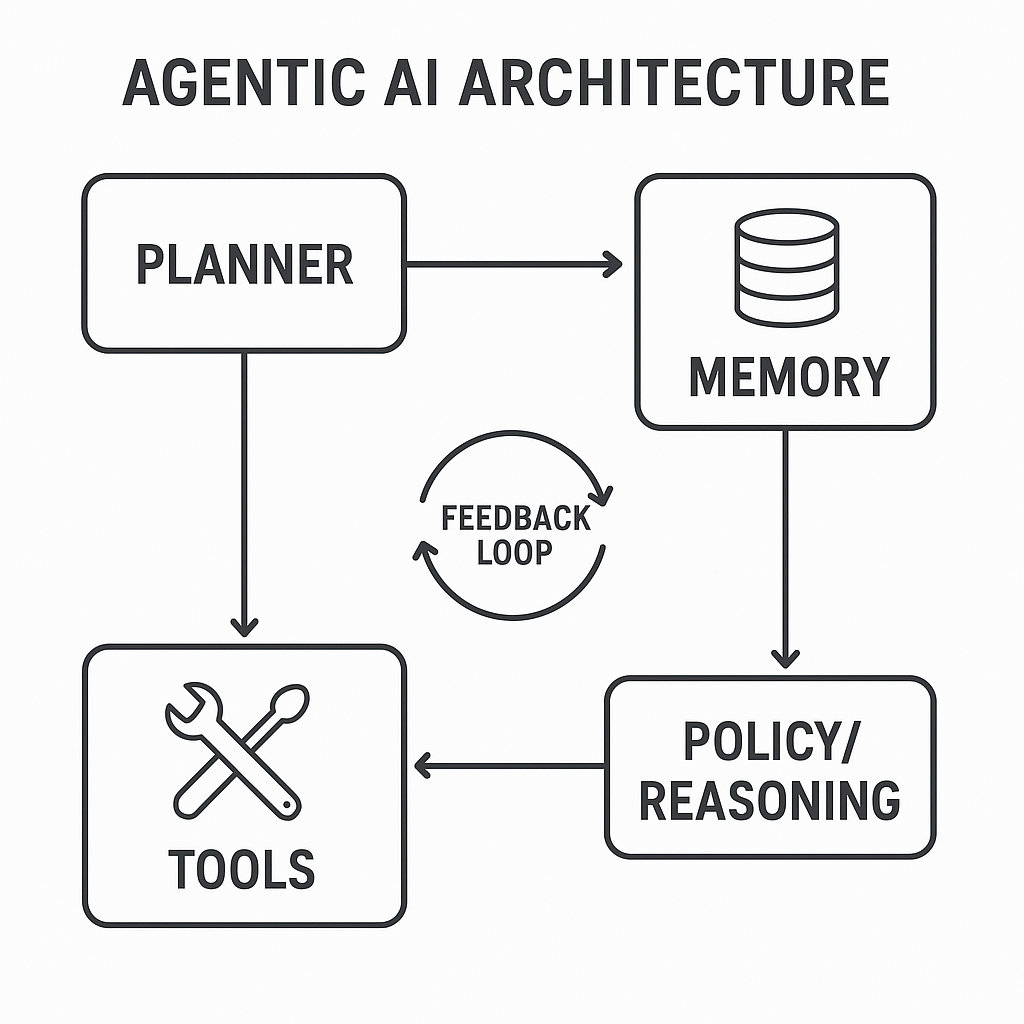
An agentic AI architecture is a software design in which one or more AI agents use a model, context, and permitted tools to pursue a task. An agent may interpret a user request, retrieve relevant information, call an API, check the result, and decide whether to continue or ask a person for help. The model helps select a next step; ordinary software still provides the boundaries and reliable operations.
That distinction matters. A conventional service usually follows code written by an engineer: receive a request, validate it, perform a known operation, and return a result. An agent can choose among multiple allowed actions when the request is unclear or the steps depend on what it discovers. This can help with work that involves messy language or many possible paths. It can also make behavior less predictable, so engineers must design for that difference.
An agent is not simply a chatbot with a database connection. A production agent usually has a defined purpose, a model, a set of tools, instructions, context assembled for the task, and rules for when to stop or hand control to a person. It may also keep memory, though memory should be chosen carefully: information that helps one task can confuse another. The model’s context window is not a substitute for a sound data design.
Agentic systems can be built as a single agent, a sequence of agents, or a graph in which different agents handle distinct tasks. More agents do not automatically mean better results. Anthropic’s guidance on building effective agents recommends starting with the simplest pattern that meets the need, rather than reaching for a complex agent system by default: Building effective agents.
The agent still needs a home in the wider system. It might run inside a service exposed through HTTP or gRPC, respond to messages on a queue, or connect to tools through a protocol such as Model Context Protocol (MCP). MCP is designed to standardize connections between AI applications and external tools or data sources; its official introduction explains the basic model. Agent2Agent (A2A) addresses communication between agents. Google introduced A2A as a way for agents built with different technologies to work together: Google’s A2A announcement.
These protocols help with communication. They do not decide which agent should access a customer record, approve a payment, or change a business rule. Those remain architecture and governance decisions. Keep agents inside bounded contexts—areas with clear ownership and data rules—so one team’s agent does not quietly acquire reach across the whole company.
Core Benefits and Why They Matter
Agentic AI is useful when software must handle language, incomplete information, or a task with several reasonable next steps. It is not an automatic upgrade for every application. Frankly, a well-written rule is often cheaper, faster, and easier to test than a model call.
- It can reduce repetitive knowledge work. A support agent might sort a request, find the relevant policy, draft a response, and prepare the right case details for a human. The person still decides what to send when the case is sensitive. The model handles the searching and assembly, not the final responsibility.
- It can work with information that does not fit tidy forms. Documents, emails, service notes, and user questions often contain useful details in different formats. Retrieval-augmented generation (RAG) can bring selected source material into the agent’s context so it can answer with evidence. That is helpful, but only if the retrieved material is current, relevant, and access-controlled.
- It can connect existing capabilities. An agent may call a search service, a ticketing API, and a scheduling tool in one task. Teams can reuse services they already own instead of rebuilding every function inside a new AI platform. A strong tool contract makes the agent’s choices easier to inspect and restrict.
- It can support flexible workflows. A fixed process can handle known steps. An agent may help when the next action depends on what the previous action found. The benefit is flexibility, not magic. Each action still needs limits, timeouts, and a way to recover when something fails.
- It can give people more time for judgment. I have seen teams lose hours to copying details between systems, checking the same policy page, and preparing routine summaries. Automating parts of that work can free staff to handle unusual cases and serve customers directly. The goal should be to respect the dignity of people’s work, not to disguise a staffing decision as a technical feature.
- It can improve access to organizational knowledge. Employees may ask questions in everyday language rather than knowing which database or team owns an answer. An agent can help locate information and explain where it came from. If the source is missing or uncertain, a safe system says so instead of inventing a confident answer.
A practical example: a purchasing assistant could compare a request with an approved supplier list, retrieve relevant policy, and prepare a draft order. It should not silently approve an unusual purchase or bypass a spending limit. The architecture should make the useful part easy and the risky part difficult.
Here’s the kicker: the business value depends on the full workflow. A fluent answer that cites the wrong policy is not a success. Measure whether the task was completed correctly, safely, and at a cost the organization can support.
Step-by-Step Implementation Guide
A sound implementation starts with a narrow problem and grows only when the evidence supports it. I have watched teams rush to build a multi-agent platform before they could explain what a single agent should do. That is an expensive way to discover the requirements.
- Choose a task with clear value and limited risk. Pick work that consumes time, has enough examples to test, and has a visible outcome. Summarizing internal documents or sorting support requests may be suitable pilots. Avoid beginning with unsupervised money movement, legal decisions, or changes to critical production systems. Write down what success means in terms a user can verify.
- Decide whether the task needs an agent at all. Draw the steps. If the work follows the same sequence every time, a normal workflow with one model call may be enough. Use an agent when the system must choose between permitted actions based on what it discovers. This distinction follows the useful separation between predefined workflows and more open-ended agent behavior described in Anthropic’s agent design guidance. Keep the first version boring.
- Set the boundary before connecting tools. Define the agent’s job, the data it may read, the actions it may take, and the actions that require approval. Organize access by business domain. An agent for returns should not automatically reach payroll or product pricing just because those systems are technically available. Domain boundaries reduce accidental coupling and limit the damage if the agent or its credentials are misused.
- Design the context deliberately. Decide what the model needs for this specific request: user input, relevant policy, retrieved records, task state, and perhaps a short history. Avoid stuffing every document into the prompt. Too much context can hide the important facts, raise cost, and make answers harder to check. Store reusable context in managed sources, retrieve only what is relevant, and preserve citations or record identifiers so the result can be traced.
- Give tools narrow, typed operations. Prefer a tool such as
create_draft_refund with explicit fields and limits over a general tool that can run arbitrary commands. Validate every input in ordinary code. Check authorization at the service boundary, not just in the prompt. An instruction telling the model to behave is not an access-control system. - Add approval and recovery paths. Decide what happens when information is missing, tools fail, the model is unsure, or actions disagree. For a high-impact operation, let the agent prepare a recommendation and require a person to approve it. Make retries safe, use idempotency where appropriate, and record which actions have already occurred. A person should be able to stop the process without needing to understand the model internals.
- Test behavior with real examples and difficult cases. Build a test set with routine requests, edge cases, missing data, conflicting instructions, and attempts to misuse tools. Check whether retrieval finds the right source, whether the agent selects allowed tools, and whether it stops when it should. Test complete workflows, not only isolated model responses. Compare model changes against the same evaluation set before deployment.
- Release gradually and watch the system. Start with a small group or a read-only mode. Track task completion, human corrections, tool errors, response time, model cost, and safety incidents. Keep a way to disable the agent or send work to the older workflow. In production, log enough to investigate what happened while protecting private data. A dashboard that counts requests but ignores wrong actions is not useful monitoring.
- Review ownership and operations. Name the team that maintains the agent, the tools, the retrieval sources, and the policies it depends on. Establish how prompts, models, permissions, and data sources change. If nobody owns an agent after launch, it will drift. Treat it like a production service with on-call responsibility, version control, and a retirement plan.
For architecture, one common pattern is an agent service within a bounded context, connected to approved tools through MCP or internal APIs. Another is an asynchronous worker that receives a message, performs a limited task, and returns a result. A2A may be useful when independently built agents need to coordinate, but do not add a protocol merely because it is available. Choose the communication path that makes ownership and failure handling clear.
Agentic AI Architecture vs. Traditional Microservices
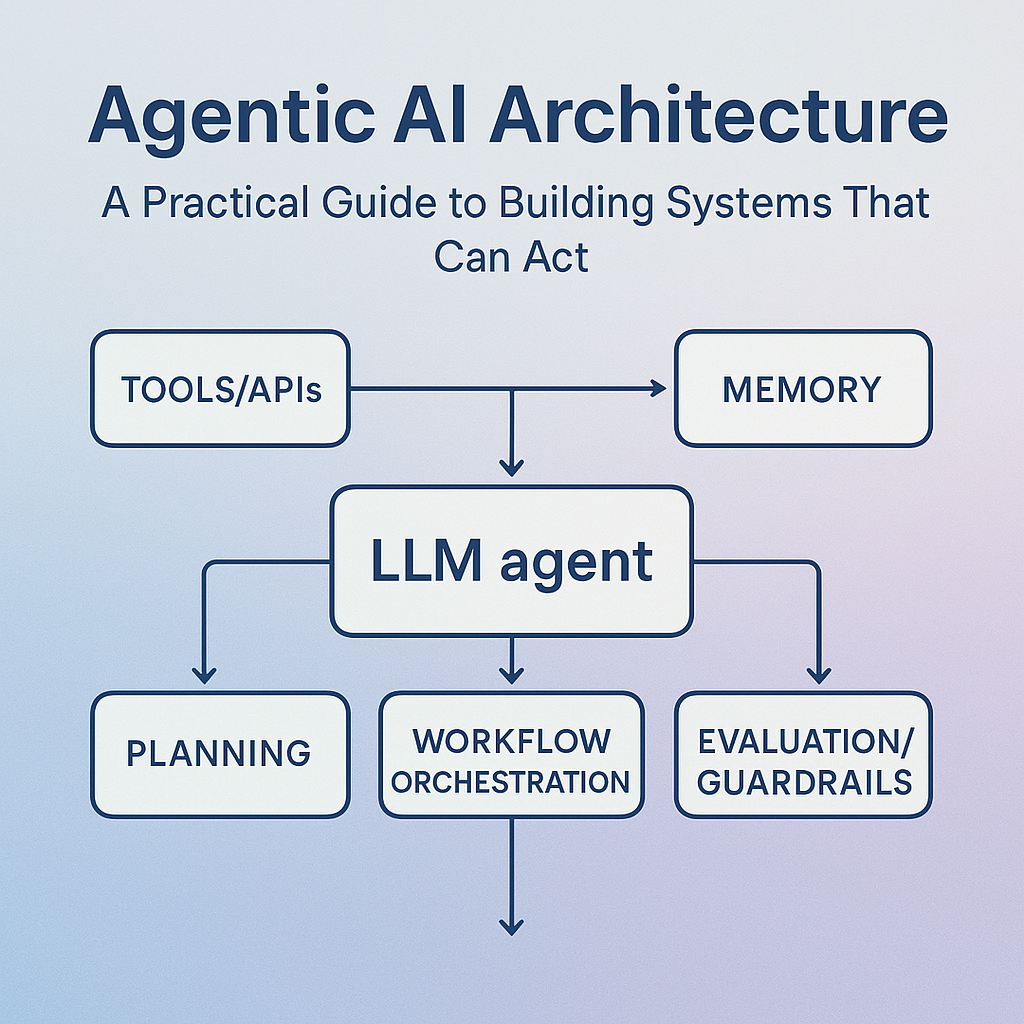
The biggest competitor is not another agent framework. It is the familiar deterministic microservice architecture, which handles many business tasks more simply and predictably. Agentic architecture adds a model-driven decision layer to that foundation; it does not make the foundation obsolete.
| Area | Agentic AI architecture | Traditional microservices |
|---|
| Main behavior | Model selects among allowed steps | Code follows defined rules and paths |
| Best fit | Ambiguous language and variable tasks | Stable, repeatable business operations |
| Inputs | Text, retrieved context, structured data | Usually structured requests and events |
| Predictability | Probabilistic; results can vary | Mostly deterministic for the same inputs |
| Testing | Needs evaluations, scenarios, and tool checks | Unit, integration, and contract tests |
| Failure handling | Needs fallback, review, and stop rules | Retries and explicit error handling |
| Cost profile | Model and retrieval costs per use | Compute and storage costs, often easier to forecast |
| Security concern | Tool access, prompt injection, data exposure | API access, identity, and service permissions |
| Best design choice | Use for tasks where flexibility earns its cost | Use for clear rules and critical transactions |
The practical answer is often a hybrid. Keep balances, permissions, and transaction rules in ordinary services; let an agent gather context, interpret a request, or prepare a recommendation. A model can propose an action, while deterministic code checks whether that action is allowed. That separation gives the system useful flexibility without making every business rule probabilistic.
MCP and A2A can improve interoperability, but a protocol does not guarantee safe behavior or sound ownership. The MCP introduction describes how clients and servers expose tools and context. The A2A announcement explains the aim of agent-to-agent communication. Teams still need to define identity, authorization, timeouts, versioning, and responsibility when a call fails.
If a task has a simple rule, keep it simple. If the process requires judgment over varied information, an agent may be worth testing. The comparison is about choosing the right tool for each part of the system, not declaring one architecture the winner.
Common Mistakes to Avoid
Starting with a swarm of agents. Multiple agents can divide work, but they also add coordination, latency, cost, and more places for errors. I would first test one agent or a fixed workflow. Add another agent only when a measured limitation calls for a separate role or capability.
Treating a prompt as a safety boundary. A prompt can guide behavior, but it cannot replace access checks, validation, or approval. If an agent can call a powerful API, that API must enforce its own permissions. Assume that user text, retrieved documents, and tool outputs may contain misleading instructions. Keep secrets out of model context unless there is a justified, controlled reason to include them.
Giving the agent broad access for convenience. A general database connection can seem faster during a prototype. It becomes a liability in production. Provide narrow tools, enforce least privilege, and keep each agent within its domain. A bounded context also helps teams understand which records and rules an agent is allowed to use.
Assuming more context always helps. Large context dumps can bury the useful facts and increase expense. Use retrieval to find relevant material, rank it, and check whether it is fresh. Context engineering is not just prompt wording; it includes how context is selected, stored, updated, and cited. When an answer depends on a policy, the system should be able to point to that policy.
Testing only the happy path. A demo with a clean question proves little. Test missing facts, conflicting records, tool errors, long requests, unauthorized actions, and adversarial instructions. Track wrong tool calls and unsafe attempts as carefully as answer quality. The NIST AI Risk Management Framework offers a risk-focused structure for identifying, assessing, and managing AI risks; it is a useful reference, not a substitute for system-specific testing.
Skipping human review because the model sounds confident. Confident wording is not proof. Let people approve actions that affect money, legal rights, safety, or access to essential services. Make review useful by showing the proposed action, its evidence, and any uncertainty. The human should have real authority to reject or change the recommendation.
Ignoring operations after launch. Models, prompts, policies, and source data change. A system that worked in a pilot may fail after a tool schema changes or a document becomes outdated. Assign an owner, version key components, monitor results, and keep a reliable fallback. The NIST framework also emphasizes ongoing risk management rather than a one-time launch check.
Frequently Asked Questions
What is the difference between agentic AI and generative AI?
Generative AI produces content, such as text or code, from a prompt. Agentic AI uses a model as part of a process that can select tools, take steps, check results, and continue or stop. A chatbot that only answers a question is generative AI; a system that retrieves a record and prepares an authorized action is more agentic. The boundary depends on what the system can do, not the label on its product page.
Do agentic AI systems replace microservices?
No. Microservices remain useful for APIs, data processing, transactions, and rules that must behave consistently. Agentic systems usually sit alongside them and call their capabilities through controlled interfaces. Keep deterministic rules in services when they need exact outcomes, and use agents where flexible interpretation provides a clear benefit.
What are MCP and A2A used for?
MCP helps an AI application connect to tools and data sources through a shared protocol. A2A is designed for communication between agents, including agents built on different systems. Neither protocol grants permission by itself or removes the need for security reviews. Teams must still define what each participant may access and how failures are handled.
How should a team start building an agentic system?
Choose one low-risk task with measurable value. Compare an agent with a regular workflow, give it limited tools and data, and test it against realistic cases before a small release. Require human approval for consequential actions. Expand only after monitoring shows that the system is accurate, safe, useful, and affordable.
Final Thought
Agentic AI architecture is not a permission slip for software to do anything it can describe. It is a way to give a system limited room to interpret a task and choose among approved actions. The hard work is still familiar: define ownership, protect data, handle failures, test changes, and make the result useful to the people who rely on it.
I’m Ermenildo Castro, and the engineering lesson I keep returning to is simple: give a system enough responsibility to serve people well, but no more authority than the task requires. Start with one process. Measure its real results. Keep a person in control where the stakes demand it. If the agent makes work clearer and safer, keep improving it; if it adds confusion, complexity, or risk, simplify the design. That is not caution for its own sake. It is sound stewardship of the tools, time, and trust placed in our care.